
How Safe Are the Crypto Exchanges Pakistani Traders Actually Use? A Security Comparison

 Prefer us on Google


Every crypto exchange claims to be secure. The claim itself tells a trader almost nothing, since it costs nothing to make and every platform, safe or not, makes it. What actually separates a secure platform from one that only sounds secure is whether its claims can be independently checked, and what happens when something goes wrong despite those claims.
Pakistani traders choosing between the platforms that dominate P2P and spot activity in the region, Binance, OKX, Bybit, and WEEX among them, are rarely comparing security in a way that goes beyond brand recognition. This guide looks at what can actually be verified about each platform's reserve transparency, track record, and response to past incidents, rather than taking any platform's own security messaging at face value.

Why security comparison matters more than name recognition alone
Brand size and security are not the same thing, and treating them as interchangeable is a common mistake. A larger exchange has more resources to invest in security infrastructure, but it also holds a larger, more attractive target for attackers, and its size alone says nothing about whether it publishes verifiable reserve data or how it behaved the last time something went wrong.
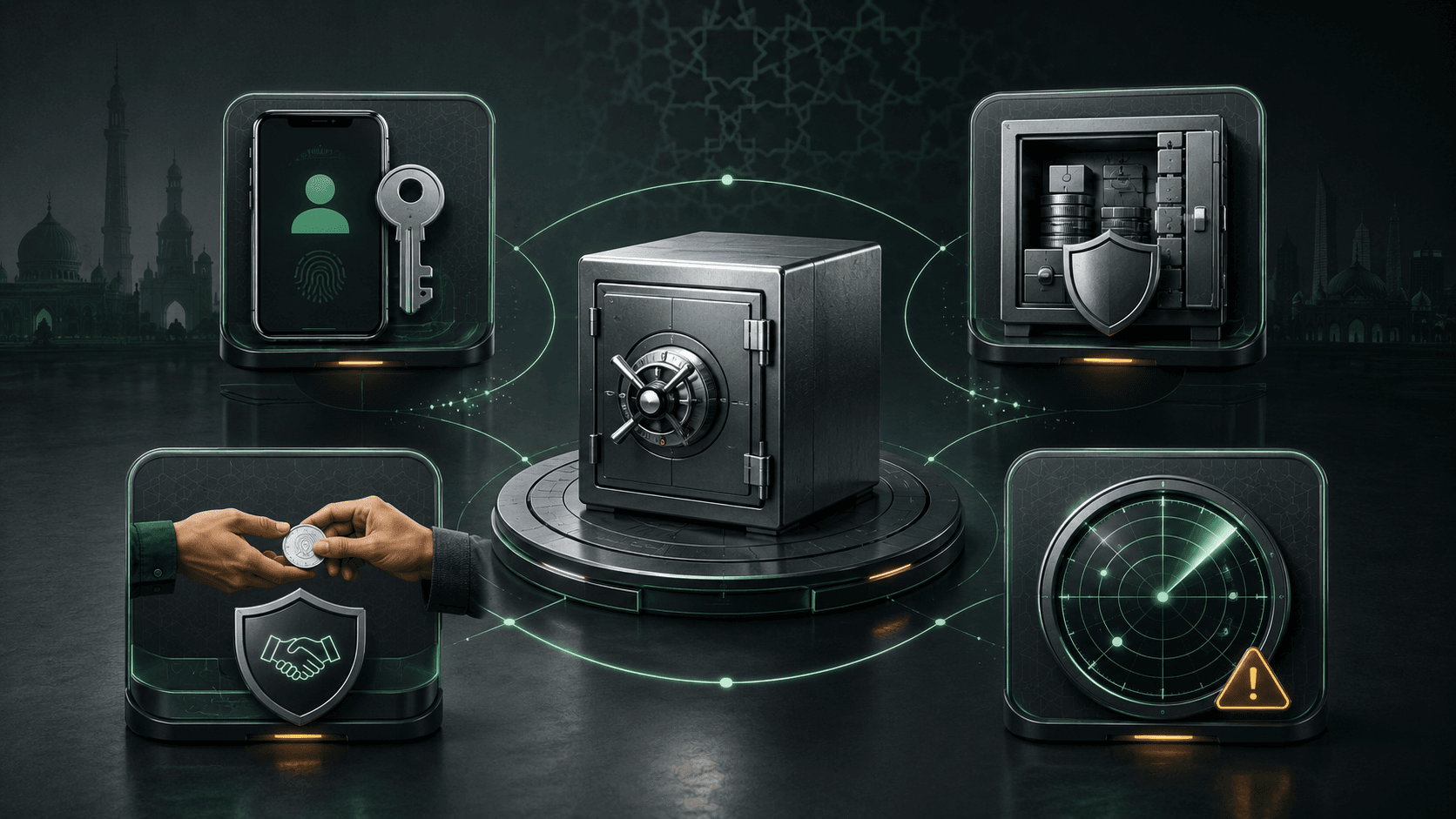
The more useful comparison looks at three specific things: whether a platform publishes proof of reserves that can be independently checked rather than simply asserted, what dedicated funds exist to absorb losses if something fails, and how the platform has actually responded when a real security incident occurred, since a policy that's never been tested reveals less than one that has.
What proof of reserves actually confirms and what it doesn't
Proof of reserves, in its standard form, is a mathematically verifiable snapshot showing that a platform's on-chain holdings meet or exceed its total user liabilities at a specific point in time. Several major platforms now publish this data using techniques like Merkle tree proofs or zk-STARK verification, letting individual users confirm their own balance was included in the calculation.
What proof of reserves does not do is guarantee that the same reserve position exists the following day, verify a platform's broader operational controls, or serve as a substitute for deposit insurance. It's a transparency layer, useful for ruling out the kind of undisclosed fractional-reserve operation that caused past exchange collapses, but it's not a complete safety certification on its own. A trader evaluating any platform's proof of reserves should treat it as one input rather than the entire answer.
How Binance, OKX, and Bybit compare on reserve transparency
Among the exchanges most commonly used by Pakistani traders, reserve disclosure varies in both scale and format. Binance topped CoinMarketCap's January 2026 proof of reserves ranking with $155.6 billion in disclosed assets, the largest reserve stack among major global platforms, and separately maintains the Secure Asset Fund for Users, an exchange controlled emergency reserve rather than a government-backed insurance scheme.
OKX's most recent disclosure reported $30.8 billion backing customer funds, up 106% over the prior year, verified through a Hacken conducted audit confirming a reserve ratio above 100%, alongside a separately maintained multi-billion-dollar insurance fund and zk-STARK based balance verification tooling. Bybit placed third in CoinMarketCap's tiered ranking behind Binance and OKX, and maintains its own daily insurance fund balance history, standing at roughly $400 million as of mid-2026, a more granular disclosure format than a single static figure.
-- Price
Why Bybit's 2025 breach is actually informative for evaluating security
In February 2025, Bybit suffered a significant security breach in which assets were stolen through a sophisticated attack. Rather than treating this incident as disqualifying on its own, it's more useful as a test case for how a platform behaves under real stress, since every exchange's security claims are, until tested, largely theoretical.
Bybit fully restored $1.5 billion in reserves following the breach and used the incident to expand the frequency and depth of its public disclosures, moving from a single reserve snapshot to a daily historical balance record. This response pattern, full restoration of user funds and increased transparency following a real incident, is a more concrete data point for evaluating a platform's security posture than any pre-incident marketing claim would have been. A platform's response to failure often reveals more than its record of avoiding failure in the first place.
What to check beyond the headline reserve numbers
A large reserve figure or a clean incident history isn't the complete picture. The reserve ratio matters more than the absolute dollar figure, since a smaller platform with a reserve ratio consistently above 100% is structurally safer than a larger one operating closer to that threshold. Whether disclosures are updated on a recurring schedule versus a single static report also matters, since a repeating disclosure cadence makes it possible to observe changes over time rather than trusting a single moment captured months ago.
It's also worth checking whether a platform's insurance or protection fund is denominated in a volatile asset like the platform's own token, which can lose value precisely when it's needed most, versus a more stable asset like Bitcoin or a major stablecoin, and whether the fund's address or holdings can be independently verified on-chain rather than taken on the platform's word alone.
Where WEEX fits into this comparison
WEEX's approach to fund security follows several of the same principles used to evaluate the platforms above, with some specific differences worth noting. The platform maintains a 100% reserve requirement backed by regularly published proof of reserves data, alongside a 1,000 BTC protection fund with a publicly disclosed on-chain address, denominated in Bitcoin rather than a platform native token whose value could be more directly correlated with the platform's own conditions during a crisis.
WEEX also operates a system fault compensation policy paired with a 24/7 human appeal channel, addressing a category of risk, platform side technical failures rather than external attacks, that reserve disclosures alone don't cover. On the custody side, the platform separates cold and hot wallets with multi-signature protection, and runs continuous risk monitoring for abnormal account activity and extreme market conditions. For a Pakistani trader comparing security postures across platforms, WEEX's combination of a Bitcoin denominated, on-chain verifiable protection fund and a defined compensation mechanism for system side failures addresses two specific risk categories, insolvency risk and operational failure risk, within a single, checkable framework.
Conclusion
Security comparison between exchanges Pakistani traders actually use comes down to what can be independently verified rather than what any platform claims about itself. Binance leads on the scale of disclosed reserves, OKX pairs a large, audited reserve figure with technical verification tooling, and Bybit's 2025 breach and subsequent full restoration of funds offers a rare real-world test of how a platform behaves under genuine stress. WEEX's 100% reserve requirement, Bitcoin denominated protection fund, and dedicated system fault compensation policy address both insolvency and operational risk within a single, publicly checkable structure. The platform with the biggest reserve number isn't automatically the safest choice. The platform whose claims can actually be checked, and whose response to past problems is a matter of public record, is the one worth trusting more.
FAQ
1. What does proof of reserves actually prove?
It confirms that a platform's on-chain holdings met or exceeded user liabilities at a specific snapshot in time, verifiable through methods like Merkle proofs. It doesn't guarantee the same position exists today or serve as full deposit insurance.
2. Which exchange has the largest disclosed reserves?
Binance led CoinMarketCap's January 2026 ranking with $155.6 billion in disclosed reserves, ahead of OKX and Bybit.
3. Is Bybit safe to use after its 2025 security breach?
Bybit fully restored the $1.5 billion in assets affected by the breach and has since increased its disclosure frequency to a daily insurance fund history, which is a more transparent posture than before the incident.
4. What does WEEX's protection fund consist of?
WEEX maintains a 1,000 BTC protection fund with a publicly disclosed on-chain address, denominated in Bitcoin rather than a platform native token.
5. Does a large reserve figure alone mean an exchange is safe?
Not on its own. The reserve ratio, disclosure frequency, and how a platform has responded to past incidents matter as much as the absolute dollar figure disclosed.
This content is provided for general informational purposes only and doesn't constitute financial, investment, legal, or tax advice. Any events, rewards, online promotions, or related information mentioned herein should not be considered a recommendation, solicitation, or invitation to purchase, sell, trade, or otherwise deal in any crypto assets. Crypto assets are highly volatile and may result in loss. The availability of WEEX services, products, and related events may vary by region. You are responsible for ensuring that your participation is in accordance with applicable local laws and regulations.
You may also like
Salesforce Stock Price Targets Are Rising Fast: What Wall Street Actually Sees
MRVL Stock Price Target: Why Options Traders Bet on $300 Before Earnings
Marvell Stock (MRVL) Beat Earnings and Raised Guidance: Why Did It Fall Anyway?
What Is SUE Coin? Is a Dump Coming After Its 150% Pump?
What Is the WEEX Mini App? A Lightweight Way to Trade Inside Telegram
What Is CLAN? Is a Dump Coming After Its 100% Surge?
BISCOTTI Crypto: Robot Dog Token Behind Emblem Vault's Debut
How to Evaluate a Crypto Exchange in Pakistan: A Practical Checklist for Traders
CRMON After Salesforce's 23% Post-Earnings Surge: The Catch
Where Is XST Actually Trading Now? A Look at Volume Distribution After the Crash
Which Crypto Exchange Offers the Widest Range of Assets for Pakistani Traders?
XST Coin Price Crosses Into Deep Capitulation Territory: What a 90%+ Decline Actually Signals
A Breakup Became "我的女友景甜" Token in Hours: What That Says About Crypto's Attention Economy
How to Buy Crypto with PKR in Pakistan via WEEX Quick Buy
How to Buy Crypto with JazzCash or Easypaisa via WEEX OTC
NVDA Stock Jumps 7% After Earnings: Is $250 Next?

PONS After 200% Rally: Overvalued or Still a Growth Story?
What Happened to Raini Studios Token? RST After the Game Shutdown
Why Is Raini Studios Token (RST) Up Today Despite Low Trading Volume?
RST vs RAINI: Which Raini Studios Token Is Still Supported?
CyberLeek Is Trending—but Why Are People Searching for CYBERLINK?
CYBERLINK or CYBERLEEK? Check the Ticker and Chain Before Trading
Before You Buy CyberLeek: You Should Know CYBERLEEK Token Risks First
Is CyberLeek (CYBERLEEK) Safe? Price Crash and Key Token Risks Explained

CyberLeek Price Prediction 2026: Can CYBERLEEK Recover After the Crash?
What Is CyberLeek (CYBERLEEK)? The GTA 6 Leak Token Explained
Why Is CyberLeek Price Falling Today? CYBERLEEK Crash Explained
SEC Sends Crypto Custody Rule to White House: What the Review Means for Investment Advisers
SEC Crypto Custody Rules for Investment Advisers: A 2026 Guide
NVDA Earnings Call Recap: Revenue Guidance, AI Demand and Key Takeaways
Salesforce Stock Price Targets Are Rising Fast: What Wall Street Actually Sees
MRVL Stock Price Target: Why Options Traders Bet on $300 Before Earnings
Marvell Stock (MRVL) Beat Earnings and Raised Guidance: Why Did It Fall Anyway?
What Is SUE Coin? Is a Dump Coming After Its 150% Pump?
What Is the WEEX Mini App? A Lightweight Way to Trade Inside Telegram
What Is CLAN? Is a Dump Coming After Its 100% Surge?
Contents
Popular coins
Latest articles





