
PKR to USDT Rate: How to Spot a Bad P2P Spread in Pakistan

 Prefer us on Google


The PKR to USDT rate you see on a peer-to-peer advertisement is almost never the dollar exchange rate. It is the dollar rate plus a merchant premium, and that premium is where most Pakistani buyers quietly lose money — not on trading fees, which on many platforms are zero for buyers. Learning to read the premium takes about two minutes and is worth more than any fee promotion. This article breaks down what sets the rate, what a reasonable spread looks like, how the full cost of one trade adds up, and the checks that stop you paying a night-time premium for a daytime trade.
What actually sets the USDT to PKR rate
Three inputs, in descending order of importance.
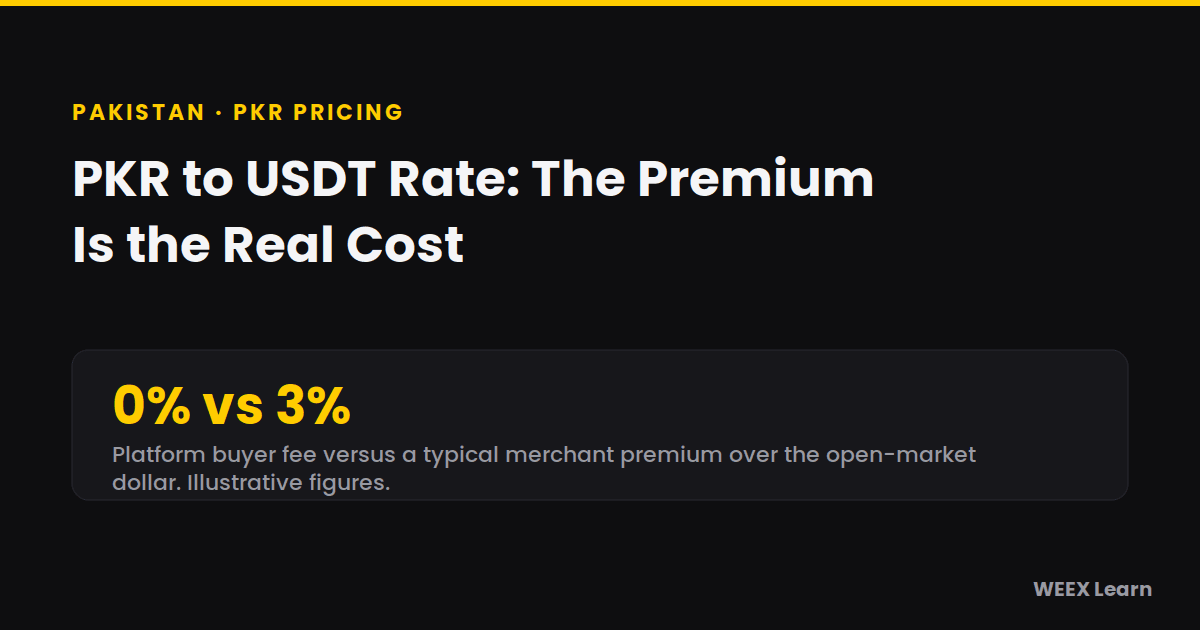
The first is the open-market dollar, not the interbank rate. P2P merchants price against what a dollar costs them to source, so the P2P quote tracks the open market and inherits its stress. When rupee pressure builds, the P2P premium widens before anything else moves.
The second is merchant inventory and risk. A merchant holding plenty of USDT and expecting rupee weakness prices tighter than one who is short, because the second has to buy USDT to fill you. That is why two ads a minute apart can differ by more than one percent for no visible reason.
The third is the payment rail. An instant, hard-to-reverse rail is worth more to a merchant than a slow or reversible one, and the rate reflects it. Rails that settle instantly and cannot easily be clawed back tend to carry the tightest quotes; anything the merchant regards as reversible or slow gets priced wider.
What a normal P2P premium looks like — and when to walk
The honest answer is that there is no fixed fair number, but there is a fair method: compare the ad price to the current open-market dollar rate, then decide whether the difference is paying for anything real.
A worked illustration, using round numbers rather than live quotes. Suppose the open-market dollar is around PKR 280 and a merchant is advertising USDT at PKR 289. That is a premium of roughly 3.2%. On a PKR 100,000 purchase, the premium costs about PKR 3,200 — against a zero platform fee. Now compare a second ad at PKR 284: same trade, same escrow, about PKR 1,800 saved by spending ninety seconds comparing.
Scale that. A trader converting PKR 200,000 a month who habitually takes the first ad instead of the third-best one is giving away a meaningful share of returns before a single position is opened.
On a PKR 100,000 buy, the cost stack breaks down roughly like this:
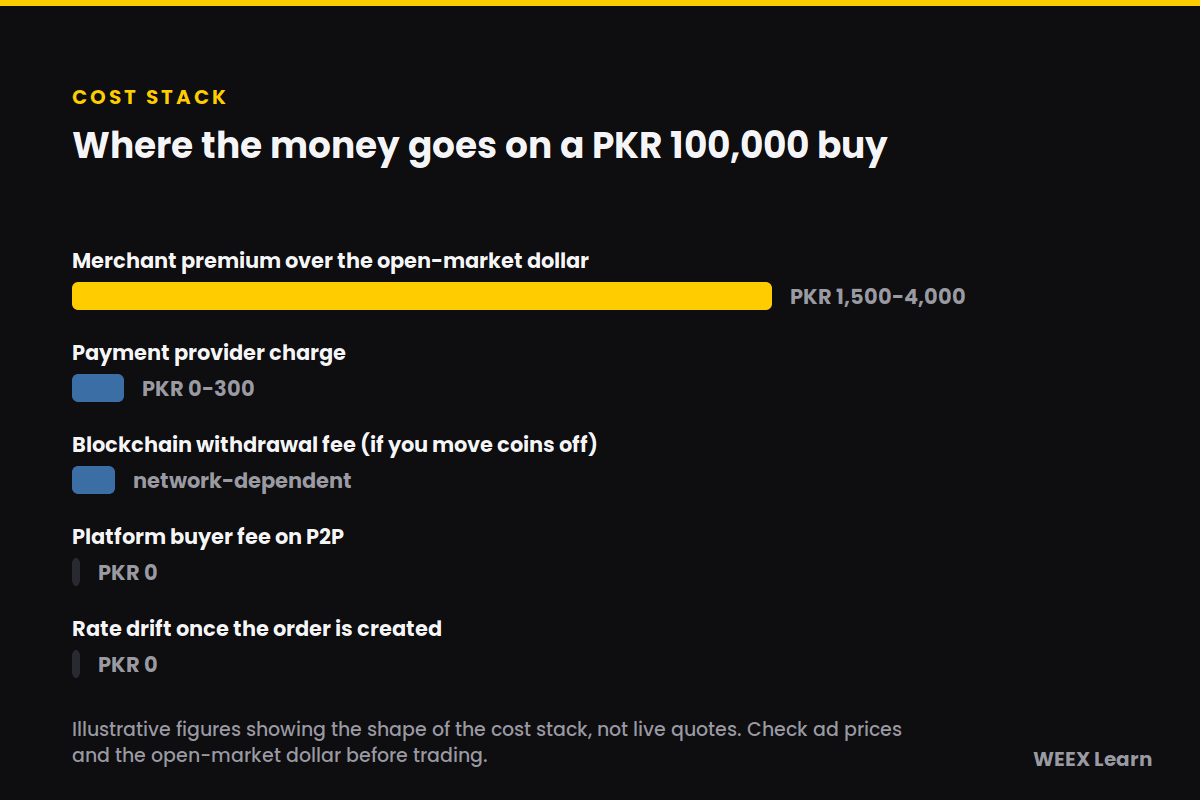
- Platform buyer fee — zero on several major P2P venues, including WEEX. PKR 0.
- Merchant premium over the open-market dollar — the real cost, varying by ad, hour and rail. Roughly PKR 1,500–4,000.
- Payment provider charge — depends on your wallet or bank tier. PKR 0–300.
- Blockchain withdrawal fee — only if you move coins off-platform, and network-dependent: TRON transfers cost far less than Ethereum. A few hundred rupees, or none if you stay on-platform.
- Rate drift while you pay — the price locks when the order is created, so this is zero if you finish the order. The exposure comes from cancelling and re-entering.
Figures are illustrative to show the shape of the cost stack, not quotes. Check live ad prices and the current open-market dollar before trading.
Why the spread widens at night and at month-end
Liquidity in the PKR book is not constant. Merchant coverage is thickest during Pakistani business hours and thins late at night, when fewer merchants are online to compete and the remaining ones price for the inconvenience. Weekend and public-holiday sessions behave the same way, with the added problem that bank rails settle more slowly while mobile wallets keep running.
Month-end and quarter-end add a second effect: remittance and salary flows change who needs rupees and who needs dollars, and the premium moves with it. None of this is exotic. It is the same pattern any illiquid book shows — the fewer participants, the more you pay for immediacy.
The practical version: if a purchase is not urgent, buying during business hours is usually cheaper than buying at 2am, and the difference is often larger than any fee you were shopping for.
-- Price
Four checks before you click buy
- Anchor to the open-market dollar. Know roughly what a dollar costs today. Without that anchor, every ad looks reasonable.
- Compare at least three ads, not one. Sort by price, then discard any merchant whose limits do not fit your amount — an ad you cannot fill is not a price.
- Weigh completion rate against a few paisa. A merchant with a high completion record and fast release is worth a slightly higher price; a stalled order costs more in stress and rate risk than the saving.
- Match the rail to the hour. Instant rails at night, bank transfer during banking hours.
On WEEX P2P the filters do most of this work: pick PKR, set your amount, filter for the payment method you actually hold, and the visible list is already restricted to fillable ads. The order mechanics — payment-method setup, comparing sellers, marking payment complete — are covered in the PKR buying walkthrough, and the mirror image applies when you convert USDT back to rupees, where the premium works against you in the opposite direction.
What traders usually miss
The round trip, not the entry. Buyers obsess over the purchase premium and forget they will pay a spread again on the way out. If you buy at 3% over the dollar and sell at 2% under it, the position needs a 5% move before you are level — and that is the arithmetic that quietly turns a flat market into a losing one.
If you cycle in and out often, the spread is your dominant cost and deserves more attention than fee marketing. If you buy USDT to hold, it matters once, and the release speed and merchant reliability matter more than a fraction of a rupee.
Frequently asked questions
1. Why is the USDT price in Pakistan higher than one dollar?
Because P2P prices track the open-market dollar plus a merchant premium covering sourcing, risk and payment-rail friction. When demand for dollars rises, the premium widens.
2. What is a reasonable PKR to USDT premium?
There is no official number. Compare the ad price against today's open-market dollar rate and against the next two or three ads. A premium far above the rest of the book is a signal to keep scrolling, not to hurry.
3. Do I pay a fee on top of the rate?
On several P2P venues, including WEEX, buyers pay no platform trading fee — the merchant side carries it. Your payment provider may still charge, and a blockchain withdrawal costs network fees if you move coins off the platform.
4. Is the cheapest merchant always the best choice?
No. Limits, completion rate, release speed and supported payment method decide whether the trade actually completes. A slightly better price on an ad you cannot fill or a merchant who takes an hour to release is a false saving.
5. Does the rate change while I am paying?
The order locks the price when it is created. The exposure comes from cancelling and re-entering, or from taking so long to pay that the order expires.
Risk Warning
Crypto assets are volatile and you can lose part or all of the money you commit — a stablecoin reduces price volatility but does not remove issuer, custody or counterparty risk. P2P trading carries specific operational risks: forged payment screenshots, third-party transfers that create dispute problems, merchants who stall on release, and attempts to move the conversation off-platform where escrow does not protect you. Rates and premiums shown here are illustrative, not quotes, and both the open-market dollar and P2P pricing can move sharply within a single session. Verify live prices, keep every trade inside the official order flow, and never release funds on the strength of a screenshot.
This content is provided for general informational purposes only and doesn't constitute financial, investment, legal, or tax advice. Any events, rewards, online promotions, or related information mentioned herein should not be considered a recommendation, solicitation, or invitation to purchase, sell, trade, or otherwise deal in any crypto assets. Crypto assets are highly volatile and may result in loss. The availability of WEEX services, products, and related events may vary by region. You are responsible for ensuring that your participation is in accordance with applicable local laws and regulations.
You may also like

SOXSB Explained: Why the 3x Chip Bear ETF Resets Without You
Is WMT Stock a Buy After Falling 23% From Its 52-Week High? What the $137 Analyst Target Actually Implies
XRP ETFs Have Pulled Nearly 1 Billion Tokens off the Market: Why the Price Keeps Sliding Anyway

JPMorgan Says Buy the Chip Dip but Morgan Stanley Says Sell: What the SOXL Analyst Disagreement Actually Means
Bitcoin's $2.7 Billion Short Squeeze: What Triggered the Largest Liquidation Event of August 2026

Crypto Exchange API: Permissions, Signing and Rate Limits
QQQB and the Fed: What the FOMC Minutes Mean for Nasdaq-100

SK Hynix Stock Is Down 35% in July: Is the Worst Finally Over?
NVDA Stock Jumps 7% After Earnings: Is $250 Next?
PONS After 200% Rally: Overvalued or Still a Growth Story?

What Happened to Raini Studios Token? RST After the Game Shutdown

Why Is Raini Studios Token (RST) Up Today Despite Low Trading Volume?
RST vs RAINI: Which Raini Studios Token Is Still Supported?
CyberLeek Is Trending—but Why Are People Searching for CYBERLINK?
CYBERLINK or CYBERLEEK? Check the Ticker and Chain Before Trading
Before You Buy CyberLeek: You Should Know CYBERLEEK Token Risks First
Is CyberLeek (CYBERLEEK) Safe? Price Crash and Key Token Risks Explained
CyberLeek Price Prediction 2026: Can CYBERLEEK Recover After the Crash?
What Is CyberLeek (CYBERLEEK)? The GTA 6 Leak Token Explained
Why Is CyberLeek Price Falling Today? CYBERLEEK Crash Explained
SEC Sends Crypto Custody Rule to White House: What the Review Means for Investment Advisers
SEC Crypto Custody Rules for Investment Advisers: A 2026 Guide
NVDA Earnings Call Recap: Revenue Guidance, AI Demand and Key Takeaways
SEC Sends Crypto Custody Rule to White House: What Happens Next?
Hamster Kombat Is Down 97% From Its Peak: What Happened to Crypto's Biggest Web3 Onboarding Experiment?
Nvidia Earnings Report Today: Did NVDA Beat Revenue and EPS Estimates?
Nvidia After-Hours Stock Price: What Moved NVDA After the Earnings Report?
Why Did Nvidia Stock Rise After Earnings? NVDA Results and Outlook
Did Nvidia Beat Earnings? NVDA Q2 Results and Stock Reaction Explained
No Official XST Announcement Explains the X2O Rebrand: What's Actually Confirmed
SOXSB Explained: Why the 3x Chip Bear ETF Resets Without You
Is WMT Stock a Buy After Falling 23% From Its 52-Week High? What the $137 Analyst Target Actually Implies
XRP ETFs Have Pulled Nearly 1 Billion Tokens off the Market: Why the Price Keeps Sliding Anyway
JPMorgan Says Buy the Chip Dip but Morgan Stanley Says Sell: What the SOXL Analyst Disagreement Actually Means
Bitcoin's $2.7 Billion Short Squeeze: What Triggered the Largest Liquidation Event of August 2026
Crypto Exchange API: Permissions, Signing and Rate Limits
Contents
Popular coins
Latest articles


