
WEEX Trade to Earn Phase 2: Trade More but Pay Less in Futures Trading Markets

 Prefer us on Google


As 2026 begins, many traders are finding themselves more active than they expected.
Markets are moving again. Bitcoin and Ethereum have shown renewed price movement, volatility has picked up, and participation across derivatives markets is increasing. Yet despite the rise in activity, strong directional conviction has not fully formed. Prices move, but trends remain incomplete.
This kind of environment often influences how traders choose to participate.
When Activity Rises Before Conviction
In transitional markets, traders rarely commit to large, long-term positions. Instead, many adopt a more flexible approach: smaller position sizes, more frequent entries and exits, and tighter risk controls.
This is not a sign of hesitation. It reflects a rational response to uncertainty. Traders stay engaged, react to short-term signals, and adjust exposure as the market searches for structure.
As a result, overall trading activity tends to rise — even when individual trades remain conservative.
Why Costs Matter More in Active Markets
When strategies rely on frequent execution rather than extended trends, the cost structure of trading becomes more visible.
In strong directional markets, fees are often overlooked because price movement does most of the work. In contrast, during choppy or developing phases, profits per trade are typically smaller. Over time, transaction fees accumulate quietly and begin to weigh on overall performance.
For active futures traders, this shifts the focus from simply finding the right setup to managing efficiency across many executions. Reducing the effective cost per trade becomes part of staying competitive.
Efficiency as a Strategic Advantage
Market uncertainty is difficult to control. Signals can be mixed, momentum can fade quickly, and false breakouts are common. What traders can control is how efficiently they operate within these conditions.
Lowering trading costs does not increase risk, alter strategy, or require stronger conviction. Instead, it improves resilience — allowing traders to remain active without letting fees erode results during periods of high participation.
This is where structural incentives begin to matter.
-- Price
How WEEX Trade to Earn Works
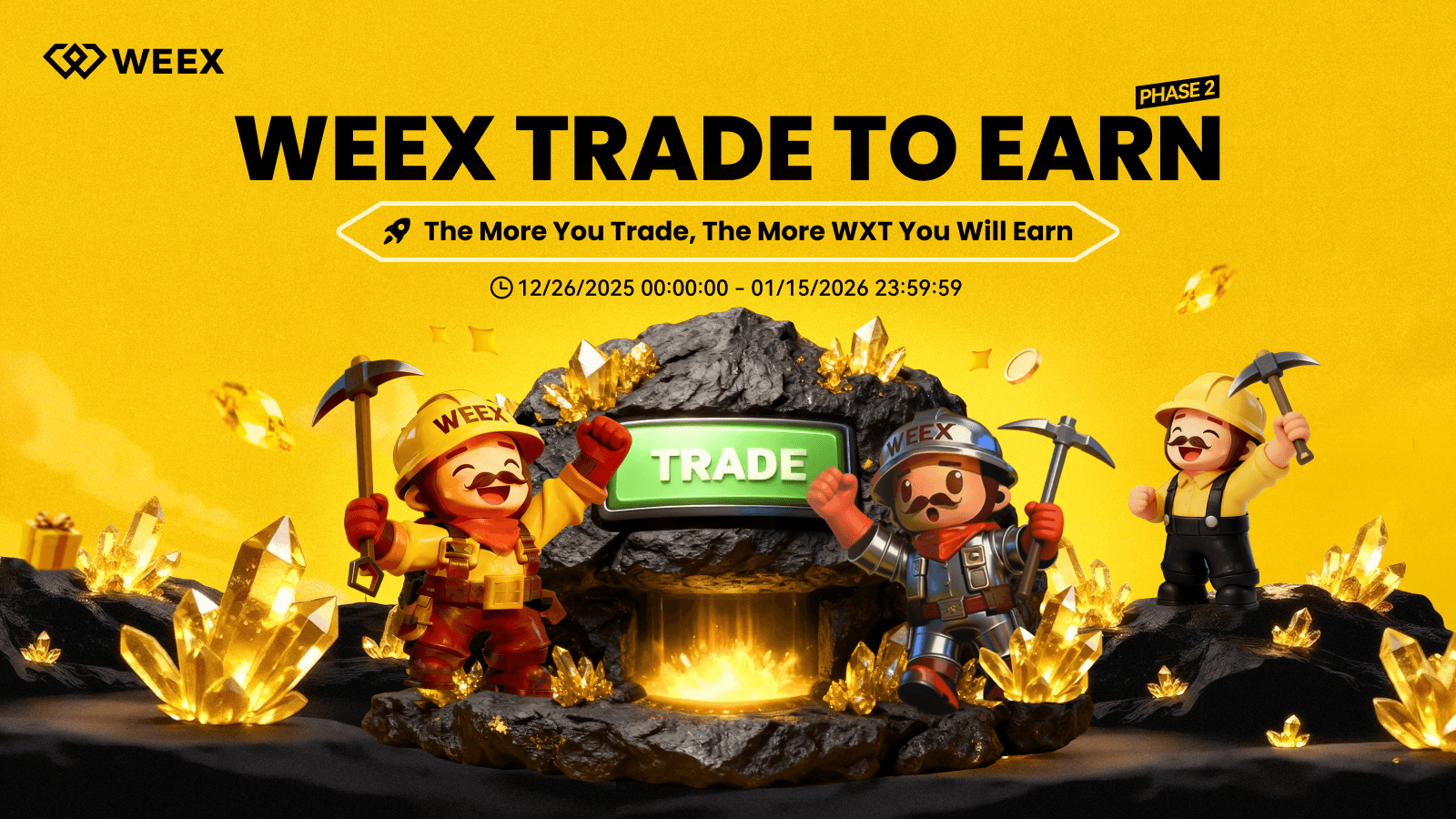
WEEX Trade to Earn is designed to align directly with real trading behavior during periods of heightened activity.
Rather than rewarding artificial actions or promotional metrics, the program returns a portion of transaction fees generated through genuine USDT-M futures trading. As users trade, they progress through miner levels, unlocking higher rebate ratios as participation increases.
At a glance, the structure focuses on efficiency:
- Rewards are based on real transaction fees, not simulated volume
- Higher trading activity unlocks higher miner levels and rebates
- Rebates are distributed in real time in WXT
- Rewards are supported by the WXT ecosystem, including quarterly token burns
What’s New in WEEX Trade to Earn Phase 2
WEEX Trade to Earn Phase 2 introduces structural improvements that make cost optimization more accessible.
- Official rebate rates now exceed 40%, up from 30% in Phase 1
- More granular miner tiers allow smoother progression as volume grows
- Additional upgrade paths are available through sharing, inviting, and WXT rebate tasks
- New users benefit from welcome rewards and agent-entry mining incentives
Together, these changes reduce friction and allow active traders to recover a greater portion of trading costs — without changing strategy or increasing risk.
Efficiency Without Changing How You Trade
WEEX Trade to Earn Phase 2 is not designed to push traders toward heavier leverage or more aggressive positioning.
It works alongside existing trading habits, particularly in markets where activity rises before conviction fully forms. When participation increases as a natural response to uncertainty, managing costs becomes essential.
By lowering the effective cost of active trading, Trade to Earn helps traders stay engaged and flexible — turning everyday participation into a sustainable, long-term advantage as the market continues to evolve in early 2026.
About WEEX
Founded in 2018, WEEX has grown into one of the world’s most trusted and innovative cryptocurrency exchanges, serving over 6.2 million users across 150+ countries and regions. With more than 2,000 trading pairs and up to 400× leverage, WEEX is known for its deep liquidity, smooth trading experience, and steadfast transparency. The platform’s 1,000 BTC Protection Fund reflects its unwavering commitment to user safety and reliability.
Beyond trading, WEEX continues to lead the frontier of intelligent finance — from launching the AI Trading Hackathon to fostering a global community of traders, builders, and innovators to shape the markets of tomorrow.
Risk Reminder
Futures trading involves risk. Please manage leverage and position sizes carefully.
All rewards are subject to the official event rules and will be distributed after the event ends.
Follow WEEX on social media:
Instagram: @WEEX Exchange
TikTok: @weex_global
YouTube: @WEEX_Global
Discord: WEEX Community
Telegram: WeexGlobal Group
This content is provided for general informational purposes only and doesn't constitute financial, investment, legal, or tax advice. Any events, rewards, online promotions, or related information mentioned herein should not be considered a recommendation, solicitation, or invitation to purchase, sell, trade, or otherwise deal in any crypto assets. Crypto assets are highly volatile and may result in loss. The availability of WEEX services, products, and related events may vary by region. You are responsible for ensuring that your participation is in accordance with applicable local laws and regulations.
You may also like
Common P2P Scams in Pakistan: How to Trade PKR Safely on WEEX
Common P2P Scams in Pakistan: How to Trade PKR Safely on WEEX
JazzCash vs Easypaisa for P2P Crypto Trading in Pakistan: Which Should You Use?
Is IMX crypto a Good Investment After Falling to Multi-Month Lows?
IMX Price Prediction 2026–2027: What Immutable's Chain Merger and SEC Clearance Actually Change
How to Buy USDT with PKR on WEEX P2P: A Step-by-Step Guide for Pakistan
How to Choose a Reliable P2P Merchant for PKR Trades in Pakistan
How to Buy USDT with Easypaisa in Pakistan: P2P Trading and Safety Guide
How to Sell USDT for PKR Safely on WEEX P2P
Is WEEX P2P Safe in Pakistan? What PKR Traders Should Know
Bitcoin Security or Commodity? How CLARITY Act Could Impact BTC
Crypto Security vs Commodity: What CLARITY Act Means for Bitcoin and Tokens
XRP Price Surges With Bitcoin and Ethereum: What Is Driving the August 20 Crypto Rally
WXT Burn Q2 2026: What It Means for WEEX Token (WXT)
Is Bitcoin Overvalued After CLARITY Act? 2026 BTC Valuation Analysis

Crypto Broker vs Stock Broker: What Is the Difference and Which Do You Need
Meta Stock at $548: The Free Cash Flow Number Behind the Drop
Tiffany Milanovich and the $5M Fake-Support Call Playbook
Can Futures Trading Bots Make Money? A Realistic Review

What Is Futures Quantitative Trading? Strategies and Risks
WEEX TradFi Trading Fest: Trade Stock Futures and Share 50,000 USDT Rewards
What Is XSolut (XST) Coin? Exploring AI Infrastructure and RWA Tokenization
What is Green Minting Token (MINT) Coin?
What is Yield Basis (YB) Coin?
Common P2P Scams in Pakistan: How to Trade PKR Safely on WEEX
Common P2P Scams in Pakistan: How to Trade PKR Safely on WEEX
JazzCash vs Easypaisa for P2P Crypto Trading in Pakistan: Which Should You Use?
Is IMX crypto a Good Investment After Falling to Multi-Month Lows?
IMX Price Prediction 2026–2027: What Immutable's Chain Merger and SEC Clearance Actually Change
How to Buy USDT with PKR on WEEX P2P: A Step-by-Step Guide for Pakistan


