
20% Oil Shortage: Why Would It Cause a Systemic Collapse?

Original Title: The World Only Lost 20% of Its Oil. Why Is Everything Breaking?
Original Author: Garrett
Translation: Peggy, BlockBeats
Editor's Note: The article points out that the current global oil supply is only short by about 20%, but what has actually escalated the crisis is not "physical scarcity" but a triple behavioral chain reaction triggered by scarcity: hoarding, speculation, and the capital logic of "waiting for the opponent to collapse and then bottom fishing."
From a 20% supply gap, to the shipping disruption in the Strait of Hormuz, to the short-term "filling" of strategic reserves, alternative pipelines, and production capacity mismatches, the system seems to still be functioning on the surface; however, at a deeper level, hoarding, speculation, and "waiting for a collapse" capital behavior are amplifying the gap itself, transforming it from a manageable supply-demand issue into a potential systemic risk.
The article further points out that the trigger for this type of risk does not follow the intuition of "gradual deterioration" but rather is closer to a run—everything seems stable as long as confidence is not shattered; yet once key variables are confirmed (reserves bottoming out, the gap widening, transport unable to recover), the market will rapidly reprice. From the 1973 oil crisis, to the 2008 financial crisis, to the 2022 energy shock, the path is highly consistent.
Within this framework, the current market's "calmness" itself becomes the most alarming signal: the real economy has already seen production cuts, restrictions, and supply constraints, yet asset prices continue to reflect risk appetite. This deviation is fundamentally the last consensus on "the system is still effective."
The core judgment of this article is: the issue is not whether there is not enough oil, but rather once enough people start to believe it may not be enough, the system will prematurely shift into contraction and reassessment. Strategic reserves can only extend the time window but cannot provide an answer; and this window is rapidly closing.
Mid to late April will be a key juncture. By then, the market will no longer face the question of "if" but rather "when to confirm."
The following is the original text:
The world is short of about 20% of its oil. In theory, everyone could tighten their belts a bit, and the economy could still function.
However, in reality, "shortage" does not operate this way. When a critical resource faces a gap, people do not ration rationally; instead, they start hoarding and speculating. And what about those who have surplus? They will wait for you to collapse and then buy your best assets at a bargain.
These three behaviors can turn a previously manageable gap into a civilization-level issue.
Hoarding, Speculation, and Vulture Waiting
The first of these is hoarding. Once the "shortage" hits the headlines, everyone starts panic-buying — not out of real need, but out of fear. They are not buying oil; they are buying a "sense of security." And this panic itself is enough to double the actual shortage.
Next comes speculation. Once oil becomes scarce, traders flock in, and prices quickly detach from the fundamentals. This is not theory; this is the law of the commodity markets. Almost every energy crisis in history has unfolded along this path.
The final and most brutal layer: waiting for you to fall.
Why People with Oil Don't Sell
The spot price for Omani crude oil has reached $150 to $200 per barrel. Yet oil-deficient countries may still not get it because players holding dollars have already secured the supply.
Some countries, despite having more than enough reserves, still refuse to sell to neighboring countries.
Why? Because what they see is a bigger game: waiting for a debt crisis to erupt, waiting for social unrest, and then acquiring the world's highest-quality assets at rock-bottom prices. A company worth $500 billion in normal times, when a nation is on the brink of collapse, may be acquired for just $50 billion — without firing a single shot.
Berkshire Hathaway currently holds nearly $375 billion in cash, setting a historical record. This accumulation began long before this war, with 12 consecutive quarters of net asset sales. But the key is not in the buildup but in the timing of execution.
What is Buffett waiting for?
This Script Has Existed for Three Thousand Years
In Genesis Chapter 47, Joseph helped Pharaoh hoard grain during seven years of plenty. Then seven years of famine arrived. The Egyptians first bought grain with money; when the money ran out, they exchanged with livestock; when the livestock ran out, they gave up their land.
By the end of the famine, Pharaoh owned nearly all of Egypt.
No war, no violence. Just control of scarce resources and enough patience.
The logic of the blockade at the Strait of Hormuz is the same. Conquering a country through force requires hundreds of thousands of troops; but blocking a strait and waiting patiently? Just a navy and time.
Joseph, at least, was trying to save the people. But the players operating around this crisis were not.
That's also why a 20% oil shortfall is enough to bring down the entire world. The issue is not "not enough oil," but rather—someone is hoarding, someone is speculating, and someone is waiting for you to fall.
Collapse never happens slowly
Most people think an economic crisis unfolds gradually. But in reality, it's quite the opposite. Lehman Brothers was still operating as usual the day before filing for bankruptcy; Silicon Valley Bank looked normal 48 hours before its collapse too.
A systemic collapse is more like a "bank run." When everyone trusts the bank, it operates almost perfectly; once trust cracks, everyone withdraws funds at the same time. Banks don't die slowly; they collapse instantly within 48 hours.
The current global energy market is in the same state.
Everyone is betting on Trump to solve the problem quickly, everyone still "believes the system is still there." But once that trust is broken—like reserves starting to run out, or the International Energy Agency confirming the gap is widening further—a sell-off will erupt like a bank run.
Not gradual. Instant.
Five weeks have passed
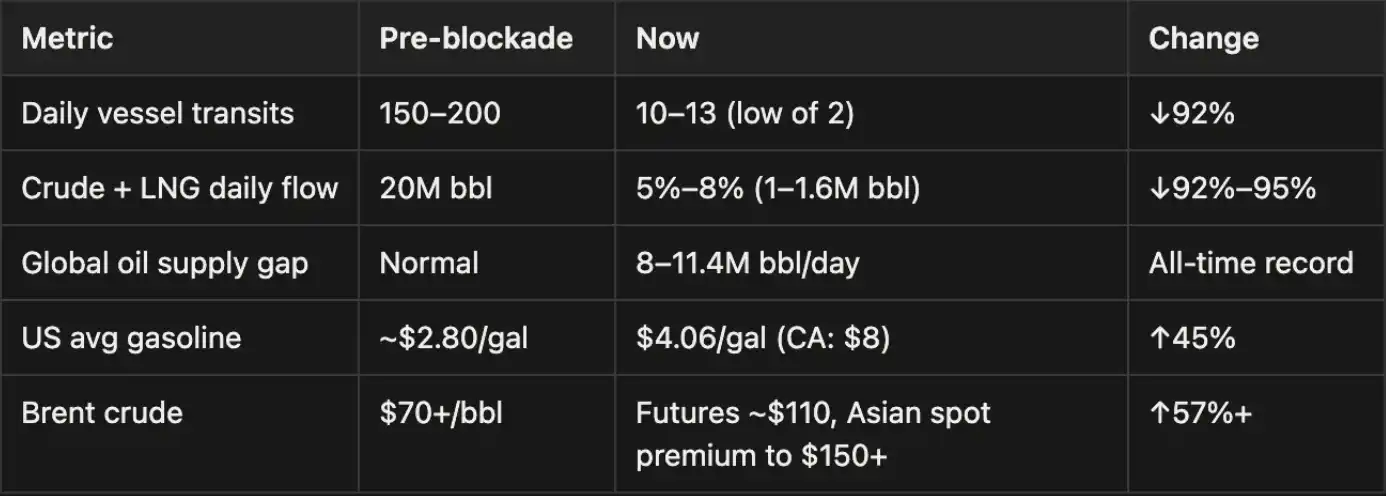
Note: The Strait of Hormuz usually carries about 20 million barrels per day of oil shipments, so the current loss of around 18-19 million barrels per day due to the blockade exceeds the global supply gap of 8-11.4 million barrels per day. This gap is being partially offset by measures including the release of strategic petroleum reserves (SPR), alternative pipelines (such as the Saudi East-West Pipeline, UAE bypass routes), and supplies from non-Hormuz oil-producing countries. But this filling is temporary.
The scale of this shock has exceeded the 2022 Russia-Ukraine energy crisis and is even being called the "most severe energy crisis in human history."
Our assessment is that this statement is likely not an exaggeration.
Strategic Reserves: Buffer Time ≠ Safety
Currently, the market is supported by only two things: the continued release of strategic oil reserves and Trump's policy statements and market expectations.
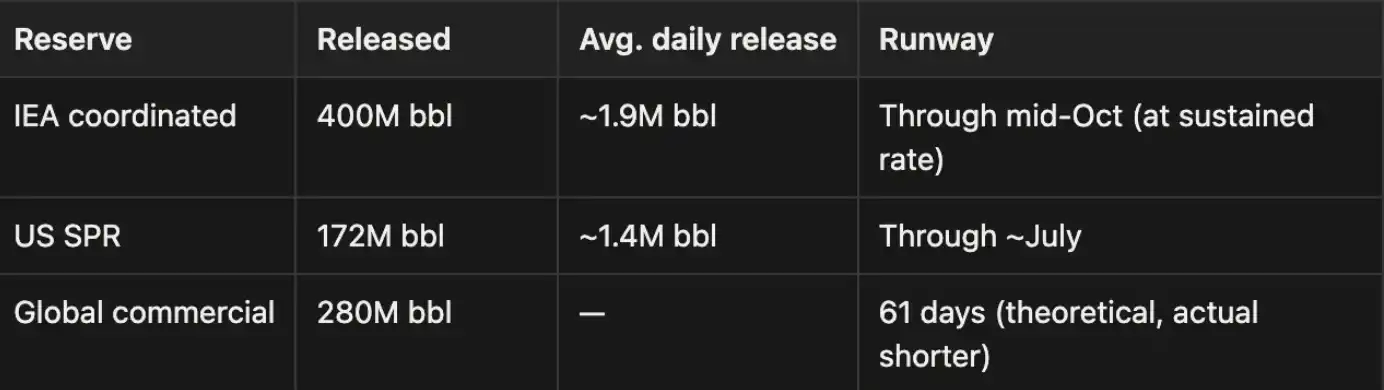
These numbers themselves pose a problem: the release of the Strategic Petroleum Reserve (SPR) has a physical limit, historically around 2 million barrels/day. In other words, the actual capacity to fill the gap is much lower than the headline number on paper.
OPEC+ nominally has 2.5 to 3.5 million barrels/day of spare capacity, but these export routes themselves have to pass through the Strait of Hormuz, effectively trapping this portion of capacity.
Some countries' disclosed reserve data also includes delayed deliveries and overestimated stockpiles. Once the buffer period ends, the supply gap will rapidly expand. Reserves can only buy time, not solutions. There is still a window of opportunity in the market, but this window is closing.
The Market is Sleepwalking
The current market situation is very surreal: Israel just experienced the most intense round of missile attacks since the start of the war, yet the stock market barely reacted. Chemical plants in Japan, South Korea, Singapore, and Thailand have begun to reduce production or even shut down, but the market has not priced these in. Australia has shifted to working from home due to fuel shortages, South Korea has implemented nationwide driving restrictions, yet the stock market is still rising.
Trump says Iran is negotiating every day, while Iran denies it every day, yet the stock market continues to rally. Semiconductors are still surging, the AI concept remains hot, quantitative and algorithmic trading continue to amplify this optimistic mood. But with a closer look, one can see that many things have actually turned red; it's just that everyone is pretending not to see it.
This market's deviation from the real economy will not last long, something that has never happened in history.
Iran's Hand
Many are betting that Trump will solve the problem quickly. But first, look at where Iran stands.
The Islamic Revolutionary Guard Corps (IRGC) of Iran has been very blunt: "The Strait of Hormuz will not reopen because of Trump's ridiculous show. We have not engaged in any negotiations, nor will we in the future."
Another practical issue is communication itself. Iran's top echelon will not handle any operational matters over the phone or through encrypted applications now—Israel has assassinated Haniyeh in Tehran and exploded Hezbollah's pagers, making this paranoia not unfounded. Therefore, real communication between Tehran and Washington must go back and forth through intermediary channels like Oman, Iraq, or Switzerland, with each round trip taking several days.
Iran's Calculation
Iran doesn't need to win; it just needs to hold out longer. The blockade of the strait is its biggest card, and it has found America's soft spot. Russia supports it, China provides "humanitarian aid," it will not starve.
Just the income from the strait toll could bring in billions of dollars annually. If the US retreats or gets bogged down, Iran can continue to control the strait. The wealth that was originally flowing to the Gulf monarchies would also be redirected to Tehran.
Trump's Dilemma
Not to strike: The petrodollar system begins to unravel.
To strike: Oil prices surge further. If the war drags on, Gulf oil cannot be shipped out, and the funding pipeline supporting the US stock market will dry up.
The real risk is that the US dollar could sharply devalue. If the petrodollar loses its anchor, all dollar-denominated assets will be repriced. And most worrisome, it seems that no one in the White House has a clear answer to this issue.
What to Watch Next
US SPR weekly report. The rate of reserve depletion is the most direct signal. Brent crude spot and futures curve. A deep contango indicates the market is pricing in long-term shortages. Trump's tone. The heavier the rhetoric, the worse the situation tends to be.
Asian factory utilization rates. Declines in chemical, automotive, and semiconductor production would be the most leading indicators. Fertilizer prices. Compared to oil prices distorted by verbal intervention, fertilizer prices are often more honest. IEA monthly report. If the mid-April update confirms the cushion has been exhausted, market confidence could collapse overnight.
Timeline
According to Dallas Fed data, if the Strait of Hormuz remains closed for the entire second quarter, the US annual GDP will contract by 2.9%. Several institutions have also been consistently raising the probability of a recession. The following probabilities are all based on the premise that the blockade continues into each stage. If the strait reopens ahead of schedule, subsequent stages will no longer apply.
Now → April 15: Reserves still releasing
Strategic reserves are still being released, and Trump is still rallying. The impact on GDP is currently limited. But if the "final ultimatum" of April 6 yields no results, the supply gap will quickly widen. Probability of global economic disorder: 20%–30%
Late April → Early May: Reserves hit bottom
Global strategic reserves start hitting bottom, the IEA confirms the gap has doubled. Real economic impacts start to concentrate: fertilizer shortages, spring planting delays, chemical plant closures, LNG tightness, European industrial cutbacks. Probability: 45%–65%. This is a critical turning point.
Mid-May to Late June: Deterioration of the Real Economy
Oil price surges to $150 to $200 per barrel. High oil prices start to suppress all economic activities. Countries scramble for supply from Russia and India, but with limited success. Europe and Asia will be the first to fall into recession. Probability: 65%–80%
Post June: Systemic Collapse
No new alternative supply routes emerge. Stagflation, unemployment, and central bank failures all happen at the same time. If rates go up, the US $40 trillion debt becomes unsustainable; if rates stay put, inflation will spiral out of control. Food crisis and social unrest follow, with gold likely hitting a new all-time high. Probability: 80%–90%
Upside Scenario
If the US directly hits Iran's energy infrastructure, add 20 percentage points to the probability of each of the above stages.
The 1973 Oil Crisis, the 2008 Lehman Moment, the 2022 Russia-Ukraine Energy Shock—the script has never really changed: until the data is truly confirmed, everyone pretends not to see; once the data is confirmed, the real sell-off begins.
Right now, we are in that 'pre-confirmation' stage. April 15th to 25th is a critical window. The ultimatum is the first catalyst.
If the strait reopens, the market will gradually return to normal; if it doesn't reopen, or if the situation escalates, the market will start front-running the collapse itself before trading collapse.
The world does not actually need to 'run out of oil' to have a problem. It just needs enough people to believe: it might.
You may also like

The large models in the United States are moving towards closure in the name of security

Morning Report | CoinEx becomes a key hub for Iran to evade sanctions, involving over $3.8 billion in funds; Kalshi seeks a new round of financing, with a valuation potentially rising to $40 billion

From the white-haired stock god to the billionaire fund mogul, the smart people shorting Nvidia are all getting rich using the same framework

Why do cryptocurrency projects always like to change their names?

Global Launch: As predictions become the most scarce asset in the AI era, Manadia is defining the next generation of the value internet

Who is footing the bill for the $64 billion accounting frenzy?
I never expected that the first application of AI x Crypto would be in security auditing

What is your view on Binance's competitive advantages?

ETH has entered a non-consensus phase, and the turning point is approaching!
The shift in the cloud of the air: from despising stablecoins a year ago to the high-profile entry of capital today
The survival dilemma of small and medium exchanges behind the withdrawal anomalies exposed by AscendEX
Why Is Bitcoin Falling Below $60K? 5 Key Market Drivers Explained
Bitcoin has dropped sharply amid ETF outflows, Strategy stock weakness, AI stock rallies, and changing Fed expectations. Explore the key forces driving BTC’s latest correction and what traders should watch next.

Bitcoin vs. Gold in 2026: Which Asset Performs Better in Different Markets?

Morning News | The draft amendment to the People's Bank of China Law aims to clarify the legal status of digital renminbi; South Korea will transfer about 40 unregistered virtual asset service providers to law enforcement agencies
The cryptocurrency industry has entered the "Show Me" era: merely relying on vision is no longer enough

Interpreting the Ethereum Foundation's new structure: Reaffirming self-sovereignty amid institutional trends
Former SpaceX engineer reconstructs the financial execution system using first principles
Standard Chartered Bank sings a 50x rhapsody again, aiming for AAVE to reach 3500 USD
The large models in the United States are moving towards closure in the name of security
Morning Report | CoinEx becomes a key hub for Iran to evade sanctions, involving over $3.8 billion in funds; Kalshi seeks a new round of financing, with a valuation potentially rising to $40 billion
From the white-haired stock god to the billionaire fund mogul, the smart people shorting Nvidia are all getting rich using the same framework
Why do cryptocurrency projects always like to change their names?
Global Launch: As predictions become the most scarce asset in the AI era, Manadia is defining the next generation of the value internet
Who is footing the bill for the $64 billion accounting frenzy?


