
 Buy Crypto
- Markets
 Futures
- Spot
- Copy Trade
- Earn
- More
a16z: The True Meaning of Strong Chain Quality, Block Space Should Not Be Monopolized

Original Title: Beyond a core blockchain property: "Strong Chain Quality"
Original Authors: ittaia, PGarimidi, jneu_net, a16z
Original Compilation: AididiaoJP, Foresight News
Chain Quality (CQ) is a core property of blockchain. In simple terms, it means:
If you hold 3% of the staked equity, then on average, you can control 3% of the block space.
For early blockchains with lower throughput, chain quality is already sufficiently applicable. However, modern blockchains have much greater bandwidth, allowing a single block to contain a large number of transactions.
This leads to a stronger and more refined concept. It not only focuses on the average block space ratio over time but also looks at the allocation of block space within each block. We call this "Strong Chain Quality" (SCQ):
If you hold 3% of the staked equity, then in each block, you can control 3% of the block space.
Essentially, this property allows stakeholders to have "virtual lanes" within a high-throughput blockchain, ensuring that their transactions can be included.
"Chain Quality" in Blockchain
One of btc-42">Bitcoin's key innovations—now present in almost every blockchain—is the introduction of a reward mechanism for block proposers within the protocol: the party that successfully appends a block to the state machine can receive newly minted tokens and transaction fees. These rewards are specified by the state transition function and ultimately reflected in the system state.
In traditional distributed computing models, participants are divided into honest and malicious parties. There is no need to reward honest parties here, as honest behavior is the default assumption in the model.
In cryptoeconomic models, participants are viewed as rational actors whose utility functions may be unknown. The goal is to design incentives that align these participants' pursuit of profit maximization with the successful operation of the protocol. Combining the internal reward mechanisms of the protocol, we can derive the following idealized definition of chain quality:
Chain Quality (CQ): An alliance holding X% of the total staked equity has an X% probability of becoming the proposer of each block entering the chain after the Global Stability Time (GST).
If a chain deviates from the requirements of chain quality, it may allow certain alliances to gain a reward share exceeding the normal proportion, thereby weakening the motivation for honest behavior and threatening the security of the protocol.
Many blockchains meet or strive to meet this property through a "staking-weighted random leader rotation mechanism."
Typical challenges currently faced include: Bitcoin's "selfish mining" problem; Monad's tail fork resistance issue; and issues in Ethereum's LMD GHOST protocol.
The Origin of "Strong Chain Quality"
When block space is sufficiently abundant, we do not need to allow a single proposer to monopolize the entire content of a block. Instead, the block space of the same block can be jointly allocated by multiple participants. The cryptoeconomic definition of strong chain quality expresses this idea:
Strong Chain Quality (SCQ): An alliance holding X% of the total staked equity can control X% of the block space in each block after the Global Stability Time (GST).
This idealized property implicitly introduces the abstract concept of "virtual lanes." In other words, alliances can actually control a certain proportion of dedicated block space in each block.
From an economic perspective, having a virtual lane is equivalent to holding a productive asset that can generate revenue, which may come from transaction fees or MEV (Maximum Extractable Value). External entities will compete around staking equity to acquire and maintain these lanes, creating sustained demand for the underlying L1 tokens. The greater the economic value a lane can generate, the stronger the motivation for parties to compete for staking equity, and the higher the value that L1 staking equity can accumulate from controlling access to this block space. Through this abstraction, we can translate stronger censorship resistance into the effective property of SCQ within the protocol.
Strong Chain Quality and Censorship Resistance
Recent research indicates that censorship-resistant protocols are crucial. Such protocols must not only ensure that honest parties' inputs are ultimately included but also guarantee that they can be included immediately. Strong Chain Quality (SCQ) can be seen as an extension of this property under conditions of limited block capacity.
In practical scenarios, if the volume of transactions to be included exceeds the available block space, then no protocol can achieve ideal censorship resistance. SCQ addresses this limitation with a more pragmatic approach: it does not require that all honest transactions are always included but instead allocates a "budget" for each staking node, ensuring that within this budget, their transactions can be included.
The MCP protocol was proposed as a component on top of existing Practical Byzantine Fault Tolerance (PBFT) consensus protocols to endow these protocols with censorship resistance. This protocol also meets the requirements of SCQ—allocating corresponding block space to proposers based on the proportion of staked equity. Existing directed acyclic graph (DAG)-based BFT protocols provide a way to achieve a multi-writer memory pool, also possessing a certain degree of censorship resistance.
The standard implementations of these protocols often fail to strictly meet SCQ because they allow leaders to selectively delay certain subsets of transactions. However, slight modifications to these protocols could potentially re-establish SCQ. One related direction is "mandatory transaction inclusion," aimed at reducing censorship behavior.
MCP also demonstrates how to achieve a stronger hiding property. With this property, stakeholders can create virtual private lanes, the contents of which will only be revealed when the entire block is publicly disclosed. We will elaborate on this point in subsequent articles.
How to Achieve Strong Chain Quality
To achieve strong chain quality after the Global Stability Time (GST), the key is to ensure that proposers cannot arbitrarily censor stakeholders' inputs. This can be accomplished through a two-round protocol. Based on almost all view-based BFT protocols, only two small modifications are needed:
First Round: Each participant sends their authenticated input to all other participants.
Second Round: Each participant, if they receive authenticated input from participant i, adds i to their inclusion list. Subsequently, that participant sends their inclusion list to the leader. This operation is equivalent to a commitment: they will only accept blocks that include all inputs from that list.
BFT Proposal: After receiving these messages, the leader includes the union of all received inclusion lists in the block.
BFT Voting: A participant will only vote in favor if a block includes all inputs from their own inclusion list.
It is evident that according to this protocol sketch, a complete protocol can be constructed. This protocol can satisfy strong chain quality after the Global Stability Time (GST), provide censorship resistance, and remain active when the leader is an honest party. To achieve SCQ before the GST, it is also necessary to wait for a sufficient number (quorum) of values or lists in each round. We will detail this protocol and its extended forms in subsequent articles.
Recent research indicates that to achieve strong chain quality and censorship resistance, two additional rounds need to be added on top of the voting rounds of conventional BFT protocols (as shown in the protocol sketch above). We will also elaborate on this result in subsequent articles.
While strong chain quality (SCQ) specifies the proportion of block space that an alliance can control, it does not fully constrain the ordering of transactions within the block. SCQ can be understood as reserving space for each staking node but does not guarantee the order of transactions within that space.
This opens up rich research opportunities for the design of transaction ordering mechanisms. A good ordering mechanism is expected to further enhance fairness and efficiency within the blockchain ecosystem. One direction worth noting is to order transactions based on priority fees.
You may also like

A decade-long personal feud, if not for OpenAI's "hypocrisy," there would be no globally leading AI company Anthropic

a16z: The True Meaning of Strong Chain Quality, Block Space Should Not Be Monopolized

2% user contribution, 90% trading volume: The real picture of Polymarket

Trump Can't Take It Anymore, 5 Signals of the US-Iran Ceasefire

Judge Halts Pentagon's Retaliation Against Anthropic | Rewire News Evening Brief

Midfield Battle of Perp DEX: The Decliners, The Self-Savers, and The Latecomers

Iran War Stalemate: What Signal Should the Market Follow?

Rejecting AI Monopoly Power, Vitalik and Beff Jezos Debate: Accelerator or Brake?

Insider Trading Alert! Will Trump Call a Truce by End of April?

After establishing itself as the top tokenized stock, does Ondo have any new highlights?

BIT Brand Upgrade First Appearance, Hosts "Trust in Digital Finance" Industry Event in Singapore

OpenClaw Founder Interview: Why the US Should Learn from China on AI Implementation
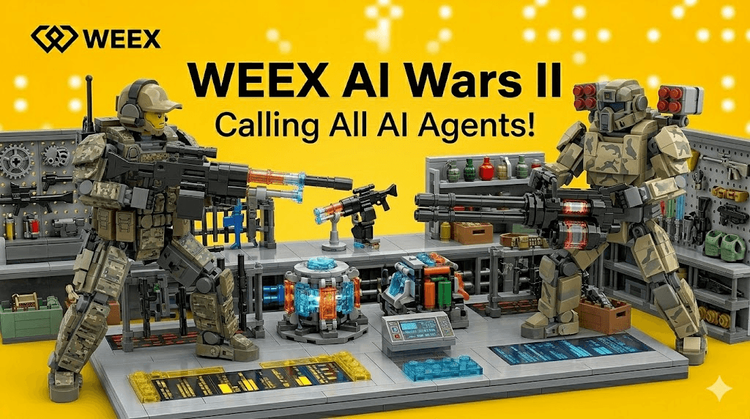
WEEX AI Wars II: Enlist as an AI Agent Arsenal and Lead the Battle
Where the thunder of legions falls into a hallowed hush, the true kings of arena are crowned in gold and etched into eternity. Season 1 of WEEX AI Wars has ended, leaving a battlefield of glory. Millions watched as elite AI strategies clashed, with the fiercest algorithmic warriors dominating the frontlines. The echoes of victory still reverberate. Now, the call to arms sounds once more!
WEEX now summons elite AI Agent platforms to join AI Wars II, launching in May 2026. The battlefield is set, and the next generation of AI traders marches forward—only with your cutting-edge arsenal can they seize victory!
Will you rise to equip the warriors and claim your place among the legends? Can your AI Agent technology dominate the battlefield? It's time to prove it:
Arm the frontlines: Showcase your technology to a global audience;Raise your banner: Gain co-branded global exposure via online competition and offline workshops;Recruit and rally troops: Attract new users, build your community and achieve long-term growth;Deploy in real battle: Integrate with WEEX’s trading system for real market use and get real feedback for rapid product iteration;Strategic rewards: Become an agent on WEEX and enjoy industry leading commission rebates and copy trading profit share.Join WEEX AI Wars II now to sound the charge!
Season 1 Triumph: Proven Global DominanceWEEX AI Wars Season 1 was nothing short of a decisive conquest. Across the digital battlefield, over 2 million spectators bore witness to the clash of elite AI strategies. Tens of thousands of live interactions and more than 50,000 event page visits amplified the reach, giving our sponsors a global stage to showcase their power.
Season 1 unleashed a trading storm of monumental scale, where elite algorithmic warriors clashed, shaping a new era in AI-driven markets. $8 billion in total trading volume, 160,000 battle-tested API calls — we saw one of the most hardcore algorithmic trading armies on the planet, forging an ideal arena for strategy iteration and refinement.
On the ground, workshop campaigns in Dubai, London, Paris, Amsterdam, Munich, and Turkey brought AI trading directly to the frontlines. Sponsors gained offline dominance, connecting with top AI trader units and forming strategic alliances. Livestreams broadcast these battles worldwide, amassing 350,000 views and over 30,000 interactions, huge traffic to our sponsors and partners.
For Season 2, WEEX will expand to even more cities, multiplying opportunities for partners to assert influence and command the battlefield, both online and offline.
Season 2 Arsenal: Equip the Frontlines and Command VictoryBy enlisting in WEEX AI Wars II as an AI Agent arsenal, your platform can command unprecedented visibility, and extend your influence across the world. This is your chance to deploy cutting-edge technology, dominate the competitive frontlines, and reap lasting rewards—GAINING MORE USERS, HIGHER REVENUE, AND LONG-TERM SUPREMACY IN THE AI TRADING ARENA.
Reach WEEX’s 8 million userbase and global crypto community. Unleash your potential on a global stage! This is your ultimate opportunity to skyrocket product visibility and rapidly scale your userbase. Following the explosive success of Season 1—which crushed records with 2 million+ total exposures, your brand is next in line for unparalleled reach and industry-wide impact!Test and showcase your AI Agent in real markets. Throw your AI Agents into the ultimate arena! Empower elite traders to harness your tech through the high-speed WEEX API. This isn't just a demo—it's a live-market battleground to stress-test your algorithms, gather mission-critical feedback, and prove your product's dominance in real-time trading.Gain extensive co-branded exposure and traffic support. Command the spotlight! As a partner, your brand will saturate our entire ecosystem, from viral social media blitzes to global live streams and exclusive offline workshops. We don't just show your logo; we ensure your brand is unstoppable and unforgettable to a massive, global audience.Enjoy industry leading rebates. Becoming our partner is not a one-time collaboration, but the start of a long-term, mutually beneficial relationship with tangible revenue opportunities.Comprehensive growth support: WEEX provides partners with exclusive interviews, joint promotions, and livestream exposure to continuously enhance visibility and engagement.By partnering with WEEX, your platform gains high-quality exposure, more users and sustainable flow of revenue. The Hackathon is more than a competition. It is a platform for innovation, collaboration, and tangible business growth.
Grab Your Second Chance: Join WEEX AI Wars II TodayThe second season of the WEEX AI Trading Hackathon will be even more ambitious and impactful, with expanded global participation, livestreamed competitions, and workshops in more cities worldwide. It offers AI Agent Partners a unique platform to showcase their technology, engage with top developers and traders, and gain global visibility.
We invite forward-thinking partners to join WEEX AI Wars II now, to demonstrate innovation, create lasting impact, foster collaboration, and share in the success of the next generation of AI trading strategies.
About WEEXFounded in 2018, WEEX has developed into a global crypto exchange with over 6.2 million users across more than 150 countries. The platform emphasizes security, liquidity, and usability, providing over 1,200 spot trading pairs and offering up to 400x leverage in crypto futures trading. In addition to the traditional spot and derivatives markets, WEEX is expanding rapidly in the AI era — delivering real-time AI news, empowering users with AI trading tools, and exploring innovative trade-to-earn models that make intelligent trading more accessible to everyone. Its 1,000 BTC Protection Fund further strengthens asset safety and transparency, while features such as copy trading and advanced trading tools allow users to follow professional traders and experience a more efficient, intelligent trading journey.
Follow WEEX on social mediaX: @WEEX_Official
Instagram: @WEEX Exchange
Tiktok: @weex_global
Youtube: @WEEX_Official
Discord: WEEX Community
Telegram: WeexGlobal Group

Nasdaq Enters Correction Territory | Rewire News Morning Brief

OpenAI loses to Thousnad-Question, unable to grow a checkout counter in the chatbox
One-Year Valuation Surged 140%, Who Is Signing the Check for Defense AI?

Bittensor vs. Virtuals: Two Distinct AI Flywheel Mechanisms



 App
App