
Bittensor Revival: Everything You Need to Know About dTAO
Original Article Title: Dynamic TAO: Your No-Nonsense Guide
Original Author: Yau Teng Yan, Founder of Chain of Thought
Original Translation: ChatGPT
Editor's Note: The article points out that the launch of dTAO has addressed the unfairness and centralization issues in Bittensor's early reward distribution. Through a market-driven mechanism, dTAO aligns the TAO rewards of subnets with demand, directing more rewards to high-demand subnets. This change has shifted from validator-driven reward distribution to pricing through the Alpha token market, ensuring that well-performing subnets receive more rewards and incentivizing overall network activity and innovation. While still facing issues of manipulation and liquidity, dTAO has taken a significant step towards decentralization and market-driven incentives.
The following is the original content (rearranged for readability and comprehension):
A year ago, I wrote about Bittensor's economic challenges. Now, with the launch of dTAO, the network is finally starting to address these issues.
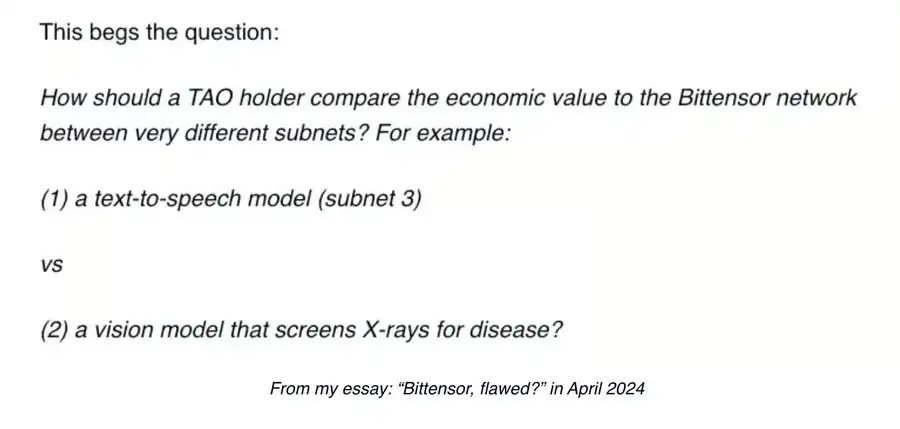
This transformation was long overdue. Bittensor's growth had outpaced the ability of root validators to fairly assess new subnets. Influence was concentrated at the top, sometimes not entirely neutral. dTAO addresses this by letting demand, not gatekeepers, determine which subnets can thrive.
Frankly, understanding dTAO was not easy at first. It took some time to piece together all the details.
That's also why I wrote this article: to break it down in plain language, so you don't feel the confusion I felt at the time. And to summarize my key takeaways.
Why dTAO?
First, it's worth asking: What problem is dTAO designed to fix?
Validator Bottleneck
In the old system, freshly minted TAO was allocated based on validator voting. In theory, this "validator democracy" made sense, but in practice, it had issues.
With more and more subnets coming online, top validators simply couldn't keep up. Too many subnets, too much noise, and bandwidth insufficient to fairly assess them.
Over time, the system fell into a state of apathy—where a few closely-knit subnets received most of the rewards, while new subnets struggled to gain support.
Conflict of Interest
Many top validators happen to also be subnet owners. By controlling reward distribution, some have weighted their own subnets more heavily, effectively increasing their own rewards.
Some have even referred to the previous system as more like "giving TAO to their friends."
In extreme cases, validators have reached private agreements or revenue-sharing deals with subnet owners, creating centralization risks, distorting reward distribution, and eroding trust in the system.
Poor Coordination
Validators have their own set of weighting methods to determine rewards, but these methods are not always aligned with the overall network's goals.
What's worse, the stakers providing economic weight cannot directly decide which subnets receive rewards. Most staked TAO is concentrated in the hands of a few validators, effectively giving them control over the entire reward distribution landscape.
dTAO—A Significant Change
Prior to the launch of dTAO, reward distribution was straightforward. Each block produced 1 TAO (equivalent to 7,200 TAO per day), which was allocated to subnets based on the weight set by the root validator. Each subnet distributed TAO to its contributors in a fixed ratio: subnet owner 18%, miner 41%, validator 41%.
For stakers, everything revolved around the Root (Subnet 0). TAO holders staked behind validators, and in return, they received newly minted TAO. This process was direct and predictable.
But all of that has now come to an end.
Under dTAO, rewards are no longer based on validator weightings. Instead, TAO rewards flow through a market-driven system using subnet tokens, also known as Alpha tokens.
The price of these Alpha tokens reflects the market's demand for a specific subnet. The higher the demand, the higher the price, indicating the subnet's greater value.
The subnet tokens use a constant product automated market maker (AMM)—similar to the pricing mechanism used by Uniswap. The price at any given time is determined by the ratio of TAO reserves to Alpha token reserves in the subnet's liquidity pool.
So, rewards are no longer randomly distributed; a subnet's TAO reward share is now determined by how the market perceives its value.
· Higher Alpha Token Price → Reflects strong market demand → More TAO rewards
· Lower Alpha Token Price → Reflects weak market demand → Fewer TAO rewards

Imagine two subnets vying for rewards:
· Subnet A Token Price = $100
· Subnet B Token Price = $50
This mechanism creates a self-adjusting system where subnets perceived to create more value (perform better) receive more TAO rewards, while underperforming subnets naturally see lower rewards.
This mechanism ensures capital flows to the most productive subnets.
Reward Distribution
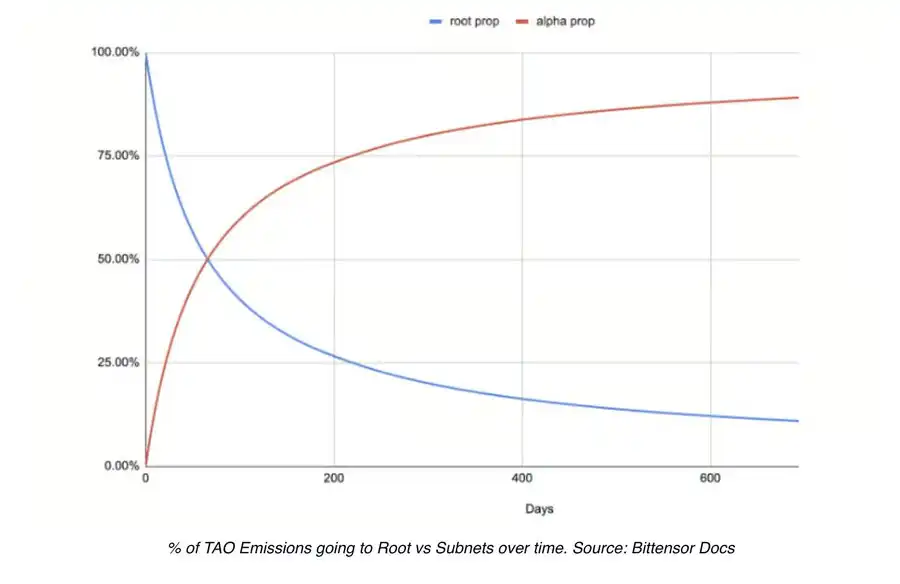
It took me a while to piece together a clear picture of the actual reward distribution, so let me try to summarize concisely. The following chart is worth referencing multiple times in the upcoming article. I found it to be one of the most informative visuals, showing the distribution of TAO rewards to the Root versus subnets over time.
What's Happening on the Root Network?
In the early stages of the dTAO (like it is now), Stakeholders on the Root (Subnet 0) will still receive the majority of TAO rewards. The reason is simple: the circulating supply of Alpha tokens is still not substantial.
The staking weight of validators on each subnet depends not only on their share of Alpha tokens in that subnet but also on the amount of TAO they stake in the Root.
Because Alpha tokens are still scarce in the early stages, Root validators hold disproportionate influence across the network.
This has resulted in the majority of newly minted Alpha tokens being automatically "sold back" to TAO and distributed to TAO stakers on the Root.
Currently, this is highly beneficial for Root stakers. Since most rewards still flow into the Root, the returns are very lucrative, with the APR reaching as high as 60-70% in the past few days.
However, this situation will not last long.
As more Alpha tokens enter circulation, their weight in the network will increase, gradually shifting the influence away from Root validators. Over time, dTAO ensures that rewards are no longer concentrated on the Root but are more evenly distributed across the network.
Approximately 100 days later, the TAO rewards for Root stakers are expected to balance out with the subnet Alpha tokens.
What Happened to Subnets?
Subnets no longer directly allocate newly minted TAO to miners and validators but instead use Alpha tokens—their native currency—to reward participants.
How Alpha Tokens Work
Each block, each subnet mints Alpha tokens, starting from 2 Alphas per block (which is double the TAO minting rate). The minting rate is dynamic, with the higher the price of Alpha tokens, the lower the minting rate.
Similar to TAO, each Alpha token has a hard cap total supply of 21 million tokens and follows the same halving schedule, with the first halving expected to occur when the total supply reaches 10.5 million—anticipated to be in less than two years.
Each subnet operates an AMM pool where TAO is paired with Alpha tokens. The price of Alpha is dynamically determined based on the ratio of TAO to Alpha tokens in the pool.
When you stake TAO into a subnet pool, you receive an equivalent amount of Alpha tokens at the current market price. Later, if you unstake, you can exchange Alpha tokens back for TAO at the market price.
When people say they are "buying" or "selling" subnet tokens, they are actually just staking or unstaking TAO into the subnet pool. There is currently no standalone mechanism to directly purchase Alpha tokens.
Reward Distribution Mechanism
For each block, the protocol scans the Alpha token prices of all subnets and dynamically determines how much newly minted TAO to inject into each subnet's pool.
· Subnets with higher prices (indicating stronger demand and utility) will receive more TAO rewards.
· Subnets with lower prices will receive fewer TAO rewards.
Subnets now have to earn TAO rewards by demonstrating actual demand for their Alpha tokens. This creates a competitive, market-driven environment where success must be earned, and only the most viable subnets can survive.
Subnets can no longer coast to rewards; they must prove their worth.
Those that demonstrate true utility and maintain a higher Alpha token price will receive more TAO rewards, while underperforming subnets will naturally decline as their rewards gradually deplete.
To prevent reward distribution from being distorted by short-term price fluctuations, the system employs Exponential Moving Average (EMA), which smooths out volatility and ensures that TAO reward distribution remains stable even in cases of sudden price swings. Therefore, changes in Alpha price are reflected with a lag in TAO reward distribution—usually taking a few days rather than hours.
Timeline
Below is a breakdown of key stages to help you anticipate future developments. Please note that these are rough timeframes and conceptual milestones, not set in stone.
Genesis Stage (Day 0 - Day 1)
· Each subnet mints 2 Alphas per block (commencing new minting).
· As Alpha tokens are not yet in circulation, Root will receive around 100% of TAO rewards.
· Validator staking weight on TAO exclusively.
· Highest TAO staking rewards on Root.
Early Adoption Stage (Day 2 - Day 30): We are currently in this stage
· More Alpha tokens enter circulation as subnets start minting Alphas.
· Validators in the subnets start accumulating Alpha, and staking weight gradually shifts to the subnets.
· Root continues to receive the majority of TAO rewards, but its dominance begins to decline.
Transition Phase (Day 30 - Day 100)
· The Alpha supply of the subnet rapidly increases due to a high minting rate.
· Subnet validators with more Alpha start to surpass TAO-based Root validators in staking weight.
· Root's share of TAO rewards significantly decreases.
· By the 100th day, the staking weight of TAO and Alpha will reach equilibrium, meaning that TAO staking will no longer dominate in validator weight calculation.
Post-Transition Phase (Day 100 - Year 1)
· Subnet validators dominate reward distribution.
· Root continues to receive TAO rewards, but at a significantly slower rate.
· Validators staking Alpha tokens in the subnet adapt to maximize earnings.
Long-Term (Year 1 and Beyond)
· TAO rewards are largely determined by market-driven subnet staking.
· Root still allows TAO staking but with minimal rewards, and TAO's weight approaches 0.
· In terms of reward distribution, the network becomes fully decentralized.
What Has Happened So Far
All subnet token pools initially had a 1 Alpha/1 TAO ratio, which can be seen as a model of fair launch.
Shortly after the launch of dTAO, the price of Alpha experienced intense fluctuations. Some subnets surged to 5-10 TAO/Alpha within the first few hours, mainly driven by speculators looking to profit from high rewards. The prices of other subnets remained between 0.1-0.2 TAO, possibly due to strong branding or a lack of early marketing.
However, the early price spikes may not be sustainable for long due to the following reasons:
· Automatic sale of Root rewards: Many newly minted Alpha tokens are automatically sold back into these subnet pools to pay the TAO stakers on Root their rewards, exerting downward pressure on the price.
· Sell Pressure: Miners, Validators, and Subnet Owners earn Alpha tokens (which mint faster than TAO) and then swap them back for TAO to cover operational costs.
Warning: In the early stages, the relative inflation of Subnet Alpha tokens is very high. Low circulation, high price volatility.
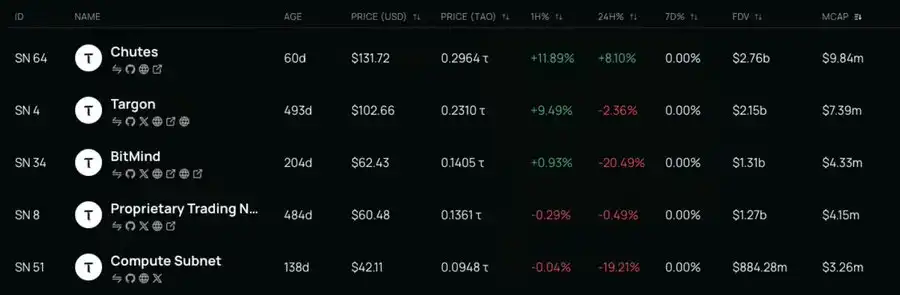
The best place I've found to track Subnet Alpha prices is @BackpropFinance.
As of now, the circulation of Alpha per Subnet is less than 0.4%, so you often see a low market cap, but the fully diluted valuation is very high, usually reaching billions of dollars.
For example, one of the most hyped ones recently is Chutes, providing serverless GPU resources by @rayon_labs (Subnet 64). It shows a market cap of about $9.2 million, but the fully diluted valuation is $26 billion, which is quite remarkable compared to TAO's market cap of around $40 billion.
Considering the severe inflation and ongoing sell pressure, I expect these fully diluted valuations (FDV) to eventually retreat to more realistic levels.
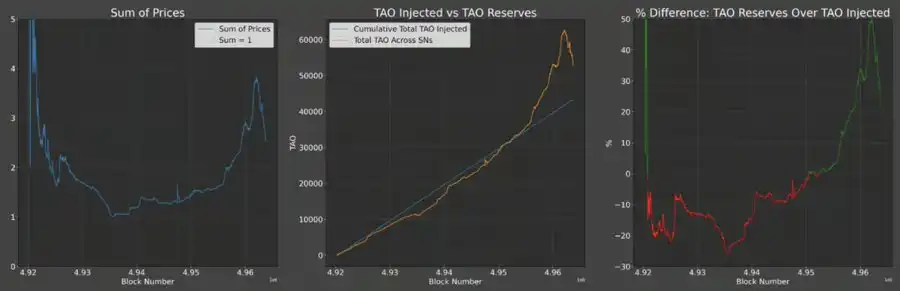
One trackable metric is the total FDV of all Subnet tokens compared to TAO's market cap (see the leftmost chart in the image above). It's currently around 2-3x, but clearly, this situation is unsustainable long-term.
However, this is still a low liquidity environment, meaning even small-scale "blind" buys or sellers can quickly drive price movements. In just the past day, we've seen Subnet token prices spike by 100-200% and then quickly cool off.
How to Acquire Subnet Alpha Tokens
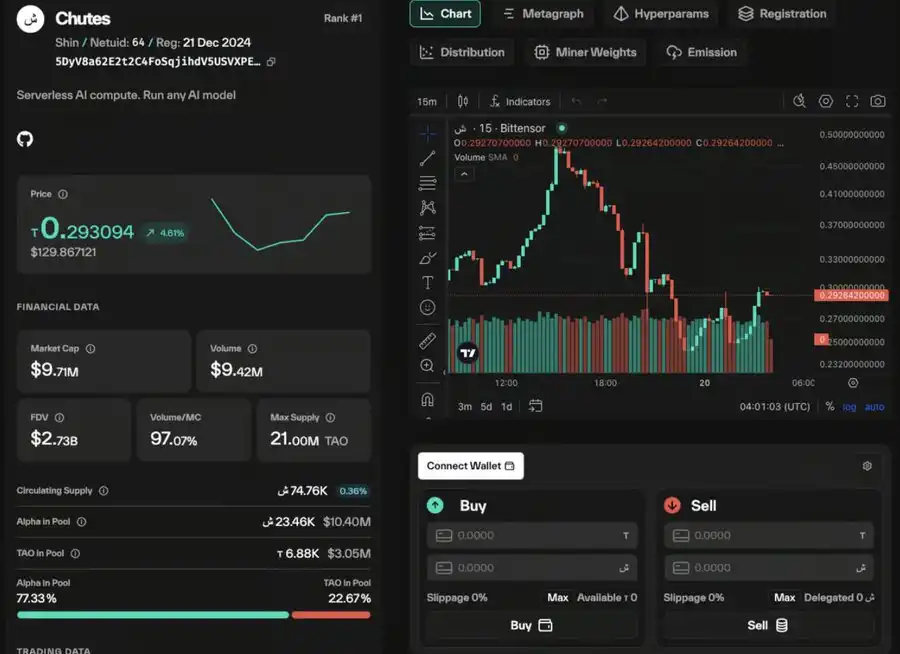
Choosing the right Subnet is the first step.
Not all Subnets are created equal, so look for practical utility, an active community, and strong miner participation—tools like Discord, X, GitHub, etc., can help you identify real market momentum.
Once you've found a subnet you like, you'll need a Bittensor wallet. A good wallet is the official Chrome extension from the @OpenTensor Foundation. You can only use TAO staking to receive subnet tokens, so there is currently no direct mechanism to exchange with ETH, USDC, or SOL.
While you can stake directly in the wallet, I prefer using platforms like Taostats.io or Backprop Finance, which provide a familiar trading interface. Just be mindful of slippage: most subnets still have low liquidity, so larger trades may cause significant price changes.
One benefit? Holding Alpha tokens allows you to earn more tokens as newly minted Alpha tokens automatically accrue to your balance. When you wish to exit, you can unstake and exchange back to TAO at the pool's rate. This rate may differ from when you staked, so you may actually lose TAO in the process.
My Thoughts on dTAO
The greatest thing about dTAO and Bittensor subnet tokens is that it makes everyone truly care about the development of each subnet. Here is real Alpha—by doing research, one can actually gain an edge—whereas previously, all you needed to do was buy TAO.
And that's the crux of it.
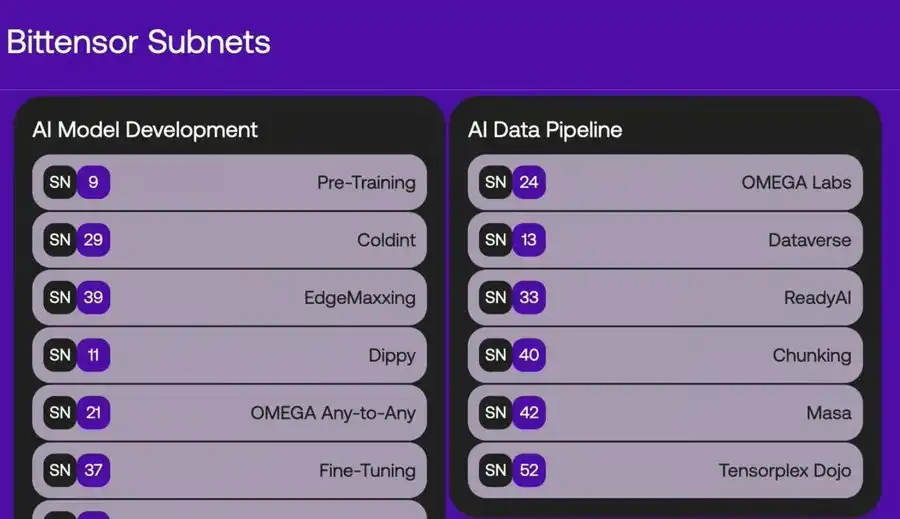
I'm taking the time to delve into what these subnets are doing, to understand their product vision and business model.
And it's actually very fascinating. Many subnets are led by technical teams with deep AI expertise, working on everything from AI model development to protein folding and advanced computer vision models in scientific research.
These subnets are at different stages of development. Some are still in the early stages, focusing on building a miner community, while others have already begun to produce valuable outputs and secure business partnerships.
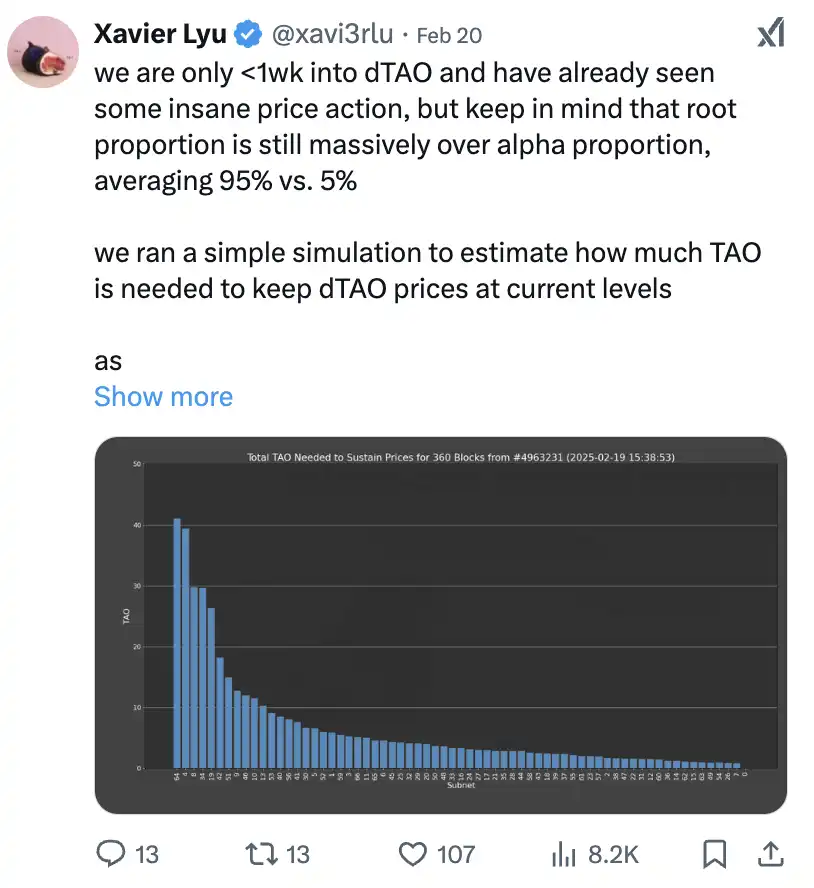
If I were to give some advice on subnet tokens, it would be: patience may be your best strategy.
dTAO is a system designed for the long term, gradually transitioning and rewarding those who take the time to deeply understand it. If you like a particular subnet, gradually getting involved through small, regular purchases (rather than a large one-time investment) can help you weather the volatility while steadily increasing liquidity.
For those who are not fans of subnet mania, you may consider continuing to delegate your TAO to the Root over the next few months. The APR there will gradually decrease over time, but it is still respectable.
Of course, there will also be those who want to play the volatility "lottery." If they can accurately time their entries and exits, they may be able to significantly increase their TAO holdings. However, this is a very risky game.
Some Thoughts
dTAO is an important step in the right direction. However, it is not a perfect system (is there such a thing as a perfect system anyway?)
Manipulation is Still Possible
Switching to an Alpha-based staking model has introduced a new set of risks. In theory, it has created a better market-driven incentive mechanism, but in practice, it still leaves room for exploitation. If a subnet's token price collapses, malicious actors could take advantage of the low price to purchase Alpha tokens and use them to manipulate rewards.
Currently, dTAO mitigates this issue by merging Root staking weight, making it harder for any single entity to hijack rewards. However, as the Root weight gradually decreases, subnets will need stronger security mechanisms to prevent hostile takeovers. Subnet owners could still engage in private agreements with large validators or miners—the medium now being Alpha instead of TAO. While the system is more decentralized, it still does not eliminate the possibility of game theory alliances.
1,000 Subnets?

Each time a new subnet is registered, the fee doubles. But over time, the price will also decay, halving approximately every 38,880 blocks—roughly every five and a half days. This means that if demand remains stable, a new subnet could be launched every five days.
What happens when we have a thousand subnets?
At such a large scale, no individual will reasonably be able to track all rewards, performances, and opportunities across the entire network. The data will be too vast, the variables too many, and the noise too much. AI-based analytics tools will become a necessity, not a luxury, to help delegators navigate through the overwhelming options.
For those launching new subnets, early liquidity will be key. They will need to create an initial surge in demand for their Alpha tokens, or else their reward share will remain insignificant.
Over time, the real winners will be those subnets that demonstrate true utility, establishing a strong correlation between usage and Alpha price. Subnets that fail to attract usage may gradually fade away, with their tokens drifting towards zero.
DeFi on Bittensor
I'm excited to see potential future upgrades bring DeFi-like mechanisms into the ecosystem, further enhancing capital efficiency.
One possibility is adopting liquidity pools akin to Uniswap V3, allowing for concentrated liquidity rather than the constant product AMM model. Another possibility is permissionless liquidity provision, where external LPs can deposit funds into Alpha–TAO pairs and earn transaction fees.
These do not exist yet—but if implemented, they could fundamentally change the rules of the game, making subnet tokens more transactional and staking-attractive.
More capital → more liquidity → more capital.
The dTAO is still in its early stages, but with the introduction of new mechanisms, Bittensor's financial layer could evolve into something more complex than what we see today.
Bittensor Renaissance
Last month, in my personal predictions for 2025, I wrote about the possibility of a Bittensor renaissance:
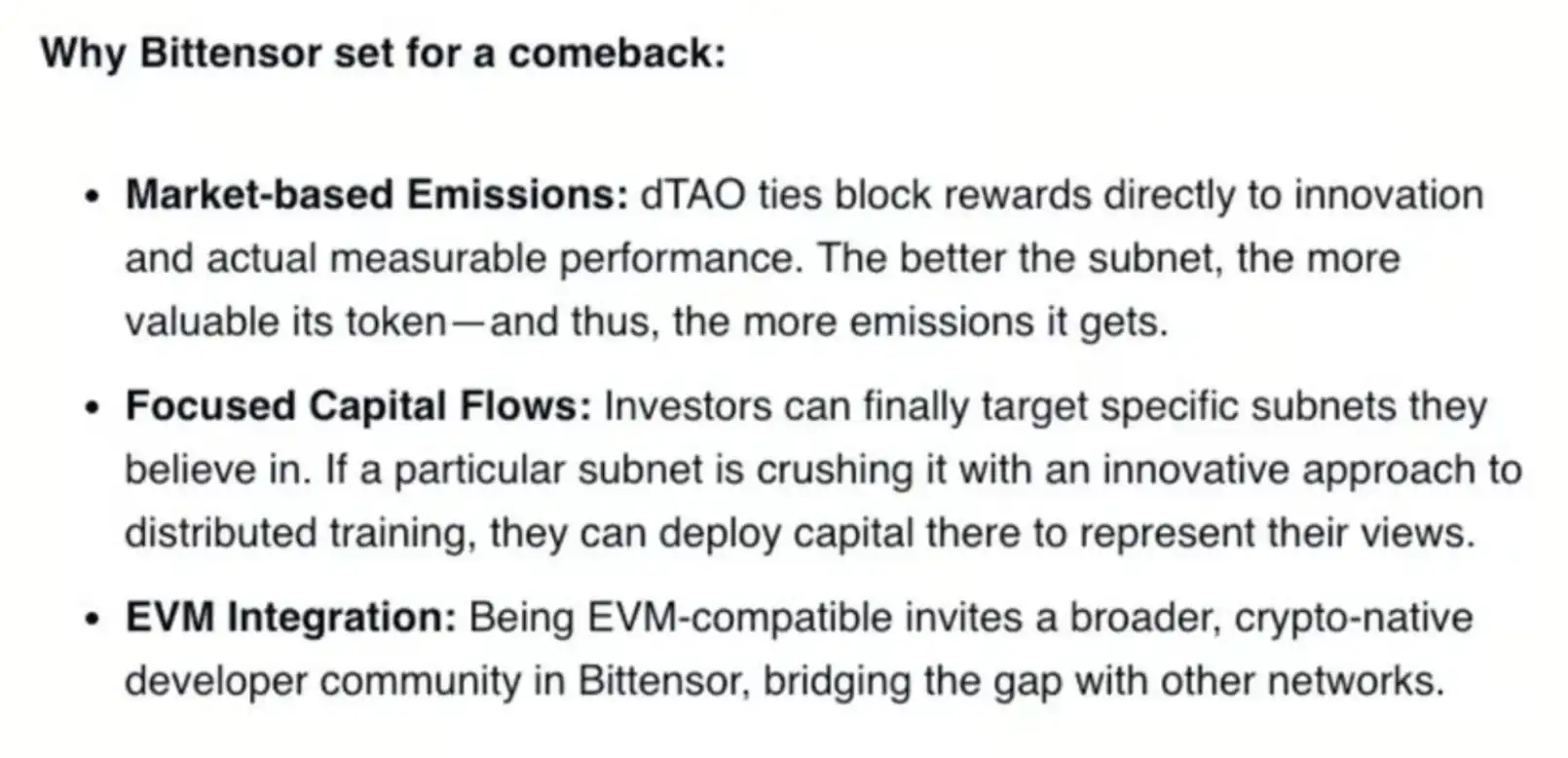
Bittensor spent most of last year in a state of turmoil—overlooked by the emerging narratives despite being the "elder" of crypto AI. While waves of AI token and AI agent hype washed over, TAO struggled to keep up.
Now, with the launch of dTAO, that narrative is changing. Interest is surging, forcing the entire network to pay attention for the first time—not just to TAO but to what each subnet is really building.
Congratulations to the const and Opentensor teams, and everyone who has worked hard for this. I admit I had my doubts.
This isn't just an upgrade. It's the beginning of the Bittensor Renaissance, a process that will unfold over many years.
Related Resources
· Dynamic TAO Whitepaper (Warning: Lots of Math)
· Opentensor's Dynamic TAO FAQ
· Taostats (Great Resource for Tracking Network and Subnet Data)
· Taopill (Overview of Each Subnet's Functionality and Key Achievements)
· Backprop Finance for Monitoring Subnet Token Prices
· Wombo's Automated Subnet Evaluation Paper
· Many Great Tweets from @bloomberg_seth, @Old_Samster (@CrucibleLabs), and @xavi3rlu (Latent Holdings)
· @taotimesdotai / @brodydotai: Best Communication for Bittensor
· @TAOTalkPod: Excellent Podcast for Bittensor
You may also like

Token Cannot Compound, Where Is the Real Investment Opportunity?

February 6th Market Key Intelligence, How Much Did You Miss?

China's Central Bank and Eight Other Departments' Latest Regulatory Focus: Key Attention to RWA Tokenized Asset Risk
Foreword: Today, the People's Bank of China's website published the "Notice of the People's Bank of China, National Development and Reform Commission, Ministry of Industry and Information Technology, Ministry of Public Security, State Administration for Market Regulation, China Banking and Insurance Regulatory Commission, China Securities Regulatory Commission, State Administration of Foreign Exchange on Further Preventing and Dealing with Risks Related to Virtual Currency and Others (Yinfa [2026] No. 42)", the latest regulatory requirements from the eight departments including the central bank, which are basically consistent with the regulatory requirements of recent years. The main focus of the regulation is on speculative activities such as virtual currency trading, exchanges, ICOs, overseas platform services, and this time, regulatory oversight of RWA has been added, explicitly prohibiting RWA tokenization, stablecoins (especially those pegged to the RMB). The following is the full text:
To the people's governments of all provinces, autonomous regions, and municipalities directly under the Central Government, the Xinjiang Production and Construction Corps:
Recently, there have been speculative activities related to virtual currency and Real-World Assets (RWA) tokenization, disrupting the economic and financial order and jeopardizing the property security of the people. In order to further prevent and address the risks related to virtual currency and Real-World Assets tokenization, effectively safeguard national security and social stability, in accordance with the "Law of the People's Republic of China on the People's Bank of China," "Law of the People's Republic of China on Commercial Banks," "Securities Law of the People's Republic of China," "Law of the People's Republic of China on Securities Investment Funds," "Law of the People's Republic of China on Futures and Derivatives," "Cybersecurity Law of the People's Republic of China," "Regulations of the People's Republic of China on the Administration of Renminbi," "Regulations on Prevention and Disposal of Illegal Fundraising," "Regulations of the People's Republic of China on Foreign Exchange Administration," "Telecommunications Regulations of the People's Republic of China," and other provisions, after reaching consensus with the Cyberspace Administration of China, the Supreme People's Court, and the Supreme People's Procuratorate, and with the approval of the State Council, the relevant matters are notified as follows:
(I) Virtual currency does not possess the legal status equivalent to fiat currency. Virtual currencies such as Bitcoin, Ether, Tether, etc., have the main characteristics of being issued by non-monetary authorities, using encryption technology and distributed ledger or similar technology, existing in digital form, etc. They do not have legal tender status, should not and cannot be circulated and used as currency in the market.
The business activities related to virtual currency are classified as illegal financial activities. The exchange of fiat currency and virtual currency within the territory, exchange of virtual currencies, acting as a central counterparty in buying and selling virtual currencies, providing information intermediary and pricing services for virtual currency transactions, token issuance financing, and trading of virtual currency-related financial products, etc., fall under illegal financial activities, such as suspected illegal issuance of token vouchers, unauthorized public issuance of securities, illegal operation of securities and futures business, illegal fundraising, etc., are strictly prohibited across the board and resolutely banned in accordance with the law. Overseas entities and individuals are not allowed to provide virtual currency-related services to domestic entities in any form.
A stablecoin pegged to a fiat currency indirectly fulfills some functions of the fiat currency in circulation. Without the consent of relevant authorities in accordance with the law and regulations, any domestic or foreign entity or individual is not allowed to issue a RMB-pegged stablecoin overseas.
(II)Tokenization of Real-World Assets refers to the use of encryption technology and distributed ledger or similar technologies to transform ownership rights, income rights, etc., of assets into tokens (tokens) or other interests or bond certificates with token (token) characteristics, and carry out issuance and trading activities.
Engaging in the tokenization of real-world assets domestically, as well as providing related intermediary, information technology services, etc., which are suspected of illegal issuance of token vouchers, unauthorized public offering of securities, illegal operation of securities and futures business, illegal fundraising, and other illegal financial activities, shall be prohibited; except for relevant business activities carried out with the approval of the competent authorities in accordance with the law and regulations and relying on specific financial infrastructures. Overseas entities and individuals are not allowed to illegally provide services related to the tokenization of real-world assets to domestic entities in any form.
(III) Inter-agency Coordination. The People's Bank of China, together with the National Development and Reform Commission, the Ministry of Industry and Information Technology, the Ministry of Public Security, the State Administration for Market Regulation, the China Banking and Insurance Regulatory Commission, the China Securities Regulatory Commission, the State Administration of Foreign Exchange, and other departments, will improve the work mechanism, strengthen coordination with the Cyberspace Administration of China, the Supreme People's Court, and the Supreme People's Procuratorate, coordinate efforts, and overall guide regions to carry out risk prevention and disposal of virtual currency-related illegal financial activities.
The China Securities Regulatory Commission, together with the National Development and Reform Commission, the Ministry of Industry and Information Technology, the Ministry of Public Security, the People's Bank of China, the State Administration for Market Regulation, the China Banking and Insurance Regulatory Commission, the State Administration of Foreign Exchange, and other departments, will improve the work mechanism, strengthen coordination with the Cyberspace Administration of China, the Supreme People's Court, and the Supreme People's Procuratorate, coordinate efforts, and overall guide regions to carry out risk prevention and disposal of illegal financial activities related to the tokenization of real-world assets.
(IV) Strengthening Local Implementation. The people's governments at the provincial level are overall responsible for the prevention and disposal of risks related to virtual currencies and the tokenization of real-world assets in their respective administrative regions. The specific leading department is the local financial regulatory department, with participation from branches and dispatched institutions of the State Council's financial regulatory department, telecommunications regulators, public security, market supervision, and other departments, in coordination with cyberspace departments, courts, and procuratorates, to improve the normalization of the work mechanism, effectively connect with the relevant work mechanisms of central departments, form a cooperative and coordinated working pattern between central and local governments, effectively prevent and properly handle risks related to virtual currencies and the tokenization of real-world assets, and maintain economic and financial order and social stability.
(5) Enhanced Risk Monitoring. The People's Bank of China, China Securities Regulatory Commission, National Development and Reform Commission, Ministry of Industry and Information Technology, Ministry of Public Security, State Administration of Foreign Exchange, Cyberspace Administration of China, and other departments continue to improve monitoring techniques and system support, enhance cross-departmental data analysis and sharing, establish sound information sharing and cross-validation mechanisms, promptly grasp the risk situation of activities related to virtual currency and real-world asset tokenization. Local governments at all levels give full play to the role of local monitoring and early warning mechanisms. Local financial regulatory authorities, together with branches and agencies of the State Council's financial regulatory authorities, as well as departments of cyberspace and public security, ensure effective connection between online monitoring, offline investigation, and fund tracking, efficiently and accurately identify activities related to virtual currency and real-world asset tokenization, promptly share risk information, improve early warning information dissemination, verification, and rapid response mechanisms.
(6) Strengthened Oversight of Financial Institutions, Intermediaries, and Technology Service Providers. Financial institutions (including non-bank payment institutions) are prohibited from providing account opening, fund transfer, and clearing services for virtual currency-related business activities, issuing and selling financial products related to virtual currency, including virtual currency and related financial products in the scope of collateral, conducting insurance business related to virtual currency, or including virtual currency in the scope of insurance liability. Financial institutions (including non-bank payment institutions) are prohibited from providing custody, clearing, and settlement services for unauthorized real-world asset tokenization-related business and related financial products. Relevant intermediary institutions and information technology service providers are prohibited from providing intermediary, technical, or other services for unauthorized real-world asset tokenization-related businesses and related financial products.
(7) Enhanced Management of Internet Information Content and Access. Internet enterprises are prohibited from providing online business venues, commercial displays, marketing, advertising, or paid traffic diversion services for virtual currency and real-world asset tokenization-related business activities. Upon discovering clues of illegal activities, they should promptly report to relevant departments and provide technical support and assistance for related investigations and inquiries. Based on the clues transferred by the financial regulatory authorities, the cyberspace administration, telecommunications authorities, and public security departments should promptly close and deal with websites, mobile applications (including mini-programs), and public accounts engaged in virtual currency and real-world asset tokenization-related business activities in accordance with the law.
(8) Strengthened Entity Registration and Advertisement Management. Market supervision departments strengthen entity registration and management, and enterprise and individual business registrations must not contain terms such as "virtual currency," "virtual asset," "cryptocurrency," "crypto asset," "stablecoin," "real-world asset tokenization," or "RWA" in their names or business scopes. Market supervision departments, together with financial regulatory authorities, legally enhance the supervision of advertisements related to virtual currency and real-world asset tokenization, promptly investigating and handling relevant illegal advertisements.
(IX) Continued Rectification of Virtual Currency Mining Activities. The National Development and Reform Commission, together with relevant departments, strictly controls virtual currency mining activities, continuously promotes the rectification of virtual currency mining activities. The people's governments of various provinces take overall responsibility for the rectification of "mining" within their respective administrative regions. In accordance with the requirements of the National Development and Reform Commission and other departments in the "Notice on the Rectification of Virtual Currency Mining Activities" (NDRC Energy-saving Building [2021] No. 1283) and the provisions of the "Guidance Catalog for Industrial Structure Adjustment (2024 Edition)," a comprehensive review, investigation, and closure of existing virtual currency mining projects are conducted, new mining projects are strictly prohibited, and mining machine production enterprises are strictly prohibited from providing mining machine sales and other services within the country.
(X) Severe Crackdown on Related Illegal Financial Activities. Upon discovering clues to illegal financial activities related to virtual currency and the tokenization of real-world assets, local financial regulatory authorities, branches of the State Council's financial regulatory authorities, and other relevant departments promptly investigate, determine, and properly handle the issues in accordance with the law, and seriously hold the relevant entities and individuals legally responsible. Those suspected of crimes are transferred to the judicial authorities for processing according to the law.
(XI) Severe Crackdown on Related Illegal and Criminal Activities. The Ministry of Public Security, the People's Bank of China, the State Administration for Market Regulation, the China Banking and Insurance Regulatory Commission, the China Securities Regulatory Commission, as well as judicial and procuratorial organs, in accordance with their respective responsibilities, rigorously crack down on illegal and criminal activities related to virtual currency, the tokenization of real-world assets, such as fraud, money laundering, illegal business operations, pyramid schemes, illegal fundraising, and other illegal and criminal activities carried out under the guise of virtual currency, the tokenization of real-world assets, etc.
(XII) Strengthen Industry Self-discipline. Relevant industry associations should enhance membership management and policy advocacy, based on their own responsibilities, advocate and urge member units to resist illegal financial activities related to virtual currency and the tokenization of real-world assets. Member units that violate regulatory policies and industry self-discipline rules are to be disciplined in accordance with relevant self-regulatory management regulations. By leveraging various industry infrastructure, conduct risk monitoring related to virtual currency, the tokenization of real-world assets, and promptly transfer issue clues to relevant departments.
(XIII) Without the approval of relevant departments in accordance with the law and regulations, domestic entities and foreign entities controlled by them may not issue virtual currency overseas.
(XIV) Domestic entities engaging directly or indirectly in overseas external debt-based tokenization of real-world assets, or conducting asset securitization activities abroad based on domestic ownership rights, income rights, etc. (hereinafter referred to as domestic equity), should be strictly regulated in accordance with the principles of "same business, same risk, same rules." The National Development and Reform Commission, the China Securities Regulatory Commission, the State Administration of Foreign Exchange, and other relevant departments regulate it according to their respective responsibilities. For other forms of overseas real-world asset tokenization activities based on domestic equity by domestic entities, the China Securities Regulatory Commission, together with relevant departments, supervise according to their division of responsibilities. Without the consent and filing of relevant departments, no unit or individual may engage in the above-mentioned business.
(15) Overseas subsidiaries and branches of domestic financial institutions providing Real World Asset Tokenization-related services overseas shall do so legally and prudently. They shall have professional personnel and systems in place to effectively mitigate business risks, strictly implement customer onboarding, suitability management, anti-money laundering requirements, and incorporate them into the domestic financial institutions' compliance and risk management system. Intermediaries and information technology service providers offering Real World Asset Tokenization services abroad based on domestic equity or conducting Real World Asset Tokenization business in the form of overseas debt for domestic entities directly or indirectly venturing abroad must strictly comply with relevant laws and regulations. They should establish and improve relevant compliance and internal control systems in accordance with relevant normative requirements, strengthen business and risk control, and report the business developments to the relevant regulatory authorities for approval or filing.
(16) Strengthen organizational leadership and overall coordination. All departments and regions should attach great importance to the prevention of risks related to virtual currencies and Real World Asset Tokenization, strengthen organizational leadership, clarify work responsibilities, form a long-term effective working mechanism with centralized coordination, local implementation, and shared responsibilities, maintain high pressure, dynamically monitor risks, effectively prevent and mitigate risks in an orderly and efficient manner, legally protect the property security of the people, and make every effort to maintain economic and financial order and social stability.
(17) Widely carry out publicity and education. All departments, regions, and industry associations should make full use of various media and other communication channels to disseminate information through legal and policy interpretation, analysis of typical cases, and education on investment risks, etc. They should promote the illegality and harm of virtual currencies and Real World Asset Tokenization-related businesses and their manifestations, fully alert to potential risks and hidden dangers, and enhance public awareness and identification capabilities for risk prevention.
(18) Engaging in illegal financial activities related to virtual currencies and Real World Asset Tokenization in violation of this notice, as well as providing services for virtual currencies and Real World Asset Tokenization-related businesses, shall be punished in accordance with relevant regulations. If it constitutes a crime, criminal liability shall be pursued according to the law. For domestic entities and individuals who knowingly or should have known that overseas entities illegally provided virtual currency or Real World Asset Tokenization-related services to domestic entities and still assisted them, relevant responsibilities shall be pursued according to the law. If it constitutes a crime, criminal liability shall be pursued according to the law.
(19) If any unit or individual invests in virtual currencies, Real World Asset Tokens, and related financial products against public order and good customs, the relevant civil legal actions shall be invalid, and any resulting losses shall be borne by them. If there are suspicions of disrupting financial order and jeopardizing financial security, the relevant departments shall deal with them according to the law.
This notice shall enter into force upon the date of its issuance. The People's Bank of China and ten other departments' "Notice on Further Preventing and Dealing with the Risks of Virtual Currency Trading Speculation" (Yinfa [2021] No. 237) is hereby repealed.

Former Partner's Perspective on Multicoin: Kyle's Exit, But the Game He Left Behind Just Getting Started
Why Bitcoin Is Falling Now: The Real Reasons Behind BTC's Crash & WEEX's Smart Profit Playbook
Bitcoin's ongoing crash explained: Discover the 5 hidden triggers behind BTC's plunge & how WEEX's Auto Earn and Trade to Earn strategies help traders profit from crypto market volatility.

Wall Street's Hottest Trades See Exodus

Vitalik Discusses Ethereum Scaling Path, Circle Announces Partnership with Polymarket, What's the Overseas Crypto Community Talking About Today?

Believing in the Capital Markets - The Essence and Core Value of Cryptocurrency

Polymarket's 'Weatherman': Predict Temperature, Win Million-Dollar Payout
$15K+ Profits: The 4 AI Trading Secrets WEEX Hackathon Prelim Winners Used to Dominate Volatile Crypto Markets
How WEEX Hackathon's top AI trading strategies made $15K+ in crypto markets: 4 proven rules for ETH/BTC trading, market structure analysis, and risk management in volatile conditions.

A nearly 20% one-day plunge, how long has it been since you last saw a $60,000 Bitcoin?

Raoul Pal: I've seen every single panic, and they are never the end.

Key Market Information Discrepancy on February 6th - A Must-Read! | Alpha Morning Report

2026 Crypto Industry's First Snowfall

The Harsh Reality Behind the $26 Billion Crypto Liquidation: Liquidity Is Killing the Market

Why Is Gold, US Stocks, Bitcoin All Falling?

Key Market Intelligence for February 5th, how much did you miss out on?

Wintermute: By 2026, crypto had gradually become the settlement layer of the Internet economy
Token Cannot Compound, Where Is the Real Investment Opportunity?
February 6th Market Key Intelligence, How Much Did You Miss?
China's Central Bank and Eight Other Departments' Latest Regulatory Focus: Key Attention to RWA Tokenized Asset Risk
Foreword: Today, the People's Bank of China's website published the "Notice of the People's Bank of China, National Development and Reform Commission, Ministry of Industry and Information Technology, Ministry of Public Security, State Administration for Market Regulation, China Banking and Insurance Regulatory Commission, China Securities Regulatory Commission, State Administration of Foreign Exchange on Further Preventing and Dealing with Risks Related to Virtual Currency and Others (Yinfa [2026] No. 42)", the latest regulatory requirements from the eight departments including the central bank, which are basically consistent with the regulatory requirements of recent years. The main focus of the regulation is on speculative activities such as virtual currency trading, exchanges, ICOs, overseas platform services, and this time, regulatory oversight of RWA has been added, explicitly prohibiting RWA tokenization, stablecoins (especially those pegged to the RMB). The following is the full text:
To the people's governments of all provinces, autonomous regions, and municipalities directly under the Central Government, the Xinjiang Production and Construction Corps:
Recently, there have been speculative activities related to virtual currency and Real-World Assets (RWA) tokenization, disrupting the economic and financial order and jeopardizing the property security of the people. In order to further prevent and address the risks related to virtual currency and Real-World Assets tokenization, effectively safeguard national security and social stability, in accordance with the "Law of the People's Republic of China on the People's Bank of China," "Law of the People's Republic of China on Commercial Banks," "Securities Law of the People's Republic of China," "Law of the People's Republic of China on Securities Investment Funds," "Law of the People's Republic of China on Futures and Derivatives," "Cybersecurity Law of the People's Republic of China," "Regulations of the People's Republic of China on the Administration of Renminbi," "Regulations on Prevention and Disposal of Illegal Fundraising," "Regulations of the People's Republic of China on Foreign Exchange Administration," "Telecommunications Regulations of the People's Republic of China," and other provisions, after reaching consensus with the Cyberspace Administration of China, the Supreme People's Court, and the Supreme People's Procuratorate, and with the approval of the State Council, the relevant matters are notified as follows:
(I) Virtual currency does not possess the legal status equivalent to fiat currency. Virtual currencies such as Bitcoin, Ether, Tether, etc., have the main characteristics of being issued by non-monetary authorities, using encryption technology and distributed ledger or similar technology, existing in digital form, etc. They do not have legal tender status, should not and cannot be circulated and used as currency in the market.
The business activities related to virtual currency are classified as illegal financial activities. The exchange of fiat currency and virtual currency within the territory, exchange of virtual currencies, acting as a central counterparty in buying and selling virtual currencies, providing information intermediary and pricing services for virtual currency transactions, token issuance financing, and trading of virtual currency-related financial products, etc., fall under illegal financial activities, such as suspected illegal issuance of token vouchers, unauthorized public issuance of securities, illegal operation of securities and futures business, illegal fundraising, etc., are strictly prohibited across the board and resolutely banned in accordance with the law. Overseas entities and individuals are not allowed to provide virtual currency-related services to domestic entities in any form.
A stablecoin pegged to a fiat currency indirectly fulfills some functions of the fiat currency in circulation. Without the consent of relevant authorities in accordance with the law and regulations, any domestic or foreign entity or individual is not allowed to issue a RMB-pegged stablecoin overseas.
(II)Tokenization of Real-World Assets refers to the use of encryption technology and distributed ledger or similar technologies to transform ownership rights, income rights, etc., of assets into tokens (tokens) or other interests or bond certificates with token (token) characteristics, and carry out issuance and trading activities.
Engaging in the tokenization of real-world assets domestically, as well as providing related intermediary, information technology services, etc., which are suspected of illegal issuance of token vouchers, unauthorized public offering of securities, illegal operation of securities and futures business, illegal fundraising, and other illegal financial activities, shall be prohibited; except for relevant business activities carried out with the approval of the competent authorities in accordance with the law and regulations and relying on specific financial infrastructures. Overseas entities and individuals are not allowed to illegally provide services related to the tokenization of real-world assets to domestic entities in any form.
(III) Inter-agency Coordination. The People's Bank of China, together with the National Development and Reform Commission, the Ministry of Industry and Information Technology, the Ministry of Public Security, the State Administration for Market Regulation, the China Banking and Insurance Regulatory Commission, the China Securities Regulatory Commission, the State Administration of Foreign Exchange, and other departments, will improve the work mechanism, strengthen coordination with the Cyberspace Administration of China, the Supreme People's Court, and the Supreme People's Procuratorate, coordinate efforts, and overall guide regions to carry out risk prevention and disposal of virtual currency-related illegal financial activities.
The China Securities Regulatory Commission, together with the National Development and Reform Commission, the Ministry of Industry and Information Technology, the Ministry of Public Security, the People's Bank of China, the State Administration for Market Regulation, the China Banking and Insurance Regulatory Commission, the State Administration of Foreign Exchange, and other departments, will improve the work mechanism, strengthen coordination with the Cyberspace Administration of China, the Supreme People's Court, and the Supreme People's Procuratorate, coordinate efforts, and overall guide regions to carry out risk prevention and disposal of illegal financial activities related to the tokenization of real-world assets.
(IV) Strengthening Local Implementation. The people's governments at the provincial level are overall responsible for the prevention and disposal of risks related to virtual currencies and the tokenization of real-world assets in their respective administrative regions. The specific leading department is the local financial regulatory department, with participation from branches and dispatched institutions of the State Council's financial regulatory department, telecommunications regulators, public security, market supervision, and other departments, in coordination with cyberspace departments, courts, and procuratorates, to improve the normalization of the work mechanism, effectively connect with the relevant work mechanisms of central departments, form a cooperative and coordinated working pattern between central and local governments, effectively prevent and properly handle risks related to virtual currencies and the tokenization of real-world assets, and maintain economic and financial order and social stability.
(5) Enhanced Risk Monitoring. The People's Bank of China, China Securities Regulatory Commission, National Development and Reform Commission, Ministry of Industry and Information Technology, Ministry of Public Security, State Administration of Foreign Exchange, Cyberspace Administration of China, and other departments continue to improve monitoring techniques and system support, enhance cross-departmental data analysis and sharing, establish sound information sharing and cross-validation mechanisms, promptly grasp the risk situation of activities related to virtual currency and real-world asset tokenization. Local governments at all levels give full play to the role of local monitoring and early warning mechanisms. Local financial regulatory authorities, together with branches and agencies of the State Council's financial regulatory authorities, as well as departments of cyberspace and public security, ensure effective connection between online monitoring, offline investigation, and fund tracking, efficiently and accurately identify activities related to virtual currency and real-world asset tokenization, promptly share risk information, improve early warning information dissemination, verification, and rapid response mechanisms.
(6) Strengthened Oversight of Financial Institutions, Intermediaries, and Technology Service Providers. Financial institutions (including non-bank payment institutions) are prohibited from providing account opening, fund transfer, and clearing services for virtual currency-related business activities, issuing and selling financial products related to virtual currency, including virtual currency and related financial products in the scope of collateral, conducting insurance business related to virtual currency, or including virtual currency in the scope of insurance liability. Financial institutions (including non-bank payment institutions) are prohibited from providing custody, clearing, and settlement services for unauthorized real-world asset tokenization-related business and related financial products. Relevant intermediary institutions and information technology service providers are prohibited from providing intermediary, technical, or other services for unauthorized real-world asset tokenization-related businesses and related financial products.
(7) Enhanced Management of Internet Information Content and Access. Internet enterprises are prohibited from providing online business venues, commercial displays, marketing, advertising, or paid traffic diversion services for virtual currency and real-world asset tokenization-related business activities. Upon discovering clues of illegal activities, they should promptly report to relevant departments and provide technical support and assistance for related investigations and inquiries. Based on the clues transferred by the financial regulatory authorities, the cyberspace administration, telecommunications authorities, and public security departments should promptly close and deal with websites, mobile applications (including mini-programs), and public accounts engaged in virtual currency and real-world asset tokenization-related business activities in accordance with the law.
(8) Strengthened Entity Registration and Advertisement Management. Market supervision departments strengthen entity registration and management, and enterprise and individual business registrations must not contain terms such as "virtual currency," "virtual asset," "cryptocurrency," "crypto asset," "stablecoin," "real-world asset tokenization," or "RWA" in their names or business scopes. Market supervision departments, together with financial regulatory authorities, legally enhance the supervision of advertisements related to virtual currency and real-world asset tokenization, promptly investigating and handling relevant illegal advertisements.
(IX) Continued Rectification of Virtual Currency Mining Activities. The National Development and Reform Commission, together with relevant departments, strictly controls virtual currency mining activities, continuously promotes the rectification of virtual currency mining activities. The people's governments of various provinces take overall responsibility for the rectification of "mining" within their respective administrative regions. In accordance with the requirements of the National Development and Reform Commission and other departments in the "Notice on the Rectification of Virtual Currency Mining Activities" (NDRC Energy-saving Building [2021] No. 1283) and the provisions of the "Guidance Catalog for Industrial Structure Adjustment (2024 Edition)," a comprehensive review, investigation, and closure of existing virtual currency mining projects are conducted, new mining projects are strictly prohibited, and mining machine production enterprises are strictly prohibited from providing mining machine sales and other services within the country.
(X) Severe Crackdown on Related Illegal Financial Activities. Upon discovering clues to illegal financial activities related to virtual currency and the tokenization of real-world assets, local financial regulatory authorities, branches of the State Council's financial regulatory authorities, and other relevant departments promptly investigate, determine, and properly handle the issues in accordance with the law, and seriously hold the relevant entities and individuals legally responsible. Those suspected of crimes are transferred to the judicial authorities for processing according to the law.
(XI) Severe Crackdown on Related Illegal and Criminal Activities. The Ministry of Public Security, the People's Bank of China, the State Administration for Market Regulation, the China Banking and Insurance Regulatory Commission, the China Securities Regulatory Commission, as well as judicial and procuratorial organs, in accordance with their respective responsibilities, rigorously crack down on illegal and criminal activities related to virtual currency, the tokenization of real-world assets, such as fraud, money laundering, illegal business operations, pyramid schemes, illegal fundraising, and other illegal and criminal activities carried out under the guise of virtual currency, the tokenization of real-world assets, etc.
(XII) Strengthen Industry Self-discipline. Relevant industry associations should enhance membership management and policy advocacy, based on their own responsibilities, advocate and urge member units to resist illegal financial activities related to virtual currency and the tokenization of real-world assets. Member units that violate regulatory policies and industry self-discipline rules are to be disciplined in accordance with relevant self-regulatory management regulations. By leveraging various industry infrastructure, conduct risk monitoring related to virtual currency, the tokenization of real-world assets, and promptly transfer issue clues to relevant departments.
(XIII) Without the approval of relevant departments in accordance with the law and regulations, domestic entities and foreign entities controlled by them may not issue virtual currency overseas.
(XIV) Domestic entities engaging directly or indirectly in overseas external debt-based tokenization of real-world assets, or conducting asset securitization activities abroad based on domestic ownership rights, income rights, etc. (hereinafter referred to as domestic equity), should be strictly regulated in accordance with the principles of "same business, same risk, same rules." The National Development and Reform Commission, the China Securities Regulatory Commission, the State Administration of Foreign Exchange, and other relevant departments regulate it according to their respective responsibilities. For other forms of overseas real-world asset tokenization activities based on domestic equity by domestic entities, the China Securities Regulatory Commission, together with relevant departments, supervise according to their division of responsibilities. Without the consent and filing of relevant departments, no unit or individual may engage in the above-mentioned business.
(15) Overseas subsidiaries and branches of domestic financial institutions providing Real World Asset Tokenization-related services overseas shall do so legally and prudently. They shall have professional personnel and systems in place to effectively mitigate business risks, strictly implement customer onboarding, suitability management, anti-money laundering requirements, and incorporate them into the domestic financial institutions' compliance and risk management system. Intermediaries and information technology service providers offering Real World Asset Tokenization services abroad based on domestic equity or conducting Real World Asset Tokenization business in the form of overseas debt for domestic entities directly or indirectly venturing abroad must strictly comply with relevant laws and regulations. They should establish and improve relevant compliance and internal control systems in accordance with relevant normative requirements, strengthen business and risk control, and report the business developments to the relevant regulatory authorities for approval or filing.
(16) Strengthen organizational leadership and overall coordination. All departments and regions should attach great importance to the prevention of risks related to virtual currencies and Real World Asset Tokenization, strengthen organizational leadership, clarify work responsibilities, form a long-term effective working mechanism with centralized coordination, local implementation, and shared responsibilities, maintain high pressure, dynamically monitor risks, effectively prevent and mitigate risks in an orderly and efficient manner, legally protect the property security of the people, and make every effort to maintain economic and financial order and social stability.
(17) Widely carry out publicity and education. All departments, regions, and industry associations should make full use of various media and other communication channels to disseminate information through legal and policy interpretation, analysis of typical cases, and education on investment risks, etc. They should promote the illegality and harm of virtual currencies and Real World Asset Tokenization-related businesses and their manifestations, fully alert to potential risks and hidden dangers, and enhance public awareness and identification capabilities for risk prevention.
(18) Engaging in illegal financial activities related to virtual currencies and Real World Asset Tokenization in violation of this notice, as well as providing services for virtual currencies and Real World Asset Tokenization-related businesses, shall be punished in accordance with relevant regulations. If it constitutes a crime, criminal liability shall be pursued according to the law. For domestic entities and individuals who knowingly or should have known that overseas entities illegally provided virtual currency or Real World Asset Tokenization-related services to domestic entities and still assisted them, relevant responsibilities shall be pursued according to the law. If it constitutes a crime, criminal liability shall be pursued according to the law.
(19) If any unit or individual invests in virtual currencies, Real World Asset Tokens, and related financial products against public order and good customs, the relevant civil legal actions shall be invalid, and any resulting losses shall be borne by them. If there are suspicions of disrupting financial order and jeopardizing financial security, the relevant departments shall deal with them according to the law.
This notice shall enter into force upon the date of its issuance. The People's Bank of China and ten other departments' "Notice on Further Preventing and Dealing with the Risks of Virtual Currency Trading Speculation" (Yinfa [2021] No. 237) is hereby repealed.
Former Partner's Perspective on Multicoin: Kyle's Exit, But the Game He Left Behind Just Getting Started
Why Bitcoin Is Falling Now: The Real Reasons Behind BTC's Crash & WEEX's Smart Profit Playbook
Bitcoin's ongoing crash explained: Discover the 5 hidden triggers behind BTC's plunge & how WEEX's Auto Earn and Trade to Earn strategies help traders profit from crypto market volatility.