Ethereum Narrative Crisis: Why Has Seven Years of Ecosystem Development Struggled to Overcome Market Indifference?


Original Article Title: ETH needs a new narrative
Original Article Author: Richard Chen
Original Article Translation: DeepTech TechFlow
Last week, the price of Ethereum (ETH) fell to the level of its initial coin offering (ICO) in 2017. Back then, Ethereum was just a whitepaper and a token, and compared to today's many real-world applications, the market seems indifferent to the 7.5 years of progress in the Ethereum developer ecosystem.
The bigger issue is that ETH needs a new narrative, a clear reason to attract people to buy the token. Let's analyze the common narratives of ETH and discuss why they are no longer effective.
1. "ETH is Bitcoin's leveraged beta."
In past bull market cycles, this statement held true, as altcoins usually outperformed BTC, with blue-chip altcoins being leveraged beta. Whenever BTC performed well, investors increased their risk exposure to gain better returns in altcoins.
This time it's different. In January 2024, the launch of a Bitcoin ETF brought a new paradigm shift. Nearly $100 billion flowed into Bitcoin ETFs, which now collectively hold 5.7% of the BTC supply. In contrast, Ethereum ETFs only attracted $5 billion in inflows. Unlike past cycles, a significant inflow of funds into the cryptocurrency market, especially from large institutions, is now only flowing into BTC and not diversifying to other parts of the market. While BTC will always have a natural demand for new funds looking to enter the cryptocurrency space, it is unclear if other assets have a similar demand.
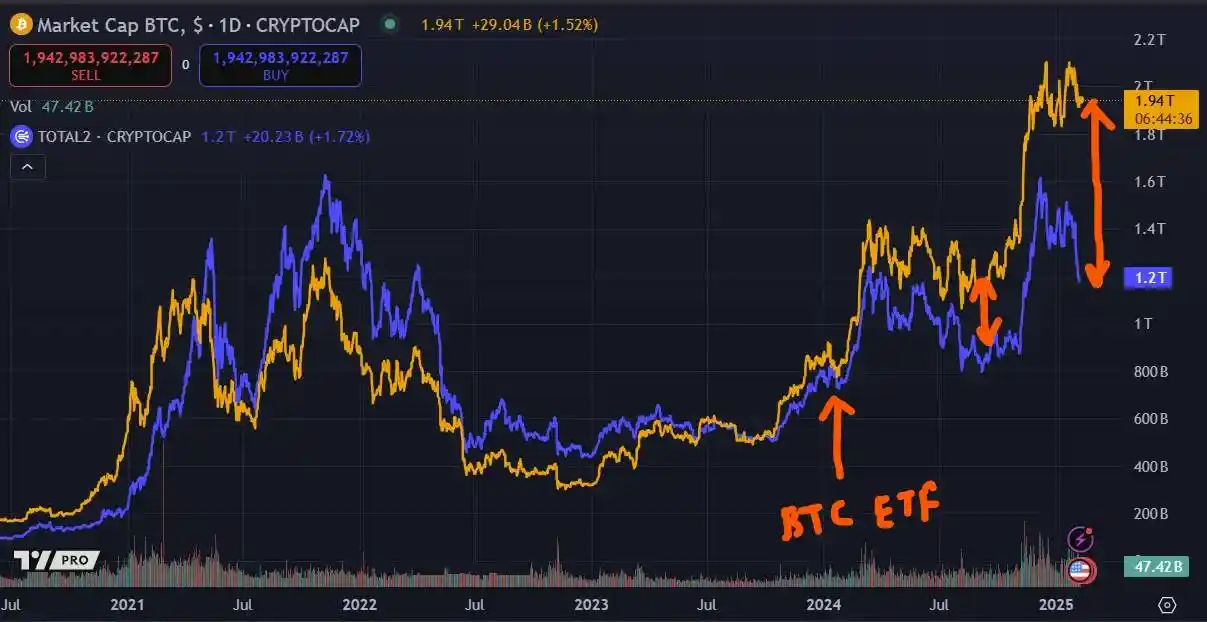
Bitcoin (BTC) is at an independent tier and differentiated from other parts of the market.
The lack of new funds flowing into altcoins leads us to a second-order effect of a zero-sum game speculative fund pool that rotates between different "casinos." This rotation has been evident in price trends over the months post-election, with speculative funds moving from Solana's AI Agent coin to Hyperliquid, then back to $TRUMP and $MELANIA. Without economic growth, the competitive zero-sum attention economy of the crypto tribes accelerates this rotation.
Another second-order effect of funds not flowing into altcoins is that it has harmed the venture capital market. The ideal scenario for a Token Generation Event (TGE) is for the infrastructure project's funding cap to be in the tens of billions of dollars, with the total addressable market (TAM) for other project categories being smaller in comparison. Due to an oversupply of capital relative to founder talent, valuations in private funding rounds have not decreased. As a result, returns in crypto venture capital are being squeezed.
2. "ETH Is Ultrasound Money."
This is no longer the case. In April 2024, the ETH supply started reversing and increasing again. In February 2025, ETH became inflationary since the merge. Therefore, the argument that ETH is a harder money than BTC is no longer valid.
The argument for ultrasound money is also somewhat nuanced. Those newly entering the crypto space would accept the scarcity narrative of "BTC as digital gold" without delving into the technical details of EIP-1559 and which of BTC or ETH is more deflationary.
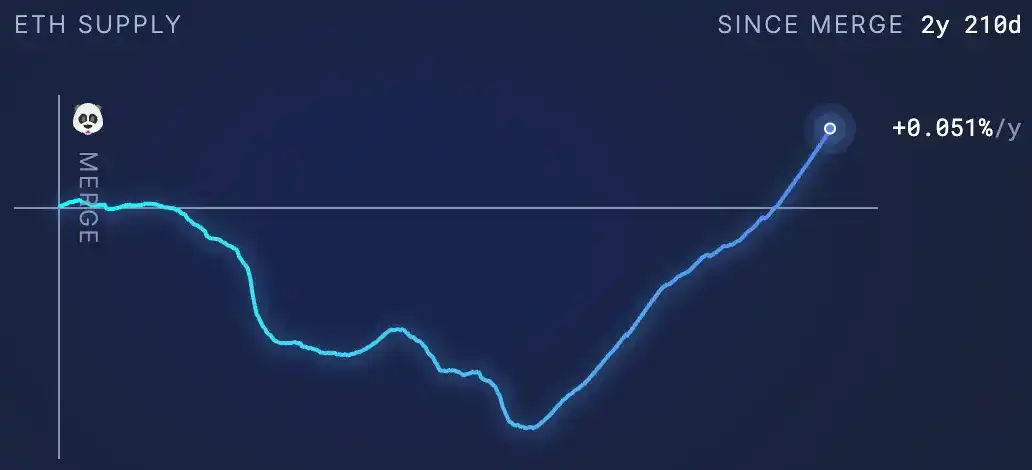
Source: ultrasound.money
3. "ETH Is Digital Oil."
The issue with this framework is that ETH would thus trade like a commodity, exhibiting sideways and range-bound movements. The value of a commodity is based on market supply and demand dynamics, rather than being a growth asset held for the long term. To illustrate this point, there are two charts below comparing the performance of oil and the S&P 500 Index over the past decade.
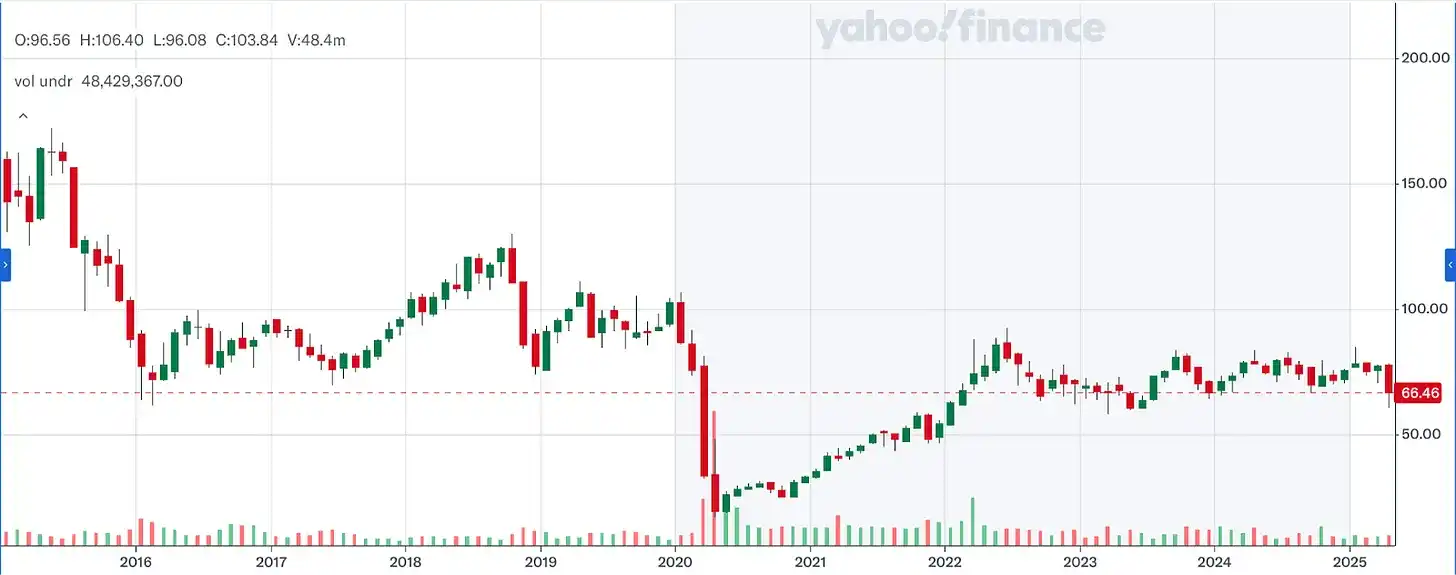
USO
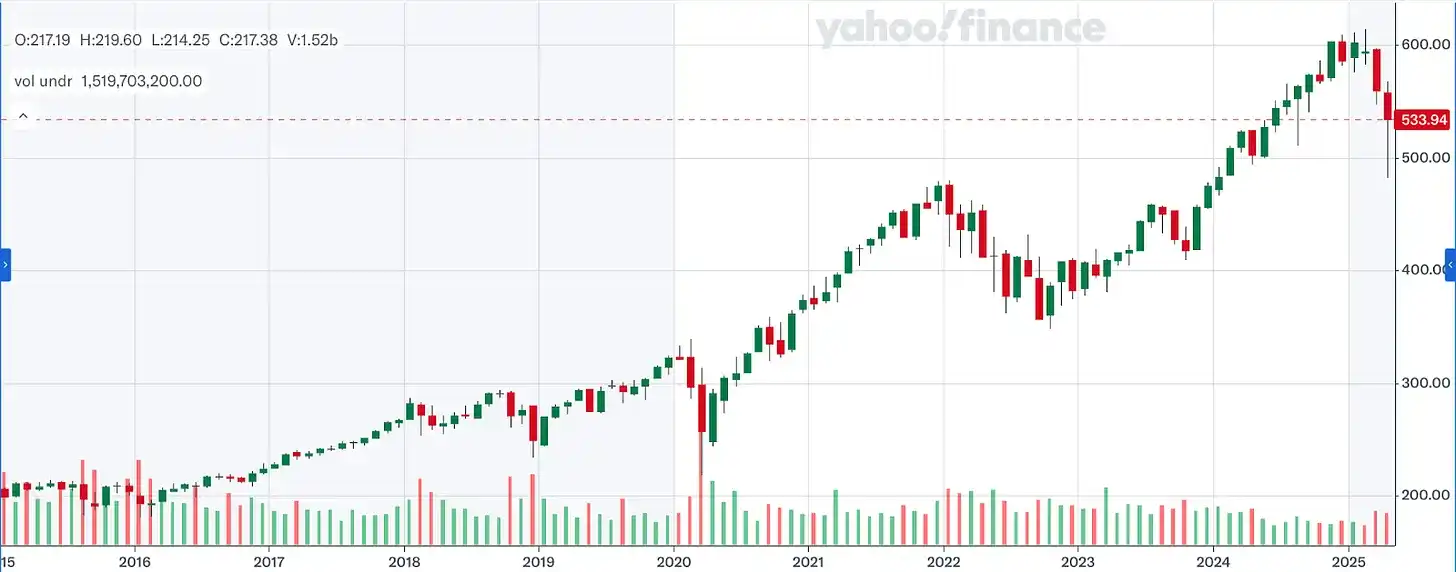
SPY
Over the past decade, oil trading has mostly been range-bound with only two exceptional events: 1) the early 2015 release of U.S. oil supply due to advancements in hydraulic fracturing technology; 2) the COVID crash in early 2020.
Using the "digital oil" framework, if ETH enters the market due to inflation again but without marginal buying demand, the price will decline.
4. "ETH Is a Global Settlement Layer."
Ethereum's long-term scaling roadmap faces an inherent contradiction between two goals: 1) Scaling will be pushed to layer 2 (L2), making Ethereum a settlement layer; 2) L2's economic activity will accrue value to ETH. When EIP-4844 significantly reduces the cost of publishing transaction data to layer 1 (L1), it improves L2 scalability but also reduces Ethereum's revenue.
The bigger issue is that when L2 introduces its own tokens, they become somewhat "parasitic" to ETH. L2 has a strong economic incentive to accumulate value to its own token rather than ETH. Therefore, apart from technical differences in the consensus mechanism, L2 behaves almost like a competing L1.
This has led to the decoupling of the Ethereum Virtual Machine (EVM) from ETH value accrual. Ethereum's greatest historical defense lies in its development tooling ecosystem around the EVM—debuggers, fuzzing tools, template contracts, etc.—all built over years of open-source development. For new developers, building on the EVM is much easier than building on a non-EVM chain without such a robust tooling infrastructure. With the decoupling of EVM and ETH, EVM adoption can continue to grow as new L2s like MegaETH and new L1s like Berachain and Monad leverage the EVM ecosystem, but the value accrues back to their native tokens rather than ETH.
5. "ETH Has the Most On-Chain Economic Activity of Any Chain."
A future scenario may arise where total value locked (TVL) in stablecoins reaches an all-time high, decentralized exchange (DEX) trading volume hits an all-time high, along with other on-chain economic activity metrics on Ethereum reaching new highs, but ETH's price has not reached an all-time high due to a price-to-earnings (P/E) multiple contraction. In this case, ETH's trading is more akin to tech stocks like Tesla (TSLA, 97x forward P/E) or Nvidia (NVDA, 24x forward P/E).
With the current annualized profit, ETH would need a 300x P/E multiple to reach a new all-time high without any price premium. Therefore, there is still significant downside risk from P/E compression.
What will happen next with ETH?
Perhaps ETH will rise due to mean reversion or continue to underperform for the reasons mentioned above.
But before that, ETH needs a new narrative.
You may also like

A pre-announced harvesting case: After the cryptocurrency price dropped by 99%, the public chain Saga exited to transform into AI
Ethereum Foundation Report: A Basic Guide to Ethereum for Governments and Financial Institutions
Portugal 2-1 Croatia: Ronaldo's 20-Year Knockout-Stage Drought Ends With a Debt Finally Collected
Portugal beat Croatia 2-1 in the 2026 global football championship's knockout rounds as Ronaldo scored his first-ever knockout-stage goal, Gonçalo Ramos struck a stoppage-time winner, and VAR ruled out a late equalizer for offside.
Bitcoin Price Prediction July 2026: Will BTC Recover to $70K or Drop Below $55K?
A South Korean company that learned the strategy of hoarding coins, from a bull market to delisting?
Where is Zhao Changpeng's billion-dollar investment going? YZi Labs' investment landscape fully revealed
Semiconductor stocks plummet, yet Anthropic wants to create a 2nm chip
WEEX API Broker Program: Turn Your Trading Platform Into a Revenue Engine
How to choose between buying discounted ETH, Bitmine, and SharpLink?
Do you want to buy CRCL?
Wosh: Inflation has cooled in recent weeks, AI is reshaping the economy, and forward guidance has lost its necessity
The most secretive AI winner
Looking at Stripe's ambitions and the future of stablecoins from OUSD
From Pump.fun to Collector Crypt: Has Solana's income throne changed hands?
Dan Bin's latest speech: Don't miss out on a great era
Robinhood launches its own blockchain, no longer wanting to be a tenant on others' chains
Why Tokenized Stocks Are Booming in 2026 While Crypto Is Still Struggling
Former ByteDance employee's account: How I started with two Pinduoduo hard drives and made six times the profit with Seagate to achieve financial freedom?
A pre-announced harvesting case: After the cryptocurrency price dropped by 99%, the public chain Saga exited to transform into AI
Ethereum Foundation Report: A Basic Guide to Ethereum for Governments and Financial Institutions
Portugal 2-1 Croatia: Ronaldo's 20-Year Knockout-Stage Drought Ends With a Debt Finally Collected
Portugal beat Croatia 2-1 in the 2026 global football championship's knockout rounds as Ronaldo scored his first-ever knockout-stage goal, Gonçalo Ramos struck a stoppage-time winner, and VAR ruled out a late equalizer for offside.
Bitcoin Price Prediction July 2026: Will BTC Recover to $70K or Drop Below $55K?
A South Korean company that learned the strategy of hoarding coins, from a bull market to delisting?
Where is Zhao Changpeng's billion-dollar investment going? YZi Labs' investment landscape fully revealed