
Feeling Cold? ETH Daily Burn Hits All-Time Low, Active Address Count Drops to Six-Month Low


Original Article Title: "Is Ethereum Being Left Behind? Daily Burn Rate Hits New Low, 'Disinflationary Asset,' ETH Active Addresses Hit Six-Month Low"
Original Article Author: James, BlockTempo from Dooqu Trending
When Ethereum implemented the London upgrade in August 2021, it introduced EIP-1559, which simplified the transaction fee mechanism and required the network to burn all ETH used to pay the base fee. The design purpose of this mechanism was to reduce inflationary pressure and potentially turn Ethereum into a deflationary asset during periods of high network activity.
Daily ETH Burn Rate Hits Historic Low
However, according to data from The Block, the Ethereum network only burned 53.07 ETH in a single day last Saturday, which, at the current price, is worth only about $10.6 thousand, setting a new historic low.
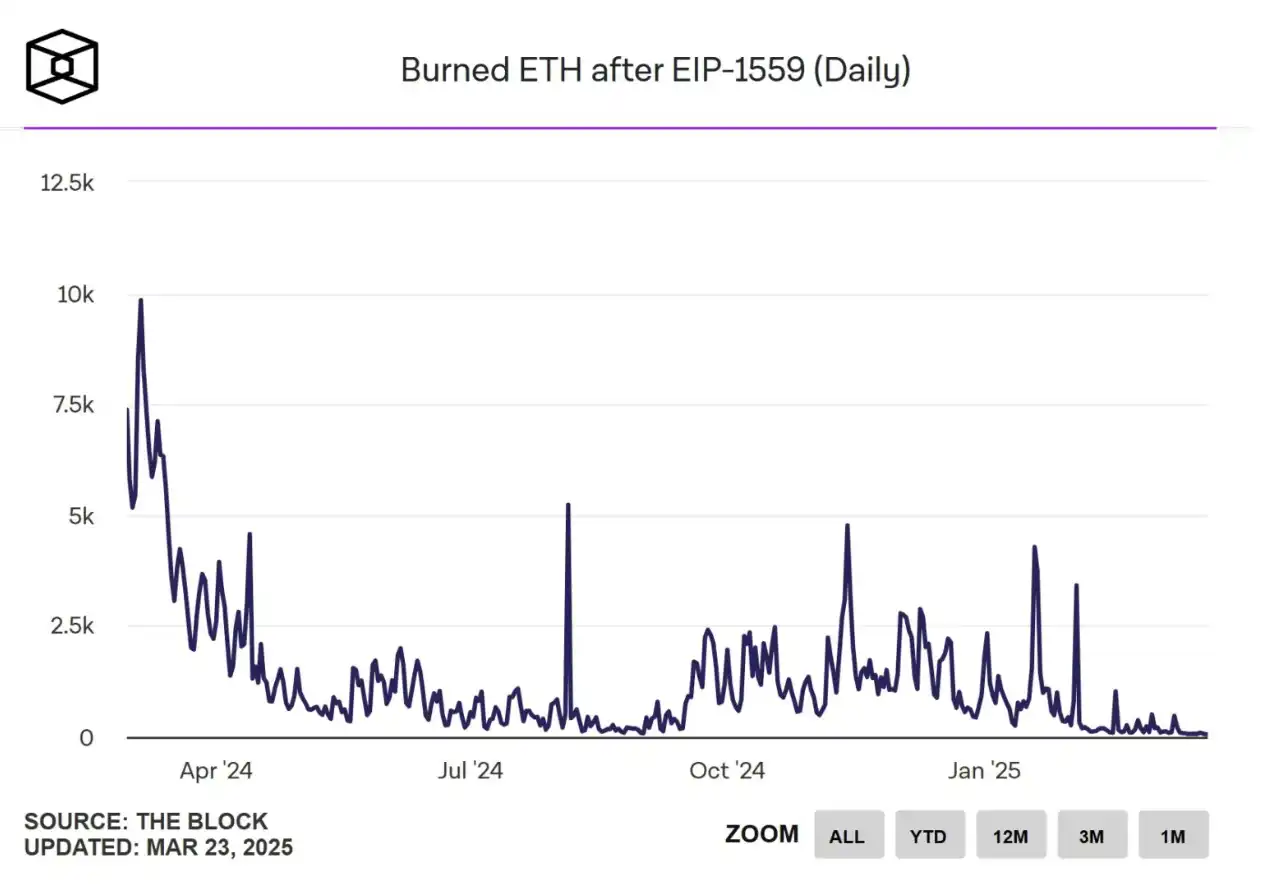
Image Source: The Block
Additionally, according to data from Ultrasound.money, if the past seven days' burn rate is considered, the estimated annual supply growth rate of Ether would be 0.76%.
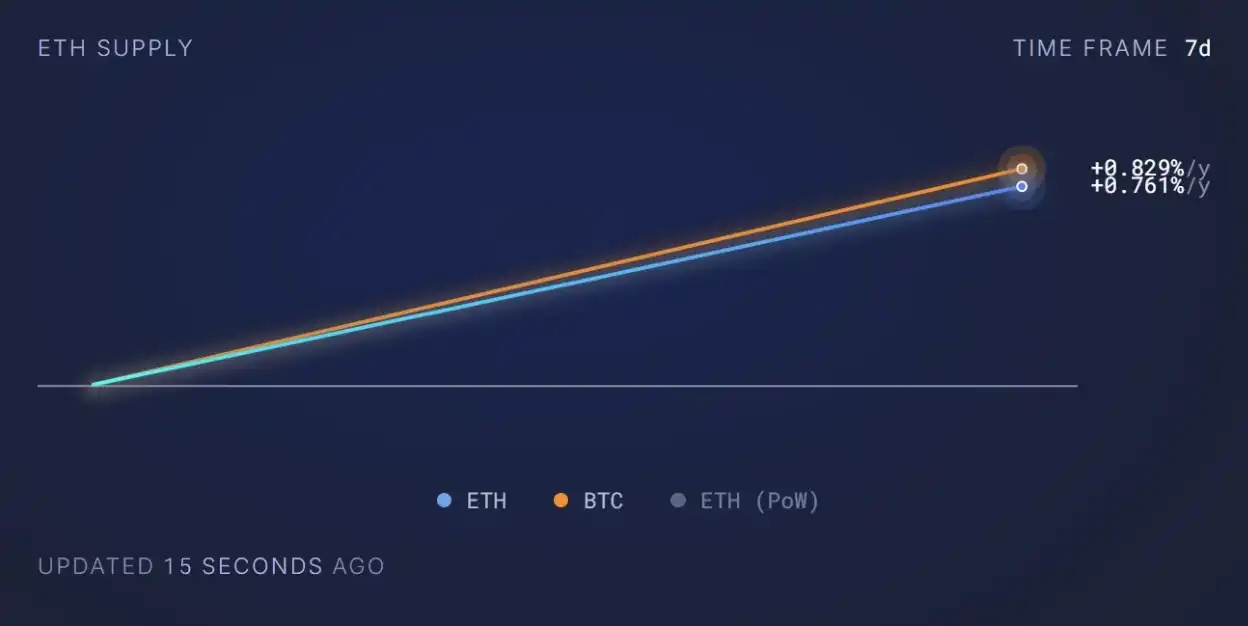
Image Source: Ultrasound.money
This low burn rate corresponds well with the decline in other Ethereum activity indicators, such as the number of active addresses. According to The Block's data, the seven-day moving average of active addresses has recently dropped to its lowest point since October 2024. New address creations, transaction counts, and daily transaction volumes have also seen declines in the past few weeks.
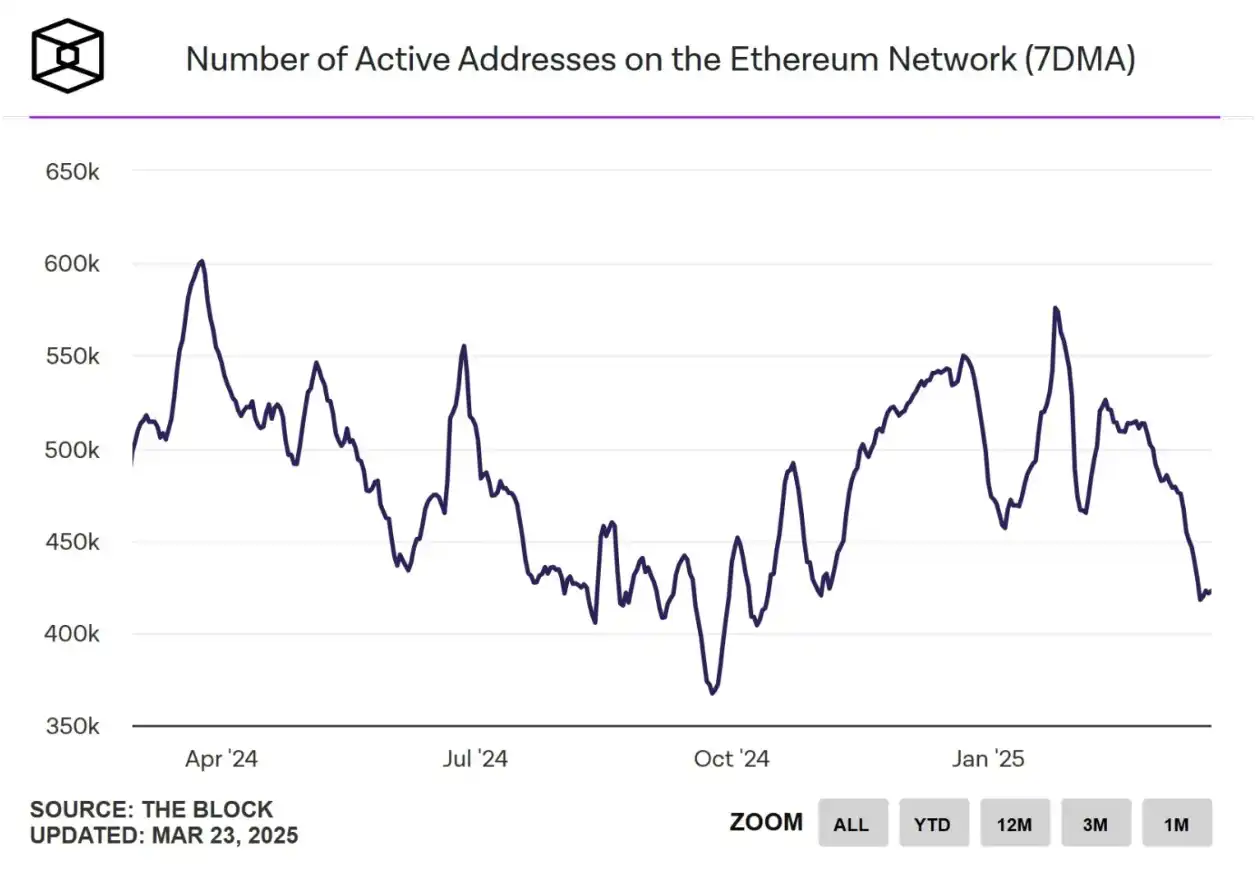
Image Source: The Block
Ethereum Foundation Considers Course Correction
During Ethereum's stagnation, Standard Chartered Bank recently significantly lowered its price forecast for Ethereum in 2025 from the original $10,000 to $4,000. This adjustment was due to the rapid growth of Ethereum's Layer 2 solutions in both number and scale.
In this report, Standard Chartered Bank points out that Ethereum is currently at a crossroads. While its various metrics still dominate the blockchain space, this dominance is gradually waning. Ethereum's proud Layer2 networks, originally intended to improve Ethereum's scalability, are now seen to have only Coinbase's Layer2 network, Base Chain, causing a $500 billion reduction in Ethereum's market cap.
To prevent this trend from continuing, Standard Chartered Bank suggests that the Ethereum Foundation needs to change its business direction, such as implementing taxes on Layer2. Additionally, if the tokenization market can experience significant growth, Ethereum may be able to maintain about an 80% share of security in this field, which could provide some support for Ethereum.
As Ethereum faces a trust crisis, Haseeb Qureshi, Managing Partner at Dragonfly, recently revealed that the Ethereum Foundation is actively responding to community feedback and considering adjusting its operational direction. The leadership is seriously contemplating how to draw lessons from other success stories, particularly Solana's Superteam model, shifting the focus from pure research to promoting project development and investment activities.
You may also like
Argentina vs Cape Verde: When a Record-Breaking Legend Meets an Unbreakable Underdog
WEEX exclusive pre-match analysis of Argentina vs Cape Verde, exploring Messi-led Argentina’s dominance and Cape Verde’s historic defensive breakout, with a breakdown of volatility, structure, and match dynamics.
How does Gate redo "buying and selling stocks" from the cryptocurrency world to the stock market?
Former ByteDance employee's account: How I started with two Pinduoduo hard drives and made six times the profit with Seagate to achieve financial freedom?
Visa and Mastercard join 140 giants to launch a new stablecoin, but the impact on the market landscape may still be limited
WEEX Launches Depth Chart for Spot Trading
MiCA reshuffle begins, Binance temporarily bids farewell to the EU
Raising interest rates to protect STRC and selling coins to maintain credit, this time the strategy has chosen the two most expensive paths
Morning Report | Samsung announces a 265.5 trillion won investment plan, focusing on semiconductor and AI computing power data centers; Vitalik publishes an article detailing the entire technology tree behind the confusion protocol (iO) mainline
In the era of AI, what is left of Bitcoin?
NeoSoul announced plans to integrate with the OKX Agentic Wallet, promoting AI agents' participation in the on-chain economy
Why Is Bitcoin Lagging Stocks in 2026? AI Stocks, ETF Outflows, and the Nasdaq Rally Explained
What you bought on CEX is really not US stocks: Analyzing the 94% liquidation monopoly and the evaporation of equity under a five-layer pipeline
In such a crowded cross-border payment arena, where is the next stop for the future?
Why Is Bitcoin Down in 2026? What We Can Learn From 2022
The large models in the United States are moving towards closure in the name of security
From the white-haired stock god to the billionaire fund mogul, the smart people shorting Nvidia are all getting rich using the same framework
Morning Report | CoinEx becomes a key hub for Iran to evade sanctions, involving over $3.8 billion in funds; Kalshi seeks a new round of financing, with a valuation potentially rising to $40 billion
Global Launch: As predictions become the most scarce asset in the AI era, Manadia is defining the next generation of the value internet
Argentina vs Cape Verde: When a Record-Breaking Legend Meets an Unbreakable Underdog
WEEX exclusive pre-match analysis of Argentina vs Cape Verde, exploring Messi-led Argentina’s dominance and Cape Verde’s historic defensive breakout, with a breakdown of volatility, structure, and match dynamics.
How does Gate redo "buying and selling stocks" from the cryptocurrency world to the stock market?
Former ByteDance employee's account: How I started with two Pinduoduo hard drives and made six times the profit with Seagate to achieve financial freedom?
Visa and Mastercard join 140 giants to launch a new stablecoin, but the impact on the market landscape may still be limited
WEEX Launches Depth Chart for Spot Trading
MiCA reshuffle begins, Binance temporarily bids farewell to the EU


