
From Binance Data: On-Chain Fund Flow - Is the Market Really in Need of Money?



Original Article Title: "Binance Data Reveals: Bull Market Still Alive!"
Original Article Author: Murphy, On-chain Data Analyst
Subconsciously, some may think that only paid data holds value, when in fact, many free datasets are also very useful. For example, after each LaunchPool event, Binance releases relevant data that contains market sentiments, fund flows, and traces of the game between whales and retail investors.
We all know that Binance has the best on-chain liquidity, attracting a massive user base and funds. Although we cannot directly access the relevant on-chain data, we can still observe some clues from limited public data.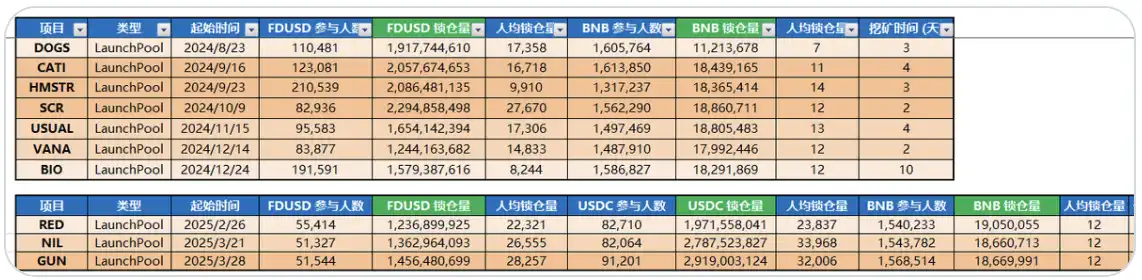
(Figure 1)
Figure 1 is a compilation of all LaunchPool-related data from August 2024 to the present. In 2024, only FDUSD and BNB could participate in LaunchPool, but in 2025, USDC was added, so we can compare the data in two parts.
From the 64th RED period to the 66th GUN period, the number of participants in each period remained relatively stable, but the amount of FDUSD and USDC locked in increased from one period to the next. Since swapping stablecoins on Binance is fee-less, theoretically, all idle stablecoins would have the incentive to participate in yield farming, including USDT. The more stablecoins participate, the more idle buying power exists within the Binance exchange.
At the same time, we also note that in these 3 events in 2025, the combined FDUSD+USDC scale was roughly between 30 billion to 40 billion USD, while in the August to December 2024 events, the quantity of FDUSD was around 15 billion to 20 billion USD, indicating that the funding scale in Q1 2025 is significantly larger than that of 2024. Some may attribute this to the addition of USDC in 2025, but I may have a different interpretation.
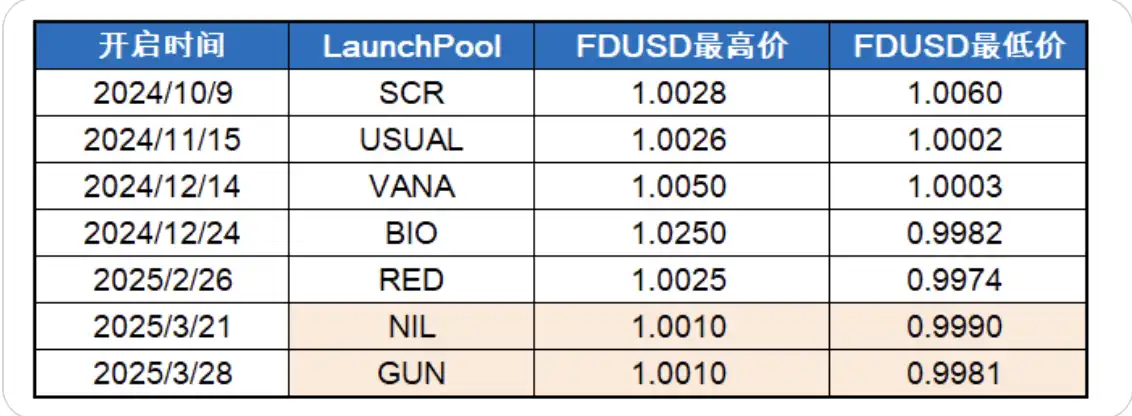
(Figure 2)
We can observe a detail: as shown in Figure 2, at the start of each LaunchPool period in 2024, FDUSD had a very high premium. This indicates a high demand for FDUSD at that time. For example, all USDT and USDC holders would convert to FDUSD to participate in mining at that moment, temporarily driving up the FDUSD exchange rate.
However, as the 25-year event began, the premium of FDUSD started to decline, indicating that the demand for FDUSD was not as high as before. The underlying reason is that USDC diverted the demand that was originally for FDUSD. Investors holding USDC do not need to exchange it for FDUSD, and some of the investors holding USDT have also switched to USDC (because after mining ended, USDC is more stable than FDUSD).
In other words, as long as funds are mostly idle, they will participate in LaunchPool. The FDUSD+USDC participants in Year 25 and the FDUSD participants in Year 24 should both be considered as the vast majority of idle funds deposited internally by the exchange. It is not solely because Binance opened a USDC participation channel in Year 25 that led to the significant increase in fund data.
Furthermore, the "per capita lockup amount" in Year 25 Q1 is also higher than in Year 24 November-December, indicating the entry into a stage dominated by whales. This means that the user base with idle purchasing power has become more dominated by "whales."
This also seems to indicate a reality: during November-December of Year 24, more whales held "coins," but by February-March of Year 25, whales held "U" instead. At this point, the market has completed a round of wealth transfer, and at the same time, whales have completed the encirclement of retail investors. They hold a large amount of idle funds and are patiently waiting for the next opportunity.
· Based on the above observations, we can draw several conclusions:
1. The idle funds in the market now are not only not decreasing compared to Year 24 but are increasing, but overall sentiment is cautious, and effective purchasing power has not been formed.
2. The increasing number of participants in LaunchPool indicates that more people have cashed out, but the funds remain in the market and are unwilling to exit, meaning that although the sentiment is cautious, it is far from being completely despairing.
3. The higher per capita lockup amount indicates that idle purchasing power is increasingly controlled by more whales; after a round of wealth redistribution, purchasing power has returned to the hands of whales. They generally believe that the bull market is not over and are therefore still waiting in the market for an opportunity.
You may also like

Former ByteDance employee's account: How I started with two Pinduoduo hard drives and made six times the profit with Seagate to achieve financial freedom?
MiCA reshuffle begins, Binance temporarily bids farewell to the EU
How does Gate redo "buying and selling stocks" from the cryptocurrency world to the stock market?
Visa and Mastercard join 140 giants to launch a new stablecoin, but the impact on the market landscape may still be limited
Circle CEO responds to OUSD's challenge: Stablecoins are a winner-takes-all business, and we will not slow down
Argentina vs Cape Verde: When a Record-Breaking Legend Meets an Unbreakable Underdog
WEEX exclusive pre-match analysis of Argentina vs Cape Verde, exploring Messi-led Argentina’s dominance and Cape Verde’s historic defensive breakout, with a breakdown of volatility, structure, and match dynamics.
WEEX Launches Depth Chart for Spot Trading
Raising interest rates to protect STRC and selling coins to maintain credit, this time the strategy has chosen the two most expensive paths
Morning Report | Samsung announces a 265.5 trillion won investment plan, focusing on semiconductor and AI computing power data centers; Vitalik publishes an article detailing the entire technology tree behind the confusion protocol (iO) mainline
In the era of AI, what is left of Bitcoin?
NeoSoul announced plans to integrate with the OKX Agentic Wallet, promoting AI agents' participation in the on-chain economy
Why Is Bitcoin Lagging Stocks in 2026? AI Stocks, ETF Outflows, and the Nasdaq Rally Explained
What you bought on CEX is really not US stocks: Analyzing the 94% liquidation monopoly and the evaporation of equity under a five-layer pipeline
In such a crowded cross-border payment arena, where is the next stop for the future?
Why Is Bitcoin Down in 2026? What We Can Learn From 2022
The large models in the United States are moving towards closure in the name of security
From the white-haired stock god to the billionaire fund mogul, the smart people shorting Nvidia are all getting rich using the same framework
Morning Report | CoinEx becomes a key hub for Iran to evade sanctions, involving over $3.8 billion in funds; Kalshi seeks a new round of financing, with a valuation potentially rising to $40 billion
Former ByteDance employee's account: How I started with two Pinduoduo hard drives and made six times the profit with Seagate to achieve financial freedom?
MiCA reshuffle begins, Binance temporarily bids farewell to the EU
How does Gate redo "buying and selling stocks" from the cryptocurrency world to the stock market?
Visa and Mastercard join 140 giants to launch a new stablecoin, but the impact on the market landscape may still be limited
Circle CEO responds to OUSD's challenge: Stablecoins are a winner-takes-all business, and we will not slow down
Argentina vs Cape Verde: When a Record-Breaking Legend Meets an Unbreakable Underdog
WEEX exclusive pre-match analysis of Argentina vs Cape Verde, exploring Messi-led Argentina’s dominance and Cape Verde’s historic defensive breakout, with a breakdown of volatility, structure, and match dynamics.