
Interpreting the Current State of the Stablecoin Race: Why Has It Become So Attractive to Institutions
Original Article Title: Stablecoin Playbook: Flipping Billions to Trillions
Original Article Author: Rui Shang, Medium Writer
Original Article Translation: zhouzhou, BlockBeats
Editor's Note: Stablecoins are driving a revolution in the financial system, especially demonstrating significant potential in improving payment efficiency, cross-border transactions, and the foreign exchange market. The traditional foreign exchange system faces high costs, low efficiency, and settlement risks, while blockchain-based forex, through decentralized exchanges, offers low costs, instant settlement, and transparency, significantly enhancing the efficiency of fund flows. The widespread adoption of stablecoins not only enhances the convenience of cross-border payments but also provides financial inclusion for underserved markets.
Below is the original content (slightly reorganized for better readability):
Introduction:
The younger generation is digital-native, and stablecoins are their native currency. With artificial intelligence and the Internet of Things driving billions of automated microtransactions, the global financial system needs a more adaptive currency solution. As a "currency API," stablecoins seamlessly transfer like internet data and reached a transaction volume of $45 trillion in 2024, a figure expected to grow as more institutions recognize stablecoins as an unparalleled business model—Tether profited $5.2 billion in the first half of 2024 by investing its reserves.
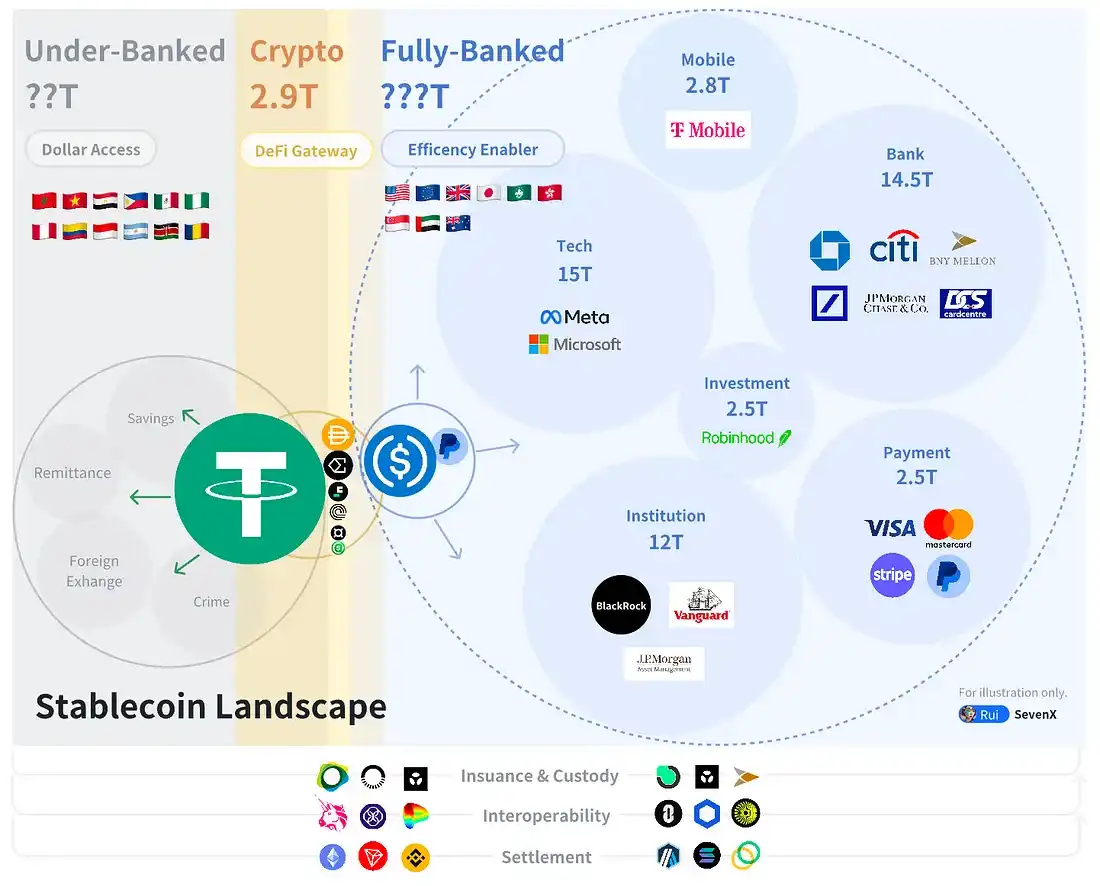
In the competition of stablecoins, distribution and real adoption are key, rather than complex cryptographic mechanisms. Their adoption is expanding in three key areas: the local crypto, fully banked, and unbanked worlds.
In the $29 trillion local crypto world, stablecoins serve as DeFi entry points, widely used for trading, lending, derivatives, yield farming, and RWA. Crypto-native stablecoins compete through liquidity incentives and DeFi integrations. In the over $400 trillion fully banked world, stablecoins enhance financial efficiency, primarily used for B2B, P2P, and B2C payments.
Stablecoins focus on regulation, licensing, and are distributed through banks, card networks, payments, and merchants. In the unbanked world, stablecoins provide dollar access, promoting financial inclusion. Stablecoins are used for savings, payments, forex, and yield generation, with entry strategies into grassroots markets being crucial.
Content Outline
Foreword:
· Native Residents of the Crypto World
· The Battle for Stablecoin Normality Peg
The Challenge of Liquidity Bootstrapping
DeFi Onramp: Trading Pairs, Lending, Derivatives, Yield, RWA
· Alien in a Fully Banked World
Dynamics of Key Players
Efficiency Drivers: B2B, P2P, C2B Payments
· Pioneer in Unbanked Worlds
Shadow Dollar Economy
Dollar Access: Savings, Payments, Forex
· Conclusion: Interwoven
Interoperability: Cross-Currency, Cross-Asset, and Cross-Chain
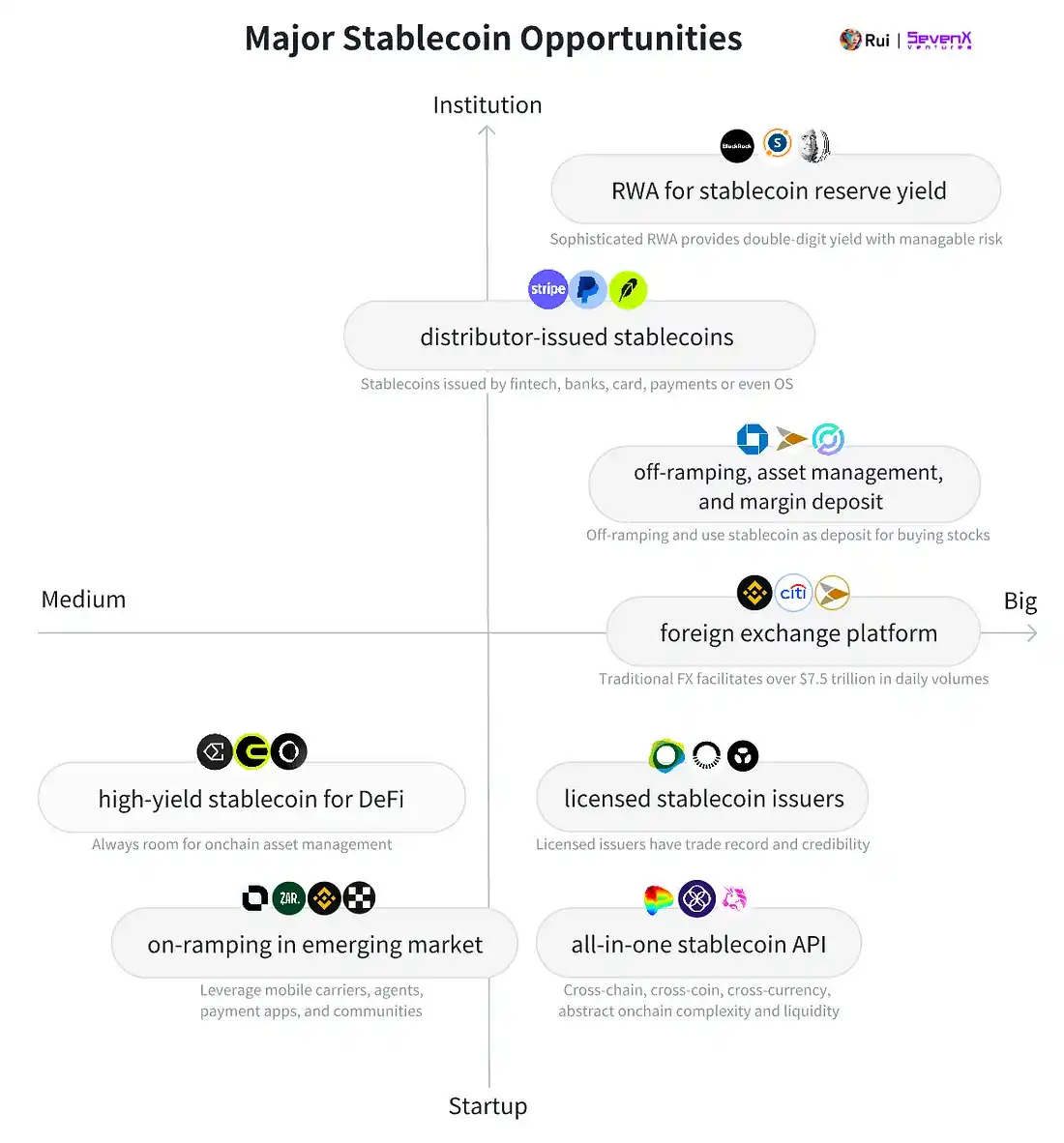
Opportunity Highlights and Unsolved Mysteries
Native Residents of the Crypto World
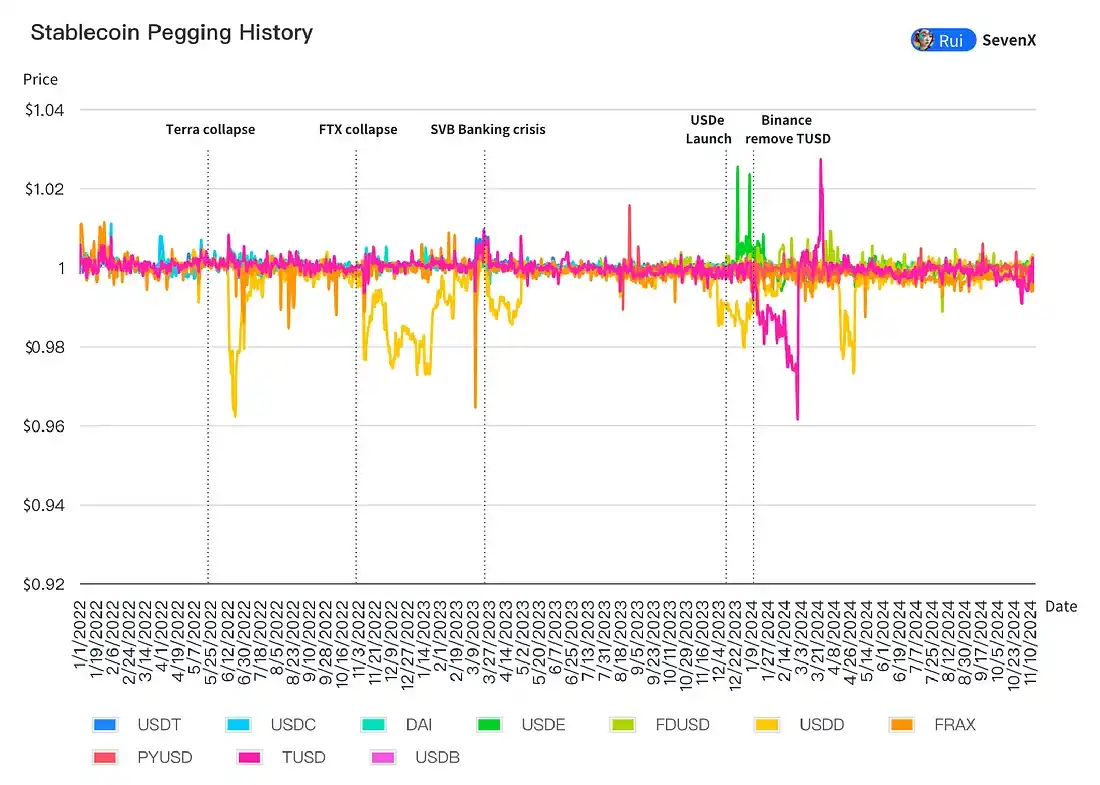
By the second quarter of 2024, stablecoins accounted for 8.2% of the entire crypto market capitalization. Maintaining peg stability remains a challenge, and unique incentive measures are key to expanding on-chain distribution, with the current core issue being the limited use cases on-chain.
Battle for Stablecoin Normality Peg
· Fiat-Backed Stablecoins Rely on Banking Relationships:
93.33% of stablecoins are fiat-backed stablecoins, offering higher stability and capital efficiency, with banks holding the ultimate redemption decision power. Regulated issuers like Paxos, able to successfully redeem billions of BUSD, have become the USD issuer for PayPal.
· CDP Stablecoins Enhance Collateral and Liquidation Mechanisms to Strengthen Peg Stability:
3.89% of stablecoins are collateralized debt position (CDP)-based stablecoins. They use cryptocurrency as collateral but face challenges in scalability and volatility. By 2024, CDPs have increased resilience by accepting a broader range of liquid and stable collateral.
Aave's GHO accepts any asset in Aave v3, while Curve's crvUSD recently added USDM (RWA). Some liquidation mechanisms have been improved, especially crvUSD's soft liquidations, utilizing its customized AMM to provide a buffer for further defaults. However, the ve-token incentive model faces challenges as the market value of crvUSD shrinks when CRV valuation drops after large-scale liquidations.
·Synthetic Dollar Maintains Stability Through Hedging:
Ethena USDe has dominated 1.67% of the stablecoin market share in a year, with a $30 billion market cap all on its own. It is a delta-neutral synthetic dollar that combats volatility by taking short positions in the derivatives market. Its funding rate is expected to perform well in the upcoming bull market, even post-"dotcom" era.
However, its heavy reliance on CEX long-term feasibility still remains questionable. With the proliferation of similar products, the impact of small funds on Ethereum may diminish. These synthetic dollars may face black swan event risks and experience low funding rates during bear markets.
·Algorithmic Stablecoins Drop to 0.56%
Liquidity Bootstrapping Challenges
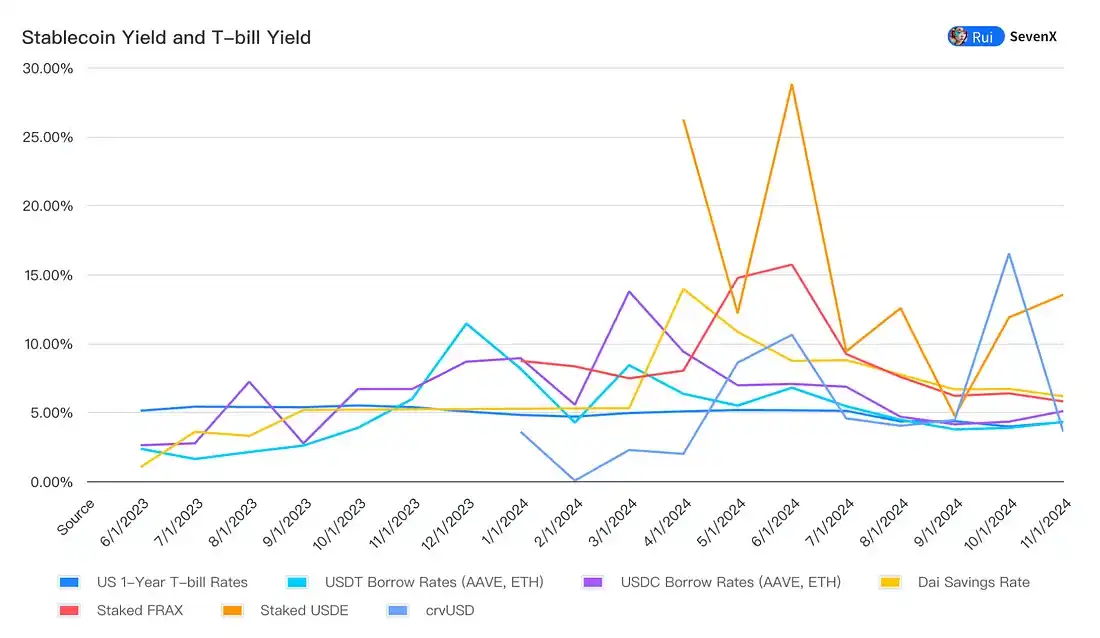
Crypto stablecoins attract liquidity through yield; fundamentally, their liquidity costs include the risk-free rate and risk premium. To remain competitive, stablecoin yields must at least match the Treasury bill (T-bill) rate—we have seen stablecoin borrowing costs drop as T-bill rates hit 5.5%.
sFrax and DAI lead in T-bill exposure, and by 2024, multiple RWA projects have enhanced on-chain T-bill composability: CrvUSD collateralizes Mountain's USDM, Ondo's USDY and Ethena's USDtb are backed by BlackRock's BUIDL.
Based on the T-bill rate, stablecoins have adopted various strategies to increase risk premiums, including fixed budget incentives (e.g., DEX volume issuance, facing constraints and death spirals), user fees (tied to lending and perpetual contract trading volume), volatility arbitrage (fall on volatility decrease), and reserve utilization such as pledging or re-pledging (less appealing).
By 2024, innovative liquidity strategies are emerging:
Maximizing In-Block Revenue:
Currently, much of the revenue comes from self-consuming DeFi inflation as an incentive, but more innovative strategies are starting to emerge. By leveraging reserves as liquidity providers, projects like CAP aim to directly channel MEV and arbitrage profits to stablecoin holders, providing a sustainable and potentially more favorable source of revenue.
Compounded with T-bill Yield:
Leveraging the newfound composability of RWA projects, plans like Usual Money (USD0) offer 'theoretically' unlimited yield through their governance tokens, with T-bill yield as a benchmark—it attracted $350 million in liquidity providers (LPs) and entered the Binance Launch Pool. Agora (AUSD) is also an offshore stablecoin based on T-bill yield.
Balancing High Yield Against Volatility:
Newer stablecoins have adopted a diversified basket strategy to avoid single-source yield and volatility risks while providing balanced high yield. For example, Fortunafi's Reservoir allocates T-bills, Hilbert, Morpho, PSM together, dynamically adjusting the ratios and incorporating other high-yield assets as needed.
Is Your TVL Just a Fad?
Stablecoin yield often faces scalability issues, where fixed-budget yield may trigger an initial peak in returns but as TVL grows, returns get diluted, and the yield effect diminishes over time. Without sustainable yield or real utility provided in trading pairs and derivatives post-incentive period, maintaining its TVL could be challenging.
The Dilemma of DeFi Entrypoints
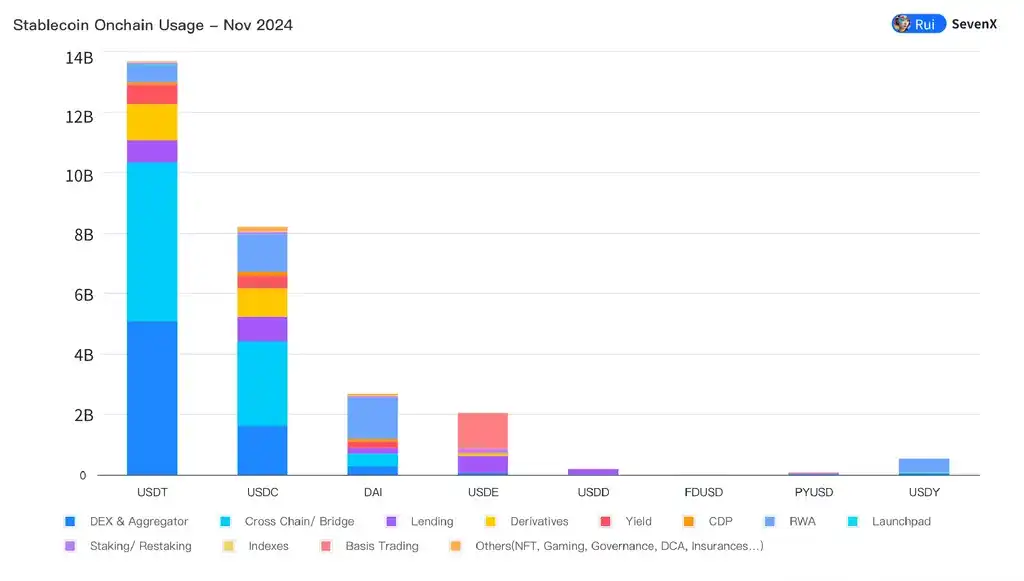
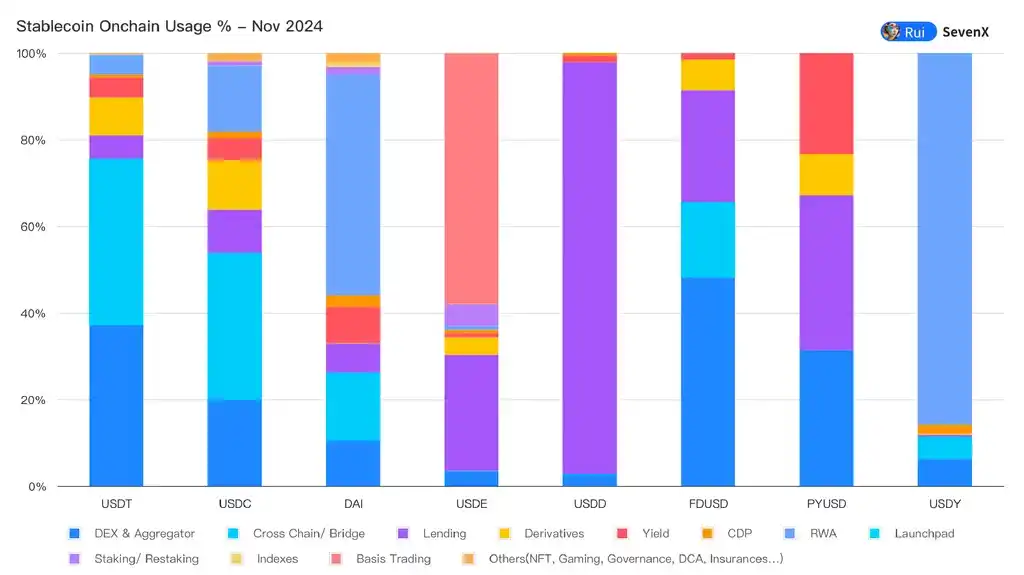
On-chain visibility allows us to examine the true nature of stablecoins: are stablecoins being used as currencies for exchange or merely financial products for yield?
Only Optimal-Interest Stablecoins Are Used as CEX Trading Pairs:
Nearly 80% of trades still occur on centralized exchanges, with top CEXs supporting their 'preferred' stablecoin (e.g., Binance using FDUSD, Coinbase using USDC). Other CEXs rely on the overflow liquidity of USDT and USDC. Furthermore, stablecoins are striving to become collateral deposits on CEXs.
Few Stablecoins Are Used as DEX Trading Pairs:
Currently, only USDT, USDC, and a small amount of DAI are used as trading pairs. Other stablecoins, such as Ethena's USDe, have 57% staked in their own protocol, purely as financial product holdings to earn yield, far from becoming a medium of exchange.
Makerdao + Curve + Morpho + Pendle, Allocation Mix:
Market preferences like Jupiter, GMX, and DYDX favor USDC as a deposit, as USDT has a more suspicious minting-redemption process. Lending platforms like Morpho and AAVE prefer USDC because of its better liquidity on Ethereum. On the other hand, PYUSD is mainly used for lending on Solana's Kamino, especially when the Solana Foundation provides incentives. Ethena's USDe is mainly used in Pendle for yield farming activities.
RWA Undervalued:
Most RWA platforms, such as BlackRock, use USDC as the minting asset, for compliance reasons, and BlackRock is also a shareholder of Circle. DAI has been successful in its RWA products.
Expand the Cake or Seek New Territories:
While stablecoins can attract major liquidity providers through incentives, they face a bottleneck—DeFi usage has been declining. Stablecoins are now in a dilemma: either they wait for the expansion of crypto-native activity or seek entirely new use cases beyond crypto.
Outsiders in a Fully Banked World
Key Players' Dynamics
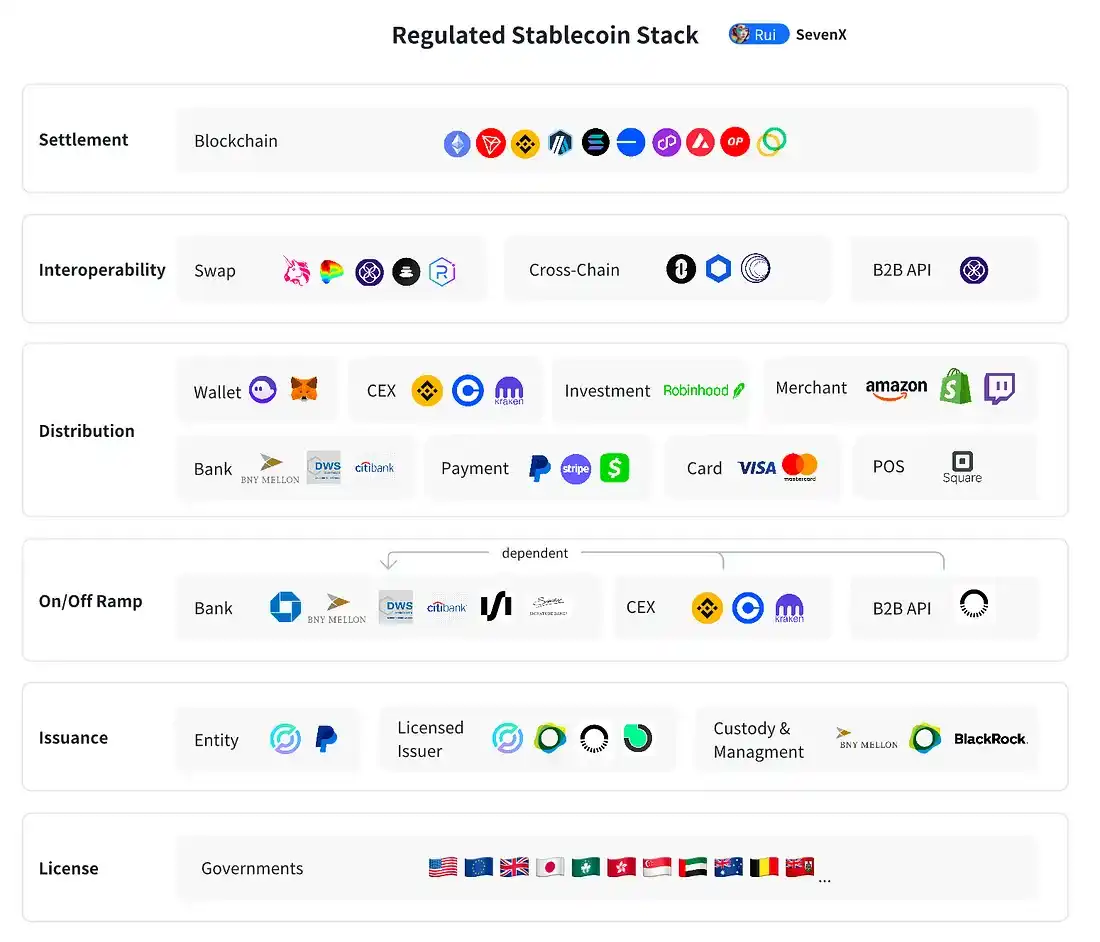
Global Regulation Becomes Clearer:
99% of stablecoins are USD-backed, with ultimate federal government control. It is expected that after the Trump presidency, the U.S. regulatory framework will be clearer, as Trump promised lower interest rates and a policy to ban CBDCs, which may benefit stablecoins. A U.S. Treasury report highlights the impact of stablecoins on short-term government bond demand, with Tether holding $90 billion in U.S. debt. Crypto crime prevention and maintaining USD dominance are also motivators.
By 2024, multiple countries have developed stablecoin-related regulations based on common principles, including approving stablecoin issuance, reserve liquidity and stability requirements, restrictions on foreign stablecoin use, and generally prohibiting interest generation. Key examples include: EU's MiCA, UAE's PTSR, Hong Kong's sandbox, Singapore's MAS, Japan's PSA. It is worth noting that Bermuda has become the first country to accept stablecoin tax payments and license interest-bearing stablecoin issuers.
Licensed Issuers Gain Trust:
Stablecoin issuance requires technological prowess, cross-jurisdictional regulatory compliance, and strong management capabilities. Key players include Paxos (PYUSD, BUSD), Brale (USC), and Bridge (B2B API). Reserve management is overseen by trusted institutions like BNY Mellon, for example, USDC, securely generating yields by investing in funds managed by BlackRock. BUIDL now allows more on-chain projects to earn income.
The Bank as the Off-Ramp Gatekeeper:
While on-ramping (fiat to stablecoin) has become easier, off-ramping (stablecoin to fiat) still poses a challenge as banks find it difficult to verify the source of funds. Banks are more inclined to choose licensed exchanges like Coinbase and Kraken, which conduct KYC/KYB and have similar AML frameworks.
Although reputable banks like Standard Chartered have started accepting off-ramping, smaller banks like DBS Bank in Singapore are speeding up this process. B2B services like Bridge have consolidated off-ramp channels, managing billions in transaction volumes for high-profile clients including SpaceX and the U.S. government.
Distributors Hold the Ultimate Decision Power:
As a leader in compliant stablecoins, Circle relies on Coinbase and is now seeking global licenses and partnerships. However, with more institutions issuing their own stablecoins, this strategy may face challenges as this business model is unparalleled—Tether, with a workforce of 100, made $5.2 billion in profit from its reserves in the first half of 2024.
Banks such as JPMorgan have introduced JPM Coin for institutional transactions. Payment apps like Stripe acquiring Bridge indicate their interest in owning a stablecoin stack, not just integrating USDC. PayPal has also issued PYUSD to capture reserve earnings. Card network companies like Visa and Mastercard are testing markets by accepting stablecoins.
Efficiency Enabler
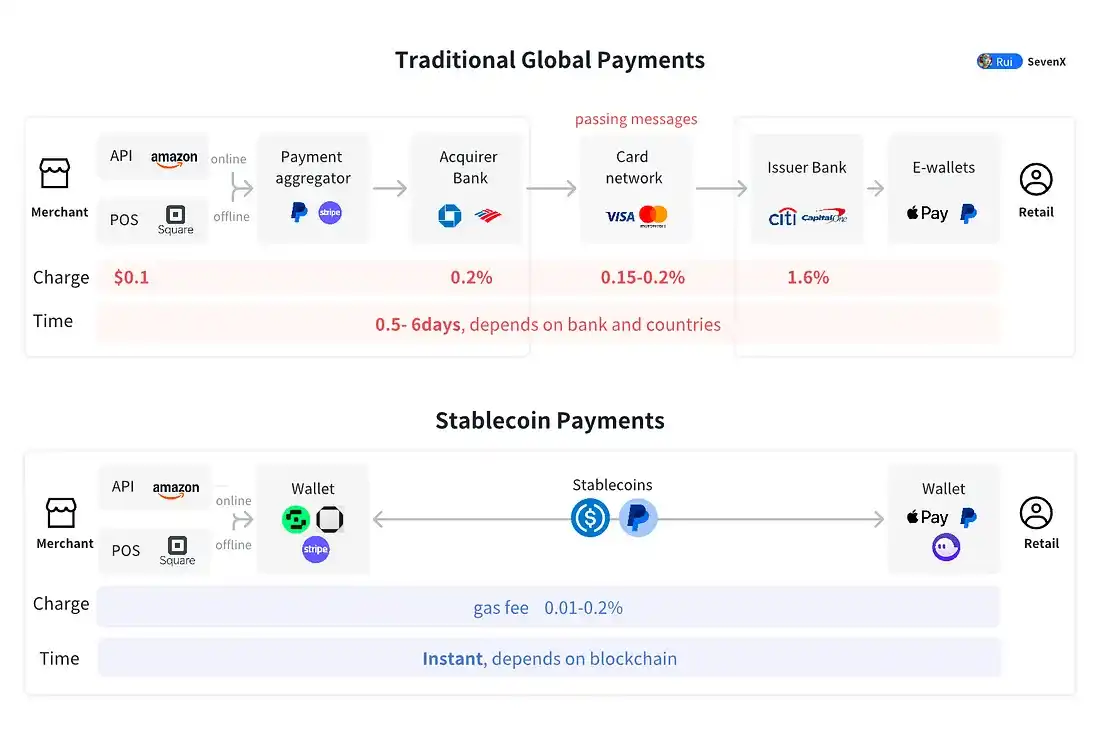
With trusted issuers, healthy bank relationships, and distributors as the foundation, stablecoins can enhance efficiency in the large-scale financial system, especially in the payments sector.
Traditional systems face efficiency and cost limitations. Internal applications or bank transfers provide instant settlement but are limited to their ecosystem. The cost of cross-bank payments is about 2.6% (70% going to the issuing bank, 20% to the acquiring bank, 10% to card networks), with settlements taking over a day. Cross-border transactions are even more expensive, around 6.25%, with settlement times of up to five days.
Stablecoin payments facilitate peer-to-peer instant settlement by eliminating intermediaries. This accelerates fund movement, reduces capital costs, and provides programmable features such as conditional automatic payments.
·B2B (Annual Transaction Volume of $120–150 Trillion): Banks are in a prime position to drive the adoption of stablecoins. In October 2023, JPM Coin, developed by JPMorgan Chase, has been used for daily transactions of around $1 billion on its Quorum chain.
·P2P (Annual Transaction Volume of $1.8–2 Trillion): E-wallets and mobile payment apps are well-positioned, with PayPal launching PYUSD, currently valued at $6.04 billion on Ethereum and Solana. PayPal allows end users to register and send PYUSD for free.
·B2C E-commerce (Annual Transaction Volume of $5.5–6 Trillion): Stablecoins need to integrate with POS systems, bank APIs, and card networks. As early as 2021, Visa became the first payment network to settle transactions using USDC.
Pioneering the "Underbanked" World, the Shadow Dollar Economy
Due to severe currency devaluation and economic instability, emerging markets have a critical need for stablecoins. In Turkey, stablecoin purchases account for 3.7% of its GDP. People and businesses are willing to pay a premium above the fiat US dollar for stablecoins, with Argentina's stablecoin premium reaching 30.5% and Nigeria at 22.1%. Stablecoins provide access to the dollar and financial inclusivity.
Tether dominates this space with a reliable 10-year track record. Even amidst complex banking relationships and redemption crises—Tether once admitted in April 2019 that USDT was only backed by 70% reserves—its stability has endured.
This is because Tether has built a robust shadow dollar economy: in emerging markets, few convert USDT back to fiat; they see it as dollars, especially prominent in Africa and Latin America, used for paying employees, bills, etc. Tether has achieved this without providing incentives through its long-standing presence and consistent utility, enhancing its credibility and acceptance. This should be the ultimate goal for every stablecoin.
Dollar Access
· Remittances: Remittance inequality hinders economic growth. Active individuals in Sub-Saharan Africa face an average remittance cost of 8.5% when sending money to low- and middle-income countries and developed nations. For businesses, high remittance costs, long processing times, bureaucracy, and exchange rate risks directly impact growth and competitiveness in the region.
·Dollarization: Currency fluctuations have caused a cost of $1.2 trillion in GDP loss for 17 developing countries from 1992 to 2022, representing 9.4% of their total GDP. Dollarization is crucial for local financial development. Many crypto projects focus on entry through the "DePIN" method, which leverages local agents to facilitate cash to stablecoin transactions in Africa, Latin America, and Pakistan.
·Forex: Today, the daily trading volume of the forex market exceeds $7.5 trillion. In the Global South, individuals often convert their local fiat into USD through the black market, mainly because the black market exchange rate is more favorable than the official channels. Binance's P2P trading has started to be adopted, but due to its order book model, it lacks flexibility. Many projects, such as ViFi, are building on-chain automated market maker forex solutions.
·Humanitarian Aid Distribution: Ukrainian war refugees can receive humanitarian aid in the form of USDC, which can be stored in a digital wallet or cashed out locally. In Venezuela, frontline healthcare workers used USDC to pay for medical supplies during the pandemic, despite facing a deepening political and economic crisis.
Conclusion: Interconnectivity
Interoperability: With the widespread adoption of stablecoins and integration of different ecosystems, interoperability becomes a core challenge and opportunity in the future development of stablecoins. Enhancing liquidity across currencies, blockchains, and monetary systems will be key to driving progress in this field.
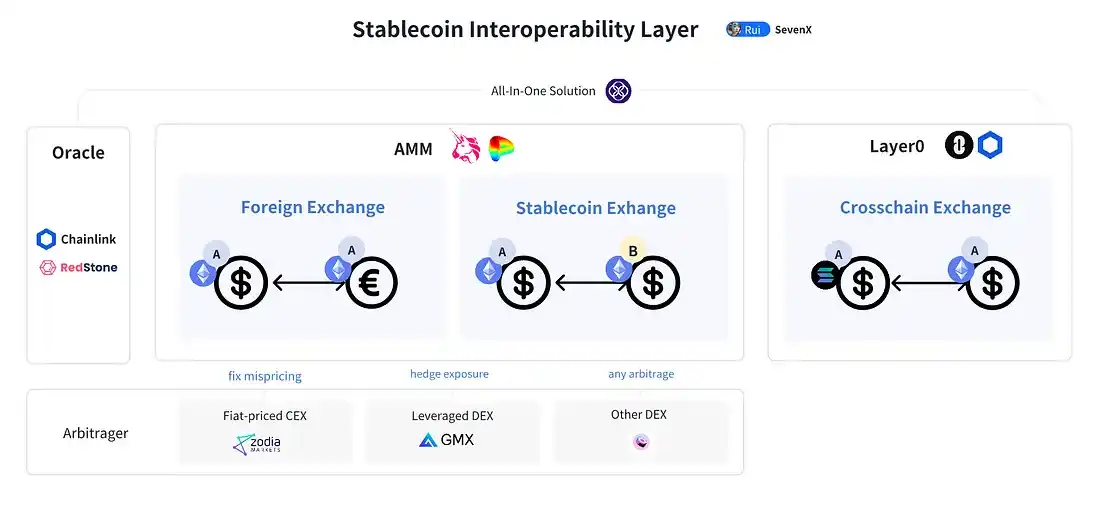
Traditional Forex Systems are inefficient and face multiple challenges:
· Counterparty Settlement Risk (CLS has been strengthened but still cumbersome)
· Multi-bank system costs (e.g., for an Australian bank to purchase yen, six banks need to participate, and the transaction needs to go through the London USD office)
· Global settlement time zone differences (e.g., the bank systems for CAD and JPY overlap for less than five hours each day)
· Limited access to the forex market (retail users pay fees 100 times higher than large institutions)
Blockchain Forex (Onchain FX) offers significant advantages:
· Cost, efficiency, and transparency: Oracles like Redstone and Chainlink provide real-time price feeds. Decentralized exchanges offer efficient cost control and transparency, and Uniswap's Concentrated Liquidity Market Makers (CLMM) reduce trading costs to 0.15-0.25%, roughly 90% lower than traditional forex. Moving from T+2 bank settlements to instant settlement, arbitrageurs can employ various strategies to correct pricing imbalances.
· Flexibility and Accessibility: Blockchain Forex enables corporate treasurers and asset managers to access various products without the need for multiple currency-specific bank accounts. Retail users can use a crypto wallet with an embedded DEX API to obtain the best forex rates.
· Currency Jurisdiction Separation: Transactions no longer require domestic banks, allowing for the separation of currency and jurisdiction. This approach leverages digital efficiency while maintaining currency sovereignty, but it comes with pros and cons.
However, challenges still exist, including the scarcity of non-USD denominated digital assets, oracle security, support for long-tail currencies, regulatory issues, and the unified on-chain/off-chain interface. Nonetheless, blockchain forex still offers lucrative opportunities. For example, Citigroup is developing a blockchain forex solution under the guidance of the Monetary Authority of Singapore.
Stablecoin Exchange
In a world where most companies issue their own stablecoins, a challenge posed by stablecoin exchanges is how to enable using PayPal's PYUSD to pay a JP Morgan merchant. While on/off-chain bridges can address this issue, they lose the efficiency of cryptocurrency settlement. Blockchain automated market makers offer optimal real-time low-cost stablecoin-to-stablecoin trading.
For instance, Uniswap offers some of these liquidity pools with fees as low as 0.01%. However, once billions of dollars flow into blockchain, they must rely on smart contract security and must have deep enough liquidity and instant performance to support real-world activities.
Cross-chain Exchange
Main blockchains have their own advantages and disadvantages, leading to the need for stablecoins to be deployed on multiple chains. The multi-chain approach poses challenges for cross-chain transactions, and bridge technologies come with significant security risks. In my view, stablecoins should introduce their own Layer 0 protocol, such as USDC's CCTP, PYUSD's Layer 0 integration, and a similar Layer 0-like solution that USDT might introduce for redeeming bridged locked tokens.
Meanwhile, there are still some open questions:
· Will regulation harm "open finance," considering compliant stablecoins may be subject to fund surveillance, freezing, and extraction?
· Can compliant stablecoins still avoid offering returns that could be deemed securities, thereby preventing decentralized finance on-chain from benefiting from its large-scale expansion?
· Can any open blockchain handle massive funds, considering Ethereum's slow transactions, its L2 reliance on a single sequencer, Solana's imperfect uptime record, and other hyped blockchains lacking a long-term stable track record?
· Would Separating Currency and Jurisdiction Bring More Chaos or Opportunity?
The prospect of a financial revolution led by stablecoins is both exciting and full of uncertainty — a new chapter where regulation and freedom dance in a delicate balance.
You may also like

Token Cannot Compound, Where Is the Real Investment Opportunity?

February 6th Market Key Intelligence, How Much Did You Miss?

China's Central Bank and Eight Other Departments' Latest Regulatory Focus: Key Attention to RWA Tokenized Asset Risk
Foreword: Today, the People's Bank of China's website published the "Notice of the People's Bank of China, National Development and Reform Commission, Ministry of Industry and Information Technology, Ministry of Public Security, State Administration for Market Regulation, China Banking and Insurance Regulatory Commission, China Securities Regulatory Commission, State Administration of Foreign Exchange on Further Preventing and Dealing with Risks Related to Virtual Currency and Others (Yinfa [2026] No. 42)", the latest regulatory requirements from the eight departments including the central bank, which are basically consistent with the regulatory requirements of recent years. The main focus of the regulation is on speculative activities such as virtual currency trading, exchanges, ICOs, overseas platform services, and this time, regulatory oversight of RWA has been added, explicitly prohibiting RWA tokenization, stablecoins (especially those pegged to the RMB). The following is the full text:
To the people's governments of all provinces, autonomous regions, and municipalities directly under the Central Government, the Xinjiang Production and Construction Corps:
Recently, there have been speculative activities related to virtual currency and Real-World Assets (RWA) tokenization, disrupting the economic and financial order and jeopardizing the property security of the people. In order to further prevent and address the risks related to virtual currency and Real-World Assets tokenization, effectively safeguard national security and social stability, in accordance with the "Law of the People's Republic of China on the People's Bank of China," "Law of the People's Republic of China on Commercial Banks," "Securities Law of the People's Republic of China," "Law of the People's Republic of China on Securities Investment Funds," "Law of the People's Republic of China on Futures and Derivatives," "Cybersecurity Law of the People's Republic of China," "Regulations of the People's Republic of China on the Administration of Renminbi," "Regulations on Prevention and Disposal of Illegal Fundraising," "Regulations of the People's Republic of China on Foreign Exchange Administration," "Telecommunications Regulations of the People's Republic of China," and other provisions, after reaching consensus with the Cyberspace Administration of China, the Supreme People's Court, and the Supreme People's Procuratorate, and with the approval of the State Council, the relevant matters are notified as follows:
(I) Virtual currency does not possess the legal status equivalent to fiat currency. Virtual currencies such as Bitcoin, Ether, Tether, etc., have the main characteristics of being issued by non-monetary authorities, using encryption technology and distributed ledger or similar technology, existing in digital form, etc. They do not have legal tender status, should not and cannot be circulated and used as currency in the market.
The business activities related to virtual currency are classified as illegal financial activities. The exchange of fiat currency and virtual currency within the territory, exchange of virtual currencies, acting as a central counterparty in buying and selling virtual currencies, providing information intermediary and pricing services for virtual currency transactions, token issuance financing, and trading of virtual currency-related financial products, etc., fall under illegal financial activities, such as suspected illegal issuance of token vouchers, unauthorized public issuance of securities, illegal operation of securities and futures business, illegal fundraising, etc., are strictly prohibited across the board and resolutely banned in accordance with the law. Overseas entities and individuals are not allowed to provide virtual currency-related services to domestic entities in any form.
A stablecoin pegged to a fiat currency indirectly fulfills some functions of the fiat currency in circulation. Without the consent of relevant authorities in accordance with the law and regulations, any domestic or foreign entity or individual is not allowed to issue a RMB-pegged stablecoin overseas.
(II)Tokenization of Real-World Assets refers to the use of encryption technology and distributed ledger or similar technologies to transform ownership rights, income rights, etc., of assets into tokens (tokens) or other interests or bond certificates with token (token) characteristics, and carry out issuance and trading activities.
Engaging in the tokenization of real-world assets domestically, as well as providing related intermediary, information technology services, etc., which are suspected of illegal issuance of token vouchers, unauthorized public offering of securities, illegal operation of securities and futures business, illegal fundraising, and other illegal financial activities, shall be prohibited; except for relevant business activities carried out with the approval of the competent authorities in accordance with the law and regulations and relying on specific financial infrastructures. Overseas entities and individuals are not allowed to illegally provide services related to the tokenization of real-world assets to domestic entities in any form.
(III) Inter-agency Coordination. The People's Bank of China, together with the National Development and Reform Commission, the Ministry of Industry and Information Technology, the Ministry of Public Security, the State Administration for Market Regulation, the China Banking and Insurance Regulatory Commission, the China Securities Regulatory Commission, the State Administration of Foreign Exchange, and other departments, will improve the work mechanism, strengthen coordination with the Cyberspace Administration of China, the Supreme People's Court, and the Supreme People's Procuratorate, coordinate efforts, and overall guide regions to carry out risk prevention and disposal of virtual currency-related illegal financial activities.
The China Securities Regulatory Commission, together with the National Development and Reform Commission, the Ministry of Industry and Information Technology, the Ministry of Public Security, the People's Bank of China, the State Administration for Market Regulation, the China Banking and Insurance Regulatory Commission, the State Administration of Foreign Exchange, and other departments, will improve the work mechanism, strengthen coordination with the Cyberspace Administration of China, the Supreme People's Court, and the Supreme People's Procuratorate, coordinate efforts, and overall guide regions to carry out risk prevention and disposal of illegal financial activities related to the tokenization of real-world assets.
(IV) Strengthening Local Implementation. The people's governments at the provincial level are overall responsible for the prevention and disposal of risks related to virtual currencies and the tokenization of real-world assets in their respective administrative regions. The specific leading department is the local financial regulatory department, with participation from branches and dispatched institutions of the State Council's financial regulatory department, telecommunications regulators, public security, market supervision, and other departments, in coordination with cyberspace departments, courts, and procuratorates, to improve the normalization of the work mechanism, effectively connect with the relevant work mechanisms of central departments, form a cooperative and coordinated working pattern between central and local governments, effectively prevent and properly handle risks related to virtual currencies and the tokenization of real-world assets, and maintain economic and financial order and social stability.
(5) Enhanced Risk Monitoring. The People's Bank of China, China Securities Regulatory Commission, National Development and Reform Commission, Ministry of Industry and Information Technology, Ministry of Public Security, State Administration of Foreign Exchange, Cyberspace Administration of China, and other departments continue to improve monitoring techniques and system support, enhance cross-departmental data analysis and sharing, establish sound information sharing and cross-validation mechanisms, promptly grasp the risk situation of activities related to virtual currency and real-world asset tokenization. Local governments at all levels give full play to the role of local monitoring and early warning mechanisms. Local financial regulatory authorities, together with branches and agencies of the State Council's financial regulatory authorities, as well as departments of cyberspace and public security, ensure effective connection between online monitoring, offline investigation, and fund tracking, efficiently and accurately identify activities related to virtual currency and real-world asset tokenization, promptly share risk information, improve early warning information dissemination, verification, and rapid response mechanisms.
(6) Strengthened Oversight of Financial Institutions, Intermediaries, and Technology Service Providers. Financial institutions (including non-bank payment institutions) are prohibited from providing account opening, fund transfer, and clearing services for virtual currency-related business activities, issuing and selling financial products related to virtual currency, including virtual currency and related financial products in the scope of collateral, conducting insurance business related to virtual currency, or including virtual currency in the scope of insurance liability. Financial institutions (including non-bank payment institutions) are prohibited from providing custody, clearing, and settlement services for unauthorized real-world asset tokenization-related business and related financial products. Relevant intermediary institutions and information technology service providers are prohibited from providing intermediary, technical, or other services for unauthorized real-world asset tokenization-related businesses and related financial products.
(7) Enhanced Management of Internet Information Content and Access. Internet enterprises are prohibited from providing online business venues, commercial displays, marketing, advertising, or paid traffic diversion services for virtual currency and real-world asset tokenization-related business activities. Upon discovering clues of illegal activities, they should promptly report to relevant departments and provide technical support and assistance for related investigations and inquiries. Based on the clues transferred by the financial regulatory authorities, the cyberspace administration, telecommunications authorities, and public security departments should promptly close and deal with websites, mobile applications (including mini-programs), and public accounts engaged in virtual currency and real-world asset tokenization-related business activities in accordance with the law.
(8) Strengthened Entity Registration and Advertisement Management. Market supervision departments strengthen entity registration and management, and enterprise and individual business registrations must not contain terms such as "virtual currency," "virtual asset," "cryptocurrency," "crypto asset," "stablecoin," "real-world asset tokenization," or "RWA" in their names or business scopes. Market supervision departments, together with financial regulatory authorities, legally enhance the supervision of advertisements related to virtual currency and real-world asset tokenization, promptly investigating and handling relevant illegal advertisements.
(IX) Continued Rectification of Virtual Currency Mining Activities. The National Development and Reform Commission, together with relevant departments, strictly controls virtual currency mining activities, continuously promotes the rectification of virtual currency mining activities. The people's governments of various provinces take overall responsibility for the rectification of "mining" within their respective administrative regions. In accordance with the requirements of the National Development and Reform Commission and other departments in the "Notice on the Rectification of Virtual Currency Mining Activities" (NDRC Energy-saving Building [2021] No. 1283) and the provisions of the "Guidance Catalog for Industrial Structure Adjustment (2024 Edition)," a comprehensive review, investigation, and closure of existing virtual currency mining projects are conducted, new mining projects are strictly prohibited, and mining machine production enterprises are strictly prohibited from providing mining machine sales and other services within the country.
(X) Severe Crackdown on Related Illegal Financial Activities. Upon discovering clues to illegal financial activities related to virtual currency and the tokenization of real-world assets, local financial regulatory authorities, branches of the State Council's financial regulatory authorities, and other relevant departments promptly investigate, determine, and properly handle the issues in accordance with the law, and seriously hold the relevant entities and individuals legally responsible. Those suspected of crimes are transferred to the judicial authorities for processing according to the law.
(XI) Severe Crackdown on Related Illegal and Criminal Activities. The Ministry of Public Security, the People's Bank of China, the State Administration for Market Regulation, the China Banking and Insurance Regulatory Commission, the China Securities Regulatory Commission, as well as judicial and procuratorial organs, in accordance with their respective responsibilities, rigorously crack down on illegal and criminal activities related to virtual currency, the tokenization of real-world assets, such as fraud, money laundering, illegal business operations, pyramid schemes, illegal fundraising, and other illegal and criminal activities carried out under the guise of virtual currency, the tokenization of real-world assets, etc.
(XII) Strengthen Industry Self-discipline. Relevant industry associations should enhance membership management and policy advocacy, based on their own responsibilities, advocate and urge member units to resist illegal financial activities related to virtual currency and the tokenization of real-world assets. Member units that violate regulatory policies and industry self-discipline rules are to be disciplined in accordance with relevant self-regulatory management regulations. By leveraging various industry infrastructure, conduct risk monitoring related to virtual currency, the tokenization of real-world assets, and promptly transfer issue clues to relevant departments.
(XIII) Without the approval of relevant departments in accordance with the law and regulations, domestic entities and foreign entities controlled by them may not issue virtual currency overseas.
(XIV) Domestic entities engaging directly or indirectly in overseas external debt-based tokenization of real-world assets, or conducting asset securitization activities abroad based on domestic ownership rights, income rights, etc. (hereinafter referred to as domestic equity), should be strictly regulated in accordance with the principles of "same business, same risk, same rules." The National Development and Reform Commission, the China Securities Regulatory Commission, the State Administration of Foreign Exchange, and other relevant departments regulate it according to their respective responsibilities. For other forms of overseas real-world asset tokenization activities based on domestic equity by domestic entities, the China Securities Regulatory Commission, together with relevant departments, supervise according to their division of responsibilities. Without the consent and filing of relevant departments, no unit or individual may engage in the above-mentioned business.
(15) Overseas subsidiaries and branches of domestic financial institutions providing Real World Asset Tokenization-related services overseas shall do so legally and prudently. They shall have professional personnel and systems in place to effectively mitigate business risks, strictly implement customer onboarding, suitability management, anti-money laundering requirements, and incorporate them into the domestic financial institutions' compliance and risk management system. Intermediaries and information technology service providers offering Real World Asset Tokenization services abroad based on domestic equity or conducting Real World Asset Tokenization business in the form of overseas debt for domestic entities directly or indirectly venturing abroad must strictly comply with relevant laws and regulations. They should establish and improve relevant compliance and internal control systems in accordance with relevant normative requirements, strengthen business and risk control, and report the business developments to the relevant regulatory authorities for approval or filing.
(16) Strengthen organizational leadership and overall coordination. All departments and regions should attach great importance to the prevention of risks related to virtual currencies and Real World Asset Tokenization, strengthen organizational leadership, clarify work responsibilities, form a long-term effective working mechanism with centralized coordination, local implementation, and shared responsibilities, maintain high pressure, dynamically monitor risks, effectively prevent and mitigate risks in an orderly and efficient manner, legally protect the property security of the people, and make every effort to maintain economic and financial order and social stability.
(17) Widely carry out publicity and education. All departments, regions, and industry associations should make full use of various media and other communication channels to disseminate information through legal and policy interpretation, analysis of typical cases, and education on investment risks, etc. They should promote the illegality and harm of virtual currencies and Real World Asset Tokenization-related businesses and their manifestations, fully alert to potential risks and hidden dangers, and enhance public awareness and identification capabilities for risk prevention.
(18) Engaging in illegal financial activities related to virtual currencies and Real World Asset Tokenization in violation of this notice, as well as providing services for virtual currencies and Real World Asset Tokenization-related businesses, shall be punished in accordance with relevant regulations. If it constitutes a crime, criminal liability shall be pursued according to the law. For domestic entities and individuals who knowingly or should have known that overseas entities illegally provided virtual currency or Real World Asset Tokenization-related services to domestic entities and still assisted them, relevant responsibilities shall be pursued according to the law. If it constitutes a crime, criminal liability shall be pursued according to the law.
(19) If any unit or individual invests in virtual currencies, Real World Asset Tokens, and related financial products against public order and good customs, the relevant civil legal actions shall be invalid, and any resulting losses shall be borne by them. If there are suspicions of disrupting financial order and jeopardizing financial security, the relevant departments shall deal with them according to the law.
This notice shall enter into force upon the date of its issuance. The People's Bank of China and ten other departments' "Notice on Further Preventing and Dealing with the Risks of Virtual Currency Trading Speculation" (Yinfa [2021] No. 237) is hereby repealed.

Former Partner's Perspective on Multicoin: Kyle's Exit, But the Game He Left Behind Just Getting Started
Why Bitcoin Is Falling Now: The Real Reasons Behind BTC's Crash & WEEX's Smart Profit Playbook
Bitcoin's ongoing crash explained: Discover the 5 hidden triggers behind BTC's plunge & how WEEX's Auto Earn and Trade to Earn strategies help traders profit from crypto market volatility.

Wall Street's Hottest Trades See Exodus

Vitalik Discusses Ethereum Scaling Path, Circle Announces Partnership with Polymarket, What's the Overseas Crypto Community Talking About Today?

Believing in the Capital Markets - The Essence and Core Value of Cryptocurrency

Polymarket's 'Weatherman': Predict Temperature, Win Million-Dollar Payout
$15K+ Profits: The 4 AI Trading Secrets WEEX Hackathon Prelim Winners Used to Dominate Volatile Crypto Markets
How WEEX Hackathon's top AI trading strategies made $15K+ in crypto markets: 4 proven rules for ETH/BTC trading, market structure analysis, and risk management in volatile conditions.

A nearly 20% one-day plunge, how long has it been since you last saw a $60,000 Bitcoin?

Raoul Pal: I've seen every single panic, and they are never the end.

Key Market Information Discrepancy on February 6th - A Must-Read! | Alpha Morning Report

2026 Crypto Industry's First Snowfall

The Harsh Reality Behind the $26 Billion Crypto Liquidation: Liquidity Is Killing the Market

Why Is Gold, US Stocks, Bitcoin All Falling?

Key Market Intelligence for February 5th, how much did you miss out on?

Wintermute: By 2026, crypto had gradually become the settlement layer of the Internet economy
Token Cannot Compound, Where Is the Real Investment Opportunity?
February 6th Market Key Intelligence, How Much Did You Miss?
China's Central Bank and Eight Other Departments' Latest Regulatory Focus: Key Attention to RWA Tokenized Asset Risk
Foreword: Today, the People's Bank of China's website published the "Notice of the People's Bank of China, National Development and Reform Commission, Ministry of Industry and Information Technology, Ministry of Public Security, State Administration for Market Regulation, China Banking and Insurance Regulatory Commission, China Securities Regulatory Commission, State Administration of Foreign Exchange on Further Preventing and Dealing with Risks Related to Virtual Currency and Others (Yinfa [2026] No. 42)", the latest regulatory requirements from the eight departments including the central bank, which are basically consistent with the regulatory requirements of recent years. The main focus of the regulation is on speculative activities such as virtual currency trading, exchanges, ICOs, overseas platform services, and this time, regulatory oversight of RWA has been added, explicitly prohibiting RWA tokenization, stablecoins (especially those pegged to the RMB). The following is the full text:
To the people's governments of all provinces, autonomous regions, and municipalities directly under the Central Government, the Xinjiang Production and Construction Corps:
Recently, there have been speculative activities related to virtual currency and Real-World Assets (RWA) tokenization, disrupting the economic and financial order and jeopardizing the property security of the people. In order to further prevent and address the risks related to virtual currency and Real-World Assets tokenization, effectively safeguard national security and social stability, in accordance with the "Law of the People's Republic of China on the People's Bank of China," "Law of the People's Republic of China on Commercial Banks," "Securities Law of the People's Republic of China," "Law of the People's Republic of China on Securities Investment Funds," "Law of the People's Republic of China on Futures and Derivatives," "Cybersecurity Law of the People's Republic of China," "Regulations of the People's Republic of China on the Administration of Renminbi," "Regulations on Prevention and Disposal of Illegal Fundraising," "Regulations of the People's Republic of China on Foreign Exchange Administration," "Telecommunications Regulations of the People's Republic of China," and other provisions, after reaching consensus with the Cyberspace Administration of China, the Supreme People's Court, and the Supreme People's Procuratorate, and with the approval of the State Council, the relevant matters are notified as follows:
(I) Virtual currency does not possess the legal status equivalent to fiat currency. Virtual currencies such as Bitcoin, Ether, Tether, etc., have the main characteristics of being issued by non-monetary authorities, using encryption technology and distributed ledger or similar technology, existing in digital form, etc. They do not have legal tender status, should not and cannot be circulated and used as currency in the market.
The business activities related to virtual currency are classified as illegal financial activities. The exchange of fiat currency and virtual currency within the territory, exchange of virtual currencies, acting as a central counterparty in buying and selling virtual currencies, providing information intermediary and pricing services for virtual currency transactions, token issuance financing, and trading of virtual currency-related financial products, etc., fall under illegal financial activities, such as suspected illegal issuance of token vouchers, unauthorized public issuance of securities, illegal operation of securities and futures business, illegal fundraising, etc., are strictly prohibited across the board and resolutely banned in accordance with the law. Overseas entities and individuals are not allowed to provide virtual currency-related services to domestic entities in any form.
A stablecoin pegged to a fiat currency indirectly fulfills some functions of the fiat currency in circulation. Without the consent of relevant authorities in accordance with the law and regulations, any domestic or foreign entity or individual is not allowed to issue a RMB-pegged stablecoin overseas.
(II)Tokenization of Real-World Assets refers to the use of encryption technology and distributed ledger or similar technologies to transform ownership rights, income rights, etc., of assets into tokens (tokens) or other interests or bond certificates with token (token) characteristics, and carry out issuance and trading activities.
Engaging in the tokenization of real-world assets domestically, as well as providing related intermediary, information technology services, etc., which are suspected of illegal issuance of token vouchers, unauthorized public offering of securities, illegal operation of securities and futures business, illegal fundraising, and other illegal financial activities, shall be prohibited; except for relevant business activities carried out with the approval of the competent authorities in accordance with the law and regulations and relying on specific financial infrastructures. Overseas entities and individuals are not allowed to illegally provide services related to the tokenization of real-world assets to domestic entities in any form.
(III) Inter-agency Coordination. The People's Bank of China, together with the National Development and Reform Commission, the Ministry of Industry and Information Technology, the Ministry of Public Security, the State Administration for Market Regulation, the China Banking and Insurance Regulatory Commission, the China Securities Regulatory Commission, the State Administration of Foreign Exchange, and other departments, will improve the work mechanism, strengthen coordination with the Cyberspace Administration of China, the Supreme People's Court, and the Supreme People's Procuratorate, coordinate efforts, and overall guide regions to carry out risk prevention and disposal of virtual currency-related illegal financial activities.
The China Securities Regulatory Commission, together with the National Development and Reform Commission, the Ministry of Industry and Information Technology, the Ministry of Public Security, the People's Bank of China, the State Administration for Market Regulation, the China Banking and Insurance Regulatory Commission, the State Administration of Foreign Exchange, and other departments, will improve the work mechanism, strengthen coordination with the Cyberspace Administration of China, the Supreme People's Court, and the Supreme People's Procuratorate, coordinate efforts, and overall guide regions to carry out risk prevention and disposal of illegal financial activities related to the tokenization of real-world assets.
(IV) Strengthening Local Implementation. The people's governments at the provincial level are overall responsible for the prevention and disposal of risks related to virtual currencies and the tokenization of real-world assets in their respective administrative regions. The specific leading department is the local financial regulatory department, with participation from branches and dispatched institutions of the State Council's financial regulatory department, telecommunications regulators, public security, market supervision, and other departments, in coordination with cyberspace departments, courts, and procuratorates, to improve the normalization of the work mechanism, effectively connect with the relevant work mechanisms of central departments, form a cooperative and coordinated working pattern between central and local governments, effectively prevent and properly handle risks related to virtual currencies and the tokenization of real-world assets, and maintain economic and financial order and social stability.
(5) Enhanced Risk Monitoring. The People's Bank of China, China Securities Regulatory Commission, National Development and Reform Commission, Ministry of Industry and Information Technology, Ministry of Public Security, State Administration of Foreign Exchange, Cyberspace Administration of China, and other departments continue to improve monitoring techniques and system support, enhance cross-departmental data analysis and sharing, establish sound information sharing and cross-validation mechanisms, promptly grasp the risk situation of activities related to virtual currency and real-world asset tokenization. Local governments at all levels give full play to the role of local monitoring and early warning mechanisms. Local financial regulatory authorities, together with branches and agencies of the State Council's financial regulatory authorities, as well as departments of cyberspace and public security, ensure effective connection between online monitoring, offline investigation, and fund tracking, efficiently and accurately identify activities related to virtual currency and real-world asset tokenization, promptly share risk information, improve early warning information dissemination, verification, and rapid response mechanisms.
(6) Strengthened Oversight of Financial Institutions, Intermediaries, and Technology Service Providers. Financial institutions (including non-bank payment institutions) are prohibited from providing account opening, fund transfer, and clearing services for virtual currency-related business activities, issuing and selling financial products related to virtual currency, including virtual currency and related financial products in the scope of collateral, conducting insurance business related to virtual currency, or including virtual currency in the scope of insurance liability. Financial institutions (including non-bank payment institutions) are prohibited from providing custody, clearing, and settlement services for unauthorized real-world asset tokenization-related business and related financial products. Relevant intermediary institutions and information technology service providers are prohibited from providing intermediary, technical, or other services for unauthorized real-world asset tokenization-related businesses and related financial products.
(7) Enhanced Management of Internet Information Content and Access. Internet enterprises are prohibited from providing online business venues, commercial displays, marketing, advertising, or paid traffic diversion services for virtual currency and real-world asset tokenization-related business activities. Upon discovering clues of illegal activities, they should promptly report to relevant departments and provide technical support and assistance for related investigations and inquiries. Based on the clues transferred by the financial regulatory authorities, the cyberspace administration, telecommunications authorities, and public security departments should promptly close and deal with websites, mobile applications (including mini-programs), and public accounts engaged in virtual currency and real-world asset tokenization-related business activities in accordance with the law.
(8) Strengthened Entity Registration and Advertisement Management. Market supervision departments strengthen entity registration and management, and enterprise and individual business registrations must not contain terms such as "virtual currency," "virtual asset," "cryptocurrency," "crypto asset," "stablecoin," "real-world asset tokenization," or "RWA" in their names or business scopes. Market supervision departments, together with financial regulatory authorities, legally enhance the supervision of advertisements related to virtual currency and real-world asset tokenization, promptly investigating and handling relevant illegal advertisements.
(IX) Continued Rectification of Virtual Currency Mining Activities. The National Development and Reform Commission, together with relevant departments, strictly controls virtual currency mining activities, continuously promotes the rectification of virtual currency mining activities. The people's governments of various provinces take overall responsibility for the rectification of "mining" within their respective administrative regions. In accordance with the requirements of the National Development and Reform Commission and other departments in the "Notice on the Rectification of Virtual Currency Mining Activities" (NDRC Energy-saving Building [2021] No. 1283) and the provisions of the "Guidance Catalog for Industrial Structure Adjustment (2024 Edition)," a comprehensive review, investigation, and closure of existing virtual currency mining projects are conducted, new mining projects are strictly prohibited, and mining machine production enterprises are strictly prohibited from providing mining machine sales and other services within the country.
(X) Severe Crackdown on Related Illegal Financial Activities. Upon discovering clues to illegal financial activities related to virtual currency and the tokenization of real-world assets, local financial regulatory authorities, branches of the State Council's financial regulatory authorities, and other relevant departments promptly investigate, determine, and properly handle the issues in accordance with the law, and seriously hold the relevant entities and individuals legally responsible. Those suspected of crimes are transferred to the judicial authorities for processing according to the law.
(XI) Severe Crackdown on Related Illegal and Criminal Activities. The Ministry of Public Security, the People's Bank of China, the State Administration for Market Regulation, the China Banking and Insurance Regulatory Commission, the China Securities Regulatory Commission, as well as judicial and procuratorial organs, in accordance with their respective responsibilities, rigorously crack down on illegal and criminal activities related to virtual currency, the tokenization of real-world assets, such as fraud, money laundering, illegal business operations, pyramid schemes, illegal fundraising, and other illegal and criminal activities carried out under the guise of virtual currency, the tokenization of real-world assets, etc.
(XII) Strengthen Industry Self-discipline. Relevant industry associations should enhance membership management and policy advocacy, based on their own responsibilities, advocate and urge member units to resist illegal financial activities related to virtual currency and the tokenization of real-world assets. Member units that violate regulatory policies and industry self-discipline rules are to be disciplined in accordance with relevant self-regulatory management regulations. By leveraging various industry infrastructure, conduct risk monitoring related to virtual currency, the tokenization of real-world assets, and promptly transfer issue clues to relevant departments.
(XIII) Without the approval of relevant departments in accordance with the law and regulations, domestic entities and foreign entities controlled by them may not issue virtual currency overseas.
(XIV) Domestic entities engaging directly or indirectly in overseas external debt-based tokenization of real-world assets, or conducting asset securitization activities abroad based on domestic ownership rights, income rights, etc. (hereinafter referred to as domestic equity), should be strictly regulated in accordance with the principles of "same business, same risk, same rules." The National Development and Reform Commission, the China Securities Regulatory Commission, the State Administration of Foreign Exchange, and other relevant departments regulate it according to their respective responsibilities. For other forms of overseas real-world asset tokenization activities based on domestic equity by domestic entities, the China Securities Regulatory Commission, together with relevant departments, supervise according to their division of responsibilities. Without the consent and filing of relevant departments, no unit or individual may engage in the above-mentioned business.
(15) Overseas subsidiaries and branches of domestic financial institutions providing Real World Asset Tokenization-related services overseas shall do so legally and prudently. They shall have professional personnel and systems in place to effectively mitigate business risks, strictly implement customer onboarding, suitability management, anti-money laundering requirements, and incorporate them into the domestic financial institutions' compliance and risk management system. Intermediaries and information technology service providers offering Real World Asset Tokenization services abroad based on domestic equity or conducting Real World Asset Tokenization business in the form of overseas debt for domestic entities directly or indirectly venturing abroad must strictly comply with relevant laws and regulations. They should establish and improve relevant compliance and internal control systems in accordance with relevant normative requirements, strengthen business and risk control, and report the business developments to the relevant regulatory authorities for approval or filing.
(16) Strengthen organizational leadership and overall coordination. All departments and regions should attach great importance to the prevention of risks related to virtual currencies and Real World Asset Tokenization, strengthen organizational leadership, clarify work responsibilities, form a long-term effective working mechanism with centralized coordination, local implementation, and shared responsibilities, maintain high pressure, dynamically monitor risks, effectively prevent and mitigate risks in an orderly and efficient manner, legally protect the property security of the people, and make every effort to maintain economic and financial order and social stability.
(17) Widely carry out publicity and education. All departments, regions, and industry associations should make full use of various media and other communication channels to disseminate information through legal and policy interpretation, analysis of typical cases, and education on investment risks, etc. They should promote the illegality and harm of virtual currencies and Real World Asset Tokenization-related businesses and their manifestations, fully alert to potential risks and hidden dangers, and enhance public awareness and identification capabilities for risk prevention.
(18) Engaging in illegal financial activities related to virtual currencies and Real World Asset Tokenization in violation of this notice, as well as providing services for virtual currencies and Real World Asset Tokenization-related businesses, shall be punished in accordance with relevant regulations. If it constitutes a crime, criminal liability shall be pursued according to the law. For domestic entities and individuals who knowingly or should have known that overseas entities illegally provided virtual currency or Real World Asset Tokenization-related services to domestic entities and still assisted them, relevant responsibilities shall be pursued according to the law. If it constitutes a crime, criminal liability shall be pursued according to the law.
(19) If any unit or individual invests in virtual currencies, Real World Asset Tokens, and related financial products against public order and good customs, the relevant civil legal actions shall be invalid, and any resulting losses shall be borne by them. If there are suspicions of disrupting financial order and jeopardizing financial security, the relevant departments shall deal with them according to the law.
This notice shall enter into force upon the date of its issuance. The People's Bank of China and ten other departments' "Notice on Further Preventing and Dealing with the Risks of Virtual Currency Trading Speculation" (Yinfa [2021] No. 237) is hereby repealed.
Former Partner's Perspective on Multicoin: Kyle's Exit, But the Game He Left Behind Just Getting Started
Why Bitcoin Is Falling Now: The Real Reasons Behind BTC's Crash & WEEX's Smart Profit Playbook
Bitcoin's ongoing crash explained: Discover the 5 hidden triggers behind BTC's plunge & how WEEX's Auto Earn and Trade to Earn strategies help traders profit from crypto market volatility.