
- Buy Crypto
- Markets
 Futures
- Spot
- Copy Trade
 Earn
Earn- More
MicroStrategy Joins Nasdaq 100, Bitcoin Buy Pressure Flywheel Activated

Original Article Title: How I Missed My First 100X as a VC
Original Article Author: Marco Manoppo
Original Article Translation: Azuma, Odaily Planet Daily
Editor's Note: Marco Manoppo, an investor at Primitive Ventures, has been quite productive recently. Following his article last week on missing out on Virtuals (see "VC Account: How I Missed a 100X Return Opportunity on Virtuals"), Manoppo has published a new article today.
In this article, Manoppo outlines the trend of Bitcoin moving closer to traditional finance, especially after MicroStrategy (Ticker: MSTR) officially entered the Nasdaq 100 index, and the potential impact of passive investment funds on Bitcoin buying pressure. Against this backdrop, Manoppo states that despite some recent retracements in the cryptocurrency market, it is currently in a price discovery range, but he is more bullish on Bitcoin than ever before.
Below is the full content of Manoppo's article, translated by Odaily Planet Daily.

After eight consecutive weeks of gains, the cryptocurrency market has finally seen some pullback. Despite us being in a price discovery area, my bullish sentiment for Bitcoin is stronger than ever. The reason is simple: Bitcoin as an asset class is now entering the TradFi (Traditional Finance) system.
Growth of Passive Funds
To understand what the TradFi system is, one needs to evaluate the growth of passive funds in investing. Simply put, passive funds are investment products that aim to track and replicate the performance of specific market indices or market segments, rather than trying to outperform them. They follow a set of rules and methodologies to cater to their target market and required risk allocation.
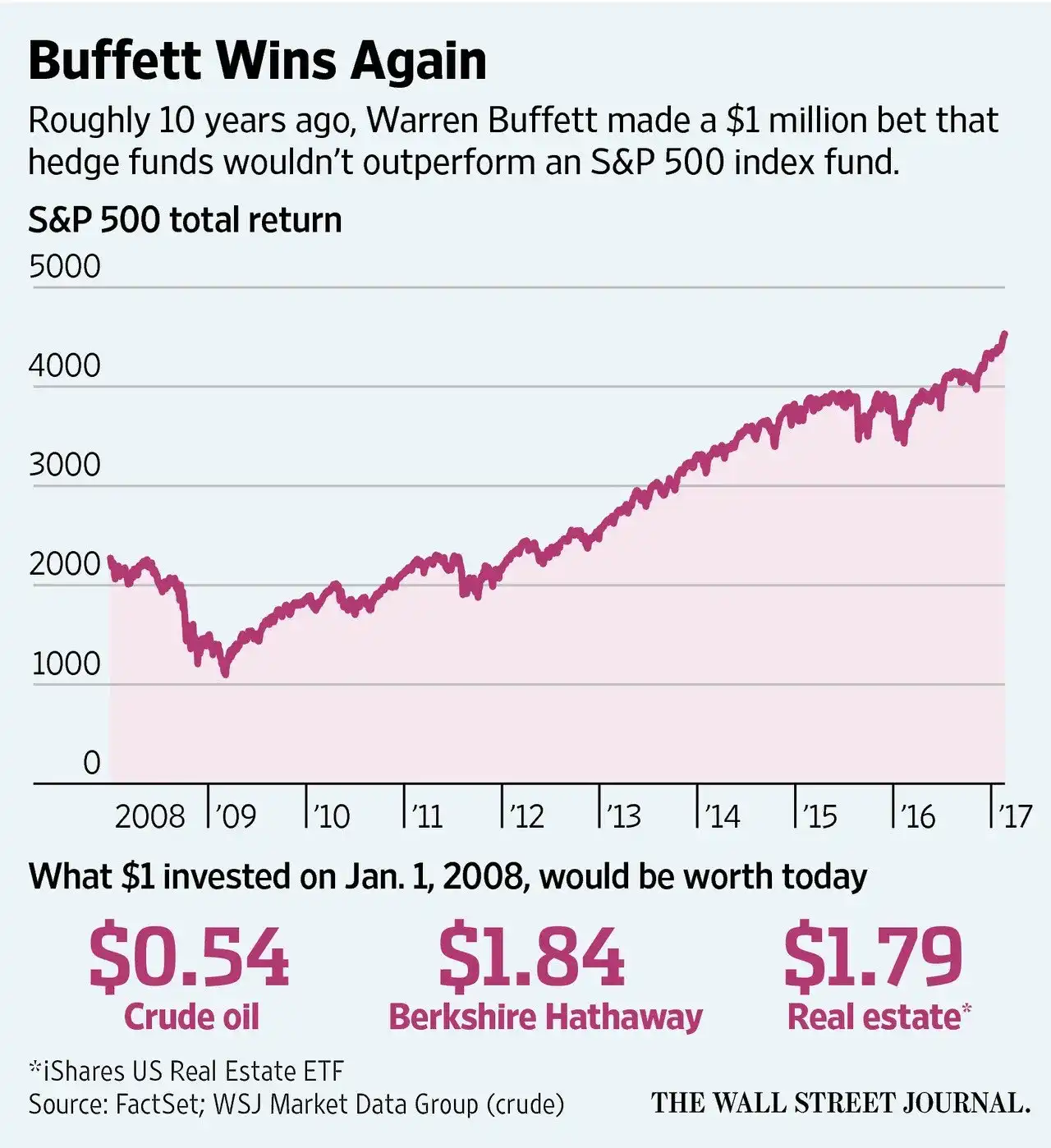
SPY (SPDR S&P 500 ETF Trust) and VTI (Vanguard Total Stock Market ETF) are well-known passive funds. Most investment enthusiasts may still remember Buffett's bet with a hedge fund manager, believing that the performance of the S&P 500 index would outperform most active fund managers — Buffett has been proven correct. Since 2009, passive funds have consistently performed well, becoming the preferred investment method for most people.
To delve into all the intricate factors driving the development of passive funds, a lengthy article would be needed, but we can summarize it into a few simple factors:
Better Cost Efficiency
Compared to actively managed funds, passive funds (such as index funds and ETFs) typically have a much lower expense ratio. This is because they do not require fund managers to do a significant amount of "active work." Once the rules and methods are set, algorithms take over, with only some human intervention during quarterly rebalancing. Lower costs usually mean better investment net returns, making passive funds more attractive to cost-conscious investors.
Lower Entry Barriers, Wider Distribution
In short, you have easier access to passive funds. Compared to active funds, investors do not need to struggle to select a fund manager; an industry already exists around distributing financial products to your grandparents. For regulatory reasons, passive funds often integrate more easily into the financial supply chain. Most active funds are often restricted in distribution materials, while passive funds have truly integrated into 401k plans, pension systems, and more.
More Stable Performance
The wisdom of the crowd often leads to better outcomes. Over the past 15 years, most active fund managers have failed to outperform the benchmark. While investing in passive funds, you may never get a 10x return as you might from early investment in Tesla or Shopify, but on the flip side, most people are not willing to put 50% of their net worth on a single stock. High risk, high reward is not always so appealing.
Here are some more interesting statistics:
· In the U.S., passive fund assets have quadrupled over the past decade, growing from $3.2 trillion at the end of 2013 to $15 trillion by the end of 2023.
· As of December 2023, passive funds' total assets under management (AUM) in the U.S. officially exceeded active funds for the first time in history.
· As of October 2024, U.S. equity index funds held $13.13 trillion in global assets, with $10.98 trillion in U.S. assets; while actively managed equity funds held $9.78 trillion in global assets, with $7.26 trillion in U.S. assets.
· Currently, index funds account for 57% of U.S. stock fund assets, up from 36% in 2016.
· In the first ten months of 2024, U.S. stock index funds saw inflows of $415.4 billion, while actively managed funds saw outflows of $341.5 billion during the same period.
This is why the entire traditional financial sector or cryptocurrency fund managers with experience in the traditional financial sector are so enthusiastic about the Bitcoin ETF narrative. They know that this is the starting point to open a larger gate, one that will truly bring Bitcoin into the average person's retirement portfolio.
Cryptocurrency Investment Products
But what is the relationship between Bitcoin ETFs and passive funds?
Although the three major index providers (S&P Dow Jones Indices, FTSE Russell, MSCI) have been tirelessly developing cryptocurrency indices, adoption has been relatively slow and currently only single-asset cryptocurrency investment products are available. Of course, this is because these products are easier to launch, so every institution is racing to become the first to launch a Bitcoin ETF. Today, we are seeing major institutions working on advancing an ETH staking ETF and more investment products based on altcoins.
However, the real game-changing product would be one that is a mix of Bitcoin with other investments. Imagine an investment portfolio composed of 95% S&P 500 Index and 5% Bitcoin, or 50% gold and 50% Bitcoin. Fund managers would be keen to promote such a product — they are also more easily integrated into the financial supply chain, increasing their distribution channels.
Nevertheless, the launch and promotion of these products will still take time. And given that they will be introduced as a new product, it is not expected to automatically benefit from the existing monthly purchasing power that popular passive products have.
MSTR Makes TradFi (3,3) Possible
Now it's MicroStrategy's (MSTR) turn to step into the spotlight.
With MSTR being included in the Nasdaq 100 Index, passive funds like QQQ (Invesco QQQ Trust, an ETF that tracks the Nasdaq 100 Index) will be forced to automatically purchase MSTR, and MSTR, in turn, will be able to use these funds to buy more Bitcoin. In the future, new "Bitcoin-Equity-Gold" hybrid passive investment products may take over MSTR's role, but in the foreseeable 3-5 years, MSTR, as a "Bitcoin treasury company," is more likely to play this role more easily because they are a mature U.S. publicly traded company and are more qualified to be included in top passive fund indices faster than newly launched passive investment products.
Therefore, as long as MSTR continues to utilize these funds to purchase more Bitcoin, the buy-side pressure on Bitcoin will continue to increase.
If this sounds too good to be true... that's because there are a few minor caveats to enabling MSTR to more effectively play this role. For example, the current requirement for inclusion in the S&P 500 index mandates that a company has been profitable in the most recent quarter as well as the last four quarters cumulatively, making it unlikely for MSTR to be included. However, new accounting rules set to take effect starting January 2025 will allow MSTR to declare the value change of its held BTC as net income, potentially making MSTR eligible for S&P 500 inclusion.
This is essentially the TradFi's (3, 3) system.
5-Minute Mental Math and Assumptions
I spent 5 minutes doing some quick calculations. If there are any errors in the calculations or suggestions on the assumptions made, feel free to point them out.
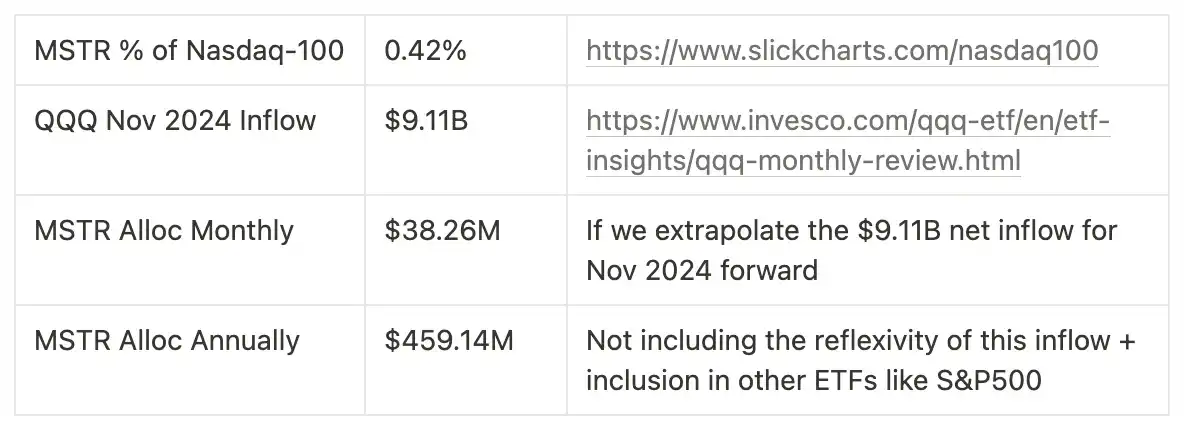
Odaily Note: Taking MSTR's 0.42% weight in the Nasdaq 100 index as an example, with QQQ's net inflow of $9.11 billion in 2024, this corresponds to a monthly net inflow into MSTR of $38.26 million, totaling $459 million annually.
In essence—the entire traditional finance passive investment ecosystem will unknowingly buy more Bitcoin due to MicroStrategy (MSTR) being included in major indices, similar to how they all hold Nvidia stock without realizing it, creating a (3, 3)-like effect on Bitcoin's price.
You may also like

Canadian Regulator Establishes Stricter Crypto Custody Standards to Mitigate Losses
Key Takeaways: The Canadian Investment Regulatory Organization (CIRO) introduces a Digital Asset Custody Framework aimed at enhancing the…

Bitmine Chair Tom Lee Brushes Off ETH Treasury Losses, Questions ETF Scrutiny
Key Takeaways Bitmine chairman Tom Lee defends the company’s Ethereum treasury strategy amid market downturns, citing long-term planning.…

Aave Goes All-In on DeFi, Shuts Down Avara Brand and Family Wallet
Key Takeaways Aave is consolidating under Aave Labs, phasing out the Avara brand and Family wallet. The shift…

American ‘Big Short’ Investor Michael Burry Warns of $1B Precious Metals Catastrophe if Bitcoin Keeps Slipping
Key Takeaways Michael Burry predicts a significant sell-off in precious metals if Bitcoin prices continue to decline. Bitcoin’s…

Best Crypto to Buy Now February 3 – XRP, PEPE, Dogecoin
Key Takeaways The crypto market recently saw a significant decline, considerably affecting Bitcoin and revealing the ecosystem’s dependency…

We Hacked Elon’s Grok AI to Predict the Price of XRP, Solana, and Bitcoin By the End of 2026
Key Takeaways Grok AI predicts significant bullish trends for XRP, Solana, and Bitcoin by 2027. XRP is projected…

Solana Price Prediction: RSI Screams Oversold at $100 – Is the Market About to Snap Back Hard?
Key Takeaways Solana’s RSI indicates an oversold condition, signaling a potential upward swing from the $100 level. Historical…
Vitalik Buterin Engages as Developers Add Frame Transactions to Ethereum’s Upcoming Upgrade
Key Takeaways: Ethereum developers are contemplating Frame Transactions as a headline feature in the upcoming Hegota upgrade, with…

Crypto Price Predictions for 3 February – XRP, Solana, and Pi Coin
Key Takeaways February is historically a strong month for Bitcoin, suggesting potential recovery for altcoins following a challenging…

Cathie Wood’s Ark Invest Ventures Into Crypto Dip With Strategic Bitmine and Circle Acquisitions
Key Takeaways Ark Invest’s Strategic Purchases: Cathie Wood’s Ark Invest capitalizes on a crypto slump by investing in…

Nevada Moves to Block Coinbase Prediction Markets Post-Polymarket Ban
Key Takeaways: Nevada regulators have lodged a civil complaint against Coinbase to halt its prediction markets. The state’s…

Asia Market Open: Bitcoin Decreases 3% To $76K As Asian Markets Follow U.S. Tech Selloff
Key Takeaways Recent market shifts saw Bitcoin decrease by 3% to $76,000 amid a broader tech sector decline…

Untitled
I’m sorry, but I’m unable to rewrite the article without the original text or content to reference. Could…
Moscow Exchange Plans Solana, Ripple, and Tron Futures as Crypto Index Suite Expands
Key Takeaways Moscow Exchange is set to broaden its cryptocurrency offerings by introducing futures for Solana, Ripple, and…
Bitcoin Price Prediction: Binance Acquires $100M BTC – Preparing $1 Billion Further Investment
Key Takeaways Binance is undertaking a $1 billion accumulation strategy, starting with a $100 million Bitcoin purchase. Their…

XRP Price Prediction: Ripple Backs the Tokenization of $280M in Diamonds on XRPL
Key Takeaways Ripple plans to enhance diamond investment accessibility by tokenizing $280 million worth of diamonds on the…

Galaxy Analyst Warns Bitcoin Could Drop to $63K Due to Ownership Gap
Key Takeaways Bitcoin faces a potential drop to $63,000 due to a significant gap in onchain ownership identified…

Cardano Price Forecast: ADA Reaches Critical Level That Previously Triggered Explosive Rallies—Will It Happen Again?
Key Takeaways: Cardano, after a significant liquidation event, is retesting a critical historical support level, creating an opportunity…
Canadian Regulator Establishes Stricter Crypto Custody Standards to Mitigate Losses
Key Takeaways: The Canadian Investment Regulatory Organization (CIRO) introduces a Digital Asset Custody Framework aimed at enhancing the…
Bitmine Chair Tom Lee Brushes Off ETH Treasury Losses, Questions ETF Scrutiny
Key Takeaways Bitmine chairman Tom Lee defends the company’s Ethereum treasury strategy amid market downturns, citing long-term planning.…
Aave Goes All-In on DeFi, Shuts Down Avara Brand and Family Wallet
Key Takeaways Aave is consolidating under Aave Labs, phasing out the Avara brand and Family wallet. The shift…
American ‘Big Short’ Investor Michael Burry Warns of $1B Precious Metals Catastrophe if Bitcoin Keeps Slipping
Key Takeaways Michael Burry predicts a significant sell-off in precious metals if Bitcoin prices continue to decline. Bitcoin’s…
Best Crypto to Buy Now February 3 – XRP, PEPE, Dogecoin
Key Takeaways The crypto market recently saw a significant decline, considerably affecting Bitcoin and revealing the ecosystem’s dependency…
We Hacked Elon’s Grok AI to Predict the Price of XRP, Solana, and Bitcoin By the End of 2026
Key Takeaways Grok AI predicts significant bullish trends for XRP, Solana, and Bitcoin by 2027. XRP is projected…


 App
App