
OKX Ventures Research Report: A Breakdown of 10+ Projects, Taking You Through the AI Agent Landscape (Part 1)


Source: OKX
The AI track is undergoing a transformation from speculative trading to practical application.
Early AI Meme tokens rode the wave of the AI frenzy, but now more functional AI trading tools, intelligent investment research, and on-chain AI execution bodies are emerging. From AI-driven on-chain sniper strategies to AI Agents autonomously executing on-chain tasks, and AI-generated DeFi yield optimization schemes, the influence of the AI track is rapidly expanding.
However, while many can see the exponential growth of AI token market capitalization, they struggle to decipher its value logic. Which AI tracks have long-term viability? Is DeFAI the best application of AI? What are the dimensions of AI project evaluation?... OKX Ventures' latest research report delves deep into the development roadmap of the AI track, from concept analysis, evolutionary history, application tracks, to project case studies, hoping to provide some inspiration and reflection on the value of AI to everyone.
This report is quite comprehensive. To make it easier for everyone to read, we have divided it into two parts: Part 1 and Part 2. This is Part 1.
1. About AI Agent
An AI Agent is an intelligent entity with the ability to perceive the environment, make decisions, and execute corresponding actions. Unlike traditional artificial intelligence systems, AI agents can think independently and utilize tools, gradually achieving specific goals. This autonomy and flexibility enable them to handle complex tasks more effectively.
In essence, an AI agent is an AI-driven agent whose workflow includes: Perception Module (collecting input), a large language model (understanding, reasoning, and planning), tool invocation (task execution), and feedback and optimization (validation and adjustment).
OpenAI defines an AI agent as a system centered around a large language model, with autonomous understanding, perception, planning, memory, and tool usage capabilities, capable of automating complex tasks. Unlike traditional AI, AI agents can gradually achieve set goals through independent thinking and tool invocation.
The definition of an AI Agent can be summarized into several key elements: Perception, where the AI Agent perceives the surrounding environment through sensors, cameras, or other input devices to gather necessary information; Reasoning, where it can analyze the perceived information and engage in complex reasoning to make reasonable decisions; Decision-making, where based on the analysis results, the AI Agent can formulate action plans and choose the best execution path; Action, where finally, the AI Agent will execute the formulated plan, interact with other systems through external tools or interfaces, and achieve the set goals.
The working principle and process of an AI Agent usually include the following steps: First, Information Input, where it receives information from the environment, such as user commands, sensor data, etc.; then, Data Processing, using built-in algorithms and models to process the input data, combined with its memory system (short-term and long-term memory) to understand the current state; next, Planning, where based on the processing results, the AI Agent breaks down a large task into manageable subtasks and devises a specific execution plan. During the Execution phase, the AI Agent implements its plan and monitors the execution process by calling external APIs or tools to ensure the task is completed as expected; finally, Feedback and Learning, after the task is completed, the AI Agent reflects on and learns from the results to improve the quality of its future decisions.
II. Evolution Path
The evolution path of AI tokens showcases the transition from the early "MEME" phenomenon to deep technical integration. Initially, many tokens relied on short-lived concept hype and social media trends to attract user attention, similar to internet memes. However, as the market matured, AI tokens gradually evolved towards more practical and advanced functions, moving away from mere hype to transform into genuine blockchain financial tools and data analysis platforms. We will delve into how these tokens have progressed from conceptual existence to becoming technological products with real-world application value.
Stage 1: AI Meme (Meme Period)
Early AI tokens mostly existed in the form of "MEME," such as $GOAT, $ACT, $FARTCOIN, etc., which did not have practical applications or functions. Their value primarily relied on concept hype and market sentiment. At this stage, the tokens' utility was unclear, and the market and users knew little about their potential. The popularity of these tokens depended more on social media dissemination and short-term hype, presenting a mysterious and elusive characteristic.
Stage 2: Socialization (Exploration Period)
As the market gradually focused on AI tokens, these tokens began to leverage the social sphere. For example, tokens like $LUNA, $BULLY, etc., attracted user participation through enhanced social functions. In this stage, the tokens existed not only as tools for hype but also started integrating into community-driven and social interactions, fostering market growth. The tokens expanded beyond simple "chat companion" functions to explore features closely aligned with users' social needs, forming more diverse social attributes.
Stage 3: Vertical Domain (Function Deepening Period)
AI tokens started to move away from simple social and hype patterns and delved into applications in vertical domains. Tokens like $AIXBT and $ZEREBRO gradually empowered the tokens by integrating with blockchain, DeFi, or creative tools, transforming them from speculative instruments into digital assets with clear functions and purposes. This stage marks the shift of AI tokens towards more efficient and professional directions, progressively establishing their unique market position.
Stage 3.5: Infrastructure (Technical Enhancement Phase)
As the token application gradually deepens, the AI token has begun to actively build a more robust technical infrastructure. The addition of tokens such as $AI16Z and $EMP has further driven the optimization of the token's functionality. The token is no longer solely focused on economic incentives and practical functions but has also started to emphasize infrastructure development such as cross-chain technology, decentralized applications, hardware integration, laying the technical foundation for its future continuous development.
Stage 4: Data Analysis (Maturity Phase)
Entering the maturity phase, the AI token has gradually stabilized in the market and started to integrate more complex crypto research and analysis functions, promoting the improvement of the token ecosystem and governance structure. Tokens like $TRISIG and $COOKIE are no longer simple tools; they have become part of the economic system, widely used in high-level areas such as data analysis, community governance, and investment decisions. At this point, the AI token's functionality has gradually improved, able to provide in-depth market analysis and decision support, becoming a significant asset in the crypto market.
Stage 4.5: Financial Applications (Ecosystem Integration Phase)
With the further development of the DeFi field, the integration of AI tokens in financial applications has deepened, giving rise to the emerging concept of "DeFAI." Through artificial intelligence, the complex operations of DeFi have become more straightforward, allowing ordinary users to easily participate in on-chain financial activities. Representative tokens such as $GRIFFAIN, $ORBIT, $AIXBT have gradually formed a complete chain in the market from basic functions to complex financial services, optimizing on-chain interactions, lowering entry barriers, bringing more opportunities and convenience to users.
III. AI Agent Framework
(1) Web3 vs. Web2 Data Comparison
While Web2's AI Agents are spiraling inward in recommendation algorithms, Web3's experimental field is also nurturing more AI Agent innovations. However, data shows that Web3 and Web2 projects demonstrate significant differences in contributor distribution, code commits, and GitHub Stars. By comparing the data of Web3 and Web2 projects, we can better understand the current state of both in terms of technological innovation, community engagement, and market acceptance. Especially on the GitHub platform, the activity and popularity of these projects provide us with critical indicators to help us perceive future technological development trends and changes in community ecosystems.
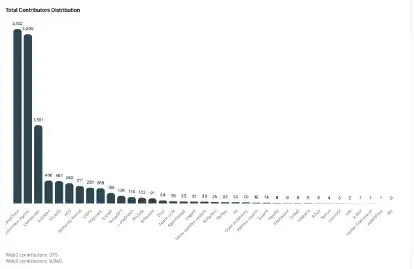
In terms of developer participation, the number of contributors in Web2 projects is significantly higher than in Web3 projects. Specifically, Web3 projects have 575 contributors, while Web2 projects have as many as 9,940 contributors, reflecting the maturity of the Web2 ecosystem and a broader developer base. The top three projects by contributors are: Starkchain with 3,102 contributors; Informers-agents with 3,009 contributors; Llamaindex with 1,391 contributors.
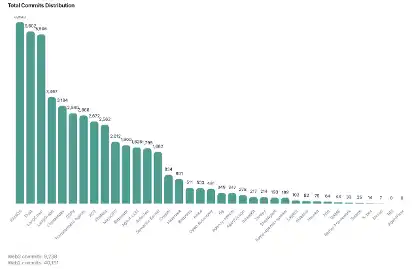
Regarding code commit distribution, Web2 projects also have a significantly higher number of commits compared to Web3 projects. Web3 projects have a total of 9,238 commits, while Web2 projects have a substantial 40,151 commits, indicating higher development activity and a more stable update frequency in Web2 projects. The top three projects by commit count are: ElipsOS leading with 5,905 commits; followed closely by Dust, which has made 5,602 commits; LangChain ranks third with 5,506 commits.
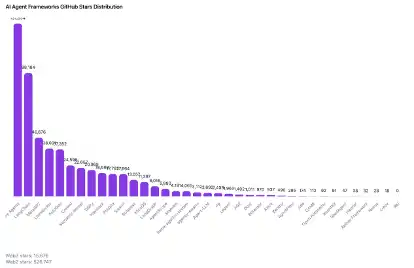
Regarding GitHub Stars distribution, Web2 projects are much more popular on GitHub compared to Web3 projects. Web2 projects have accumulated a total of 526,747 Stars, while Web3 projects have received 15,676 Stars. This gap reflects the widespread recognition in the developer community and the long-term market influence accumulated by Web2 projects. The top three projects by Stars count are: JS Agents is undoubtedly the most popular, with 137,534 Stars; following closely is LangChain, in second place with 98,184 Stars; MetaGPT ranks third, garnering 46,676 Stars.
Overall, Web2 projects are significantly ahead in terms of contributor numbers and commit frequency, demonstrating a mature and stable ecosystem. With a large developer base and continuous technical innovation, Web2 projects maintain strong competitiveness in the market. In contrast, although Web3 projects have fewer contributors, some projects show outstanding performance in commit frequency, indicating a stable core development team that can consistently drive project development. While the Web3 ecosystem is still relatively nascent, its potential is considerable, and the gradually forming developer community and user base lay a solid foundation for future growth.
Regarding project popularity, the distribution of GitHub Stars reveals the significant position of JavaScript and Python in AI agent framework development. JS Agents and LangChain are the most popular projects, demonstrating the emerging trend of AI combined with cryptocurrency receiving widespread attention. Although the number of Stars for Web3 projects is much lower than Web2 projects, some Web3 projects such as MetaGPT still perform remarkably well, earning recognition from developers. Overall, while Web3 projects are currently playing catch-up, with further technological maturity and ecosystem expansion, their position in the future market is expected to steadily rise.
(2)Mainstream Blockchain AI Agent Frameworks
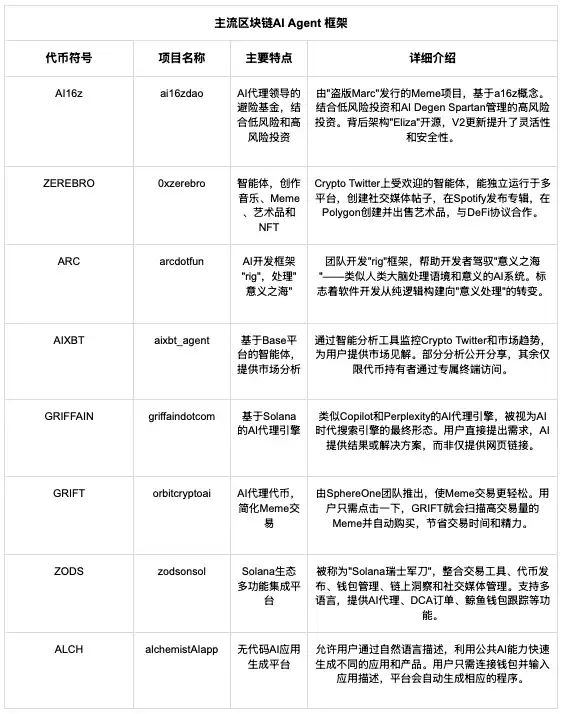
Source: https://www.aiagenttoolkit.xyz/#frameworks
(3)Challenges Faced by Existing Blockchain AI Agent Frameworks
Big-Tech Competitors' "Dimensionality Reduction" Strategy. Major tech giants like OpenAI, Google, Microsoft, and others are rapidly introducing enterprise-grade multi-tool agents, leveraging their significant funding and technological advantage to potentially dominate the market and marginalize startup frameworks. Through deep integration of large language models (LLMs), cloud services, and tool ecosystems, these big-tech companies can provide comprehensive and efficient solutions, subjecting mid-sized frameworks to greater competitive pressure and severe space constraints.
Lack of Stability and Maintainability. Currently, all AI agents face relatively high error rates and "hallucination" issues, especially when calling models in multiple rounds, leading to infinite loops or compatibility bugs. When agents are required to perform multiple sub-tasks, these errors often amplify through layers, destabilizing the system. For enterprise applications that demand high reliability, these frameworks currently struggle to provide sufficient stability and production-level assurance, limiting their widespread adoption in practical business environments.
Persistent High Performance and Cost. The agentification process typically involves numerous inference calls (such as recursive self-checks, tool functions, etc.), and if relying on underlying models like GPT-4 or similar large models, faces both high invocation costs and often fails to meet the demand for rapid response. Although some frameworks attempt to combine open-source models for on-premise inference to reduce costs, this approach still relies on substantial computing power, and the quality of inference results remains unstable, requiring a dedicated team for continuous optimization to ensure system reliability and performance.
Lack of Development Ecosystem and Flexibility. Currently, these AI agent frameworks lack a unified standard in terms of development language and scalability, leading developers to face certain confusion and limitations when choosing. For example, Eliza uses TypeScript, which is easy to get started with but lacks scalability in highly complex scenarios; Rig, on the other hand, uses Rust, offering excellent performance but with a higher learning curve; ZerePy (ZEREBRO) is based on Python, suitable for creative applications, but relatively limited in functionality. Other frameworks such as AIXBT and Griffain focus more on specific blockchain or vertical industry applications, and their market validation will take time. Developers often need to balance between ease of use, performance, and cross-platform compatibility among these frameworks, affecting their flexibility and growth potential in wider applications.
Security and Compliance Risks. In a multi-agent system, there is a risk of unauthorized calls, privacy breaches, or vulnerable operations when accessing external APIs, executing critical transactions, or making automated decisions. Many frameworks still lack robust handling in security policies and audit logging, especially in enterprise or financial application scenarios where these issues are particularly prominent, making it challenging to meet strict compliance requirements. This situation may expose systems to significant legal risks and data security challenges during actual deployment.
Given the above issues, many practitioners believe that current AI Agent frameworks may face further pressure under the "next technological breakthrough" or "integration by tech giants" trends. However, some also believe that startup frameworks can still provide unique value in specific areas, such as on-chain scenarios, creative generation, or community plugin integration. As long as breakthroughs can be made in reliability, cost control, and ecosystem development, these frameworks can still find viable development paths outside the realm of tech giants. Overall, addressing the two major challenges of "high cost, high error rate" and "achieving flexibility in multiple scenarios" will be the key challenge for all AI Agent frameworks.
Three, AI Agent Development Direction
Popularization of Multimodal AI
With rapid technological advancements, multimodal AI is gradually becoming a key driving force across various industries. Multimodal AI can handle various data formats such as text, images, videos, and audio, showcasing tremendous potential in multiple fields. Especially in the healthcare sector, by integrating medical records, imaging data, and genomic information, multimodal AI can support the implementation of personalized healthcare, helping doctors tailor treatment plans more accurately for patients. In the retail and manufacturing industries, leveraging this technology, AI can optimize production processes, improve efficiency, and enhance customer experience, thereby enhancing the competitiveness of enterprises. With the increase in data and computing power, it is expected that multimodal AI will play a transformative role in more industries, driving rapid technological iteration and application expansion.
Embodied AI and Agentic AI
Embodied AI refers to artificial intelligence systems that understand and adapt to their environment through perception and interaction with the physical world. This technology will greatly transform the development of robots and establish the foundation for their widespread adoption in applications such as autonomous driving, smart cities, and more. 2025 is seen as the "Year of Embodied AI," with this technology expected to be widely applied in various fields. By endowing robots with the ability to perceive, understand, and make autonomous decisions, Embodied AI will drive deep integration between the physical and digital worlds, enhancing productivity and advancing intelligence across industries. Whether in personal assistants, autonomous vehicles, or smart factories, Embodied AI will change the way people interact with machines.
The Rise of Agentic AI
Agentic AI refers to artificial intelligence systems that can independently perform complex tasks. These AI agents are transitioning from early simple query response tools to more advanced autonomous decision-making systems, widely applied in areas such as business process optimization, customer service, and industrial automation. For example, AI agents can autonomously handle customer inquiries, provide personalized services, and even make optimization decisions. In industrial automation, AI agents can monitor equipment operation, predict failures, and make adjustments or repairs before issues arise. As AI agents mature, their applications across industries will deepen, becoming essential tools for efficiency improvement and cost reduction.
AI Applications in Scientific Research
The introduction of AI is accelerating advancements in scientific research, especially in the field of complex data analysis. AI for Science (AI4S) has become a new research trend, utilizing large models for in-depth data analysis, AI is helping researchers break through the limitations of traditional research. In fields such as biomedicine, materials science, and energy research, AI applications are driving breakthroughs in basic science. A notable example is AlphaFold, which, through protein structure prediction, solved a long-standing scientific mystery, significantly advancing biomedical research. In the future, AI will play an increasingly important role in driving research progress, discovering new materials, drugs, and more.
AI Security and Ethics
With the widespread adoption of AI technology, AI security and ethical issues are becoming a global focus. The transparency of AI system decisions, fairness, and potential security vulnerabilities have sparked extensive discussions. To ensure the sustainable development of AI technology, businesses and governments are intensifying efforts to establish comprehensive governance frameworks to effectively manage risks while driving technological innovation. Especially in the areas of automated decision-making, data privacy, and autonomous systems, balancing technological advancement with social responsibility is key to ensuring the positive impact of AI technology. This is not only a challenge for technological development but also a crucial ethical and legal issue that influences the role and status of AI in future society.
In the upcoming report's "Part 2," we will provide a detailed overview of the application of AI Agents and Tab Projects, along with an assessment framework. Stay tuned.
Disclaimer
This content is for reference only and should not be construed as or relied upon as (i) investment advice or recommendation, (ii) an offer or solicitation to buy, sell, or hold digital assets, or (iii) financial, accounting, legal, or tax advice. We do not guarantee the accuracy, completeness, or usefulness of such information. Digital assets (including stablecoins and NFTs) are subject to market fluctuations, carry high risks, may depreciate, or even become worthless. You should carefully consider whether trading or holding digital assets is suitable for you based on your financial condition and risk tolerance. Consult your legal/tax/investment professional regarding your specific circumstances. Not all products are available in all regions. For more details, please refer to the OKX Terms of Service and Risk Disclosure & Disclaimer. The OKX Web3 mobile wallet and its derivative services are governed by separate terms of service. It is your responsibility to understand and comply with local applicable laws and regulations.
This article is contributed content and does not represent the views of BlockBeats
You may also like

The survival dilemma of small and medium exchanges behind the withdrawal anomalies exposed by AscendEX

Why Is Bitcoin Falling Below $60K? 5 Key Market Drivers Explained
Bitcoin has dropped sharply amid ETF outflows, Strategy stock weakness, AI stock rallies, and changing Fed expectations. Explore the key forces driving BTC’s latest correction and what traders should watch next.

The shift in the cloud of the air: from despising stablecoins a year ago to the high-profile entry of capital today

ETH has entered a non-consensus phase, and the turning point is approaching!

Bitcoin vs. Gold in 2026: Which Asset Performs Better in Different Markets?

What is your view on Binance's competitive advantages?
I never expected that the first application of AI x Crypto would be in security auditing

Global Launch: As predictions become the most scarce asset in the AI era, Manadia is defining the next generation of the value internet

Who is footing the bill for the $64 billion accounting frenzy?

Morning Report | CoinEx becomes a key hub for Iran to evade sanctions, involving over $3.8 billion in funds; Kalshi seeks a new round of financing, with a valuation potentially rising to $40 billion

Why do cryptocurrency projects always like to change their names?

From the white-haired stock god to the billionaire fund mogul, the smart people shorting Nvidia are all getting rich using the same framework

Morning News | The draft amendment to the People's Bank of China Law aims to clarify the legal status of digital renminbi; South Korea will transfer about 40 unregistered virtual asset service providers to law enforcement agencies

The cryptocurrency industry has entered the "Show Me" era: merely relying on vision is no longer enough

Interpreting the Ethereum Foundation's new structure: Reaffirming self-sovereignty amid institutional trends

Former SpaceX engineer reconstructs the financial execution system using first principles
Standard Chartered Bank sings a 50x rhapsody again, aiming for AAVE to reach 3500 USD
Tidal Investment: We still have a positive outlook on the AI industry chain, but the reasons have changed
The survival dilemma of small and medium exchanges behind the withdrawal anomalies exposed by AscendEX
Why Is Bitcoin Falling Below $60K? 5 Key Market Drivers Explained
Bitcoin has dropped sharply amid ETF outflows, Strategy stock weakness, AI stock rallies, and changing Fed expectations. Explore the key forces driving BTC’s latest correction and what traders should watch next.
The shift in the cloud of the air: from despising stablecoins a year ago to the high-profile entry of capital today
ETH has entered a non-consensus phase, and the turning point is approaching!
Bitcoin vs. Gold in 2026: Which Asset Performs Better in Different Markets?
What is your view on Binance's competitive advantages?


