
On-Chain Data Academy (Part 3): Have the Whales Profiting from Bottom Feeding Cashed Out?


Original Article Title: "On-chain Data School (Part 3): Have the Bottom-Fishing Whales Taken Profit?"
Original Article Author: Mr. Berg, On-chain Data Analyst
This article is the 3rd part of the On-chain Data School series, with a total of 10 parts. It takes you step by step through understanding on-chain data analysis. Interested readers are welcome to follow this series of articles.
Related Reading: "On-chain Data School (Part 2): The Ever-profitable Hodlers, What Is Their BTC Acquisition Cost?"
TLDR
- This article will introduce the on-chain metric Realized Profit
- Realized Profit shows the daily amount of profit-taking in the market
- Massive Realized Profit is usually only caused by low-cost chip holders
- Tops are usually accompanied by massive Realized Profit
Realized Profit & Realized Loss Overview
Realized Profit, translated as "已实现利润" in Chinese, is based on the price of each BTC at the time of its last transfer and the price at the time of the previous transfer, calculating how many BTC are profitably settled each day. By summing up the total profit from these settled BTC, the daily Realized Profit can be obtained.
Of course, if the price at the time of the last transfer is lower than the price at the time of the previous transfer, it will be recorded as Realized Loss.
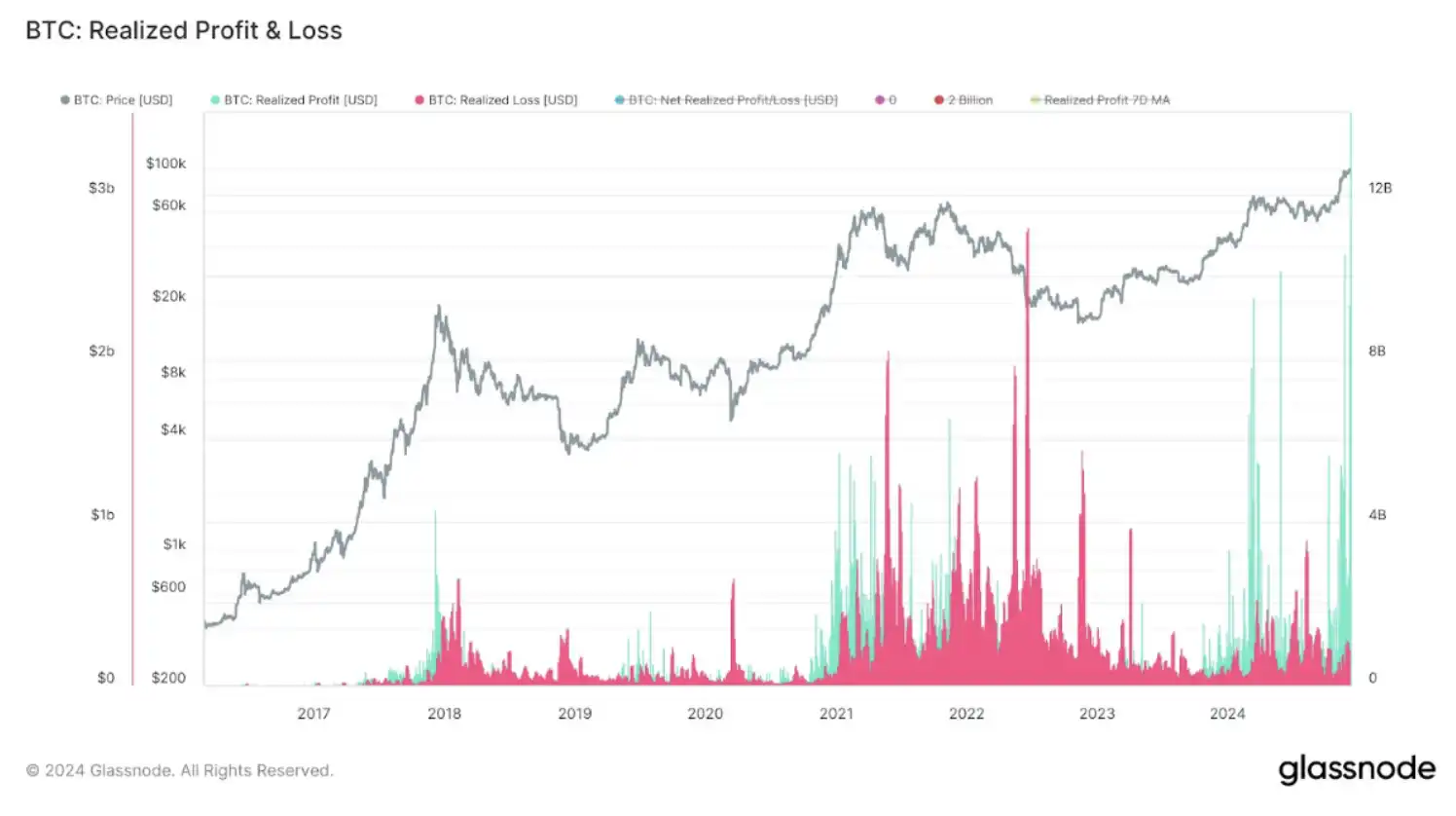
Realized Profit & Realized Loss Chart
Massive Realized Profit is Usually Only Caused by Low-Cost Chip Holders
As shown in the diagram below: Due to the high cost basis of holders, their profit margin is not large, so when they sell, the **Realized Profit** they can generate is not high.
Therefore, when we see a significant amount of Realized Profit, it usually means that holders with a low cost basis are selling BTC.
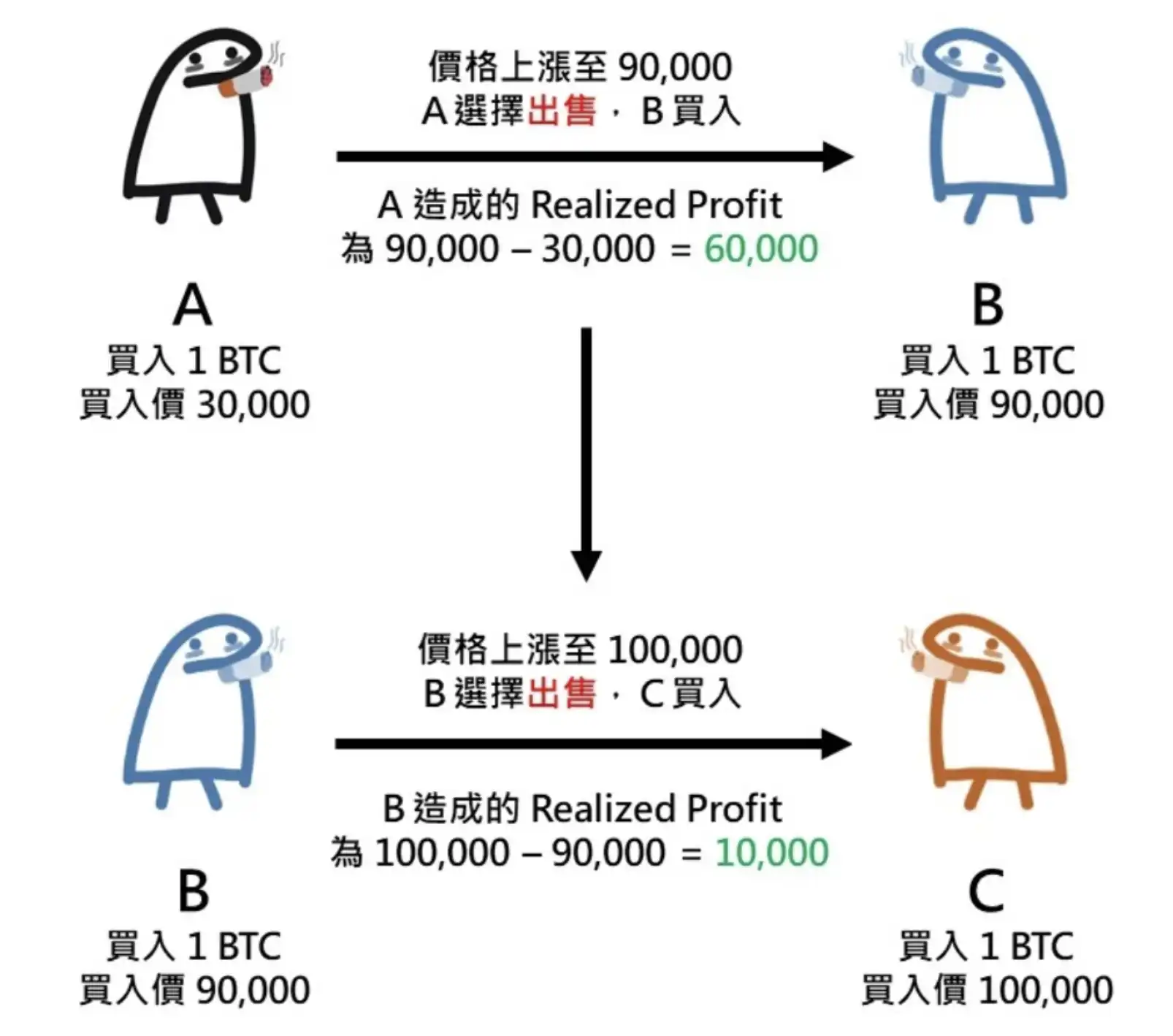
Realized Profit Calculation Diagram
Tops are usually accompanied by significant Realized Profit
When a large number of holders with a low cost basis sell their BTC, we will see clustered high-volume realized profits on the chart.
At this point, since the remaining participants in the market are high cost basis acquirers, and the market price is close to their cost basis, any slight shift in sentiment is more likely to trigger panic selling from them, causing a cascading price drop, forming a top.
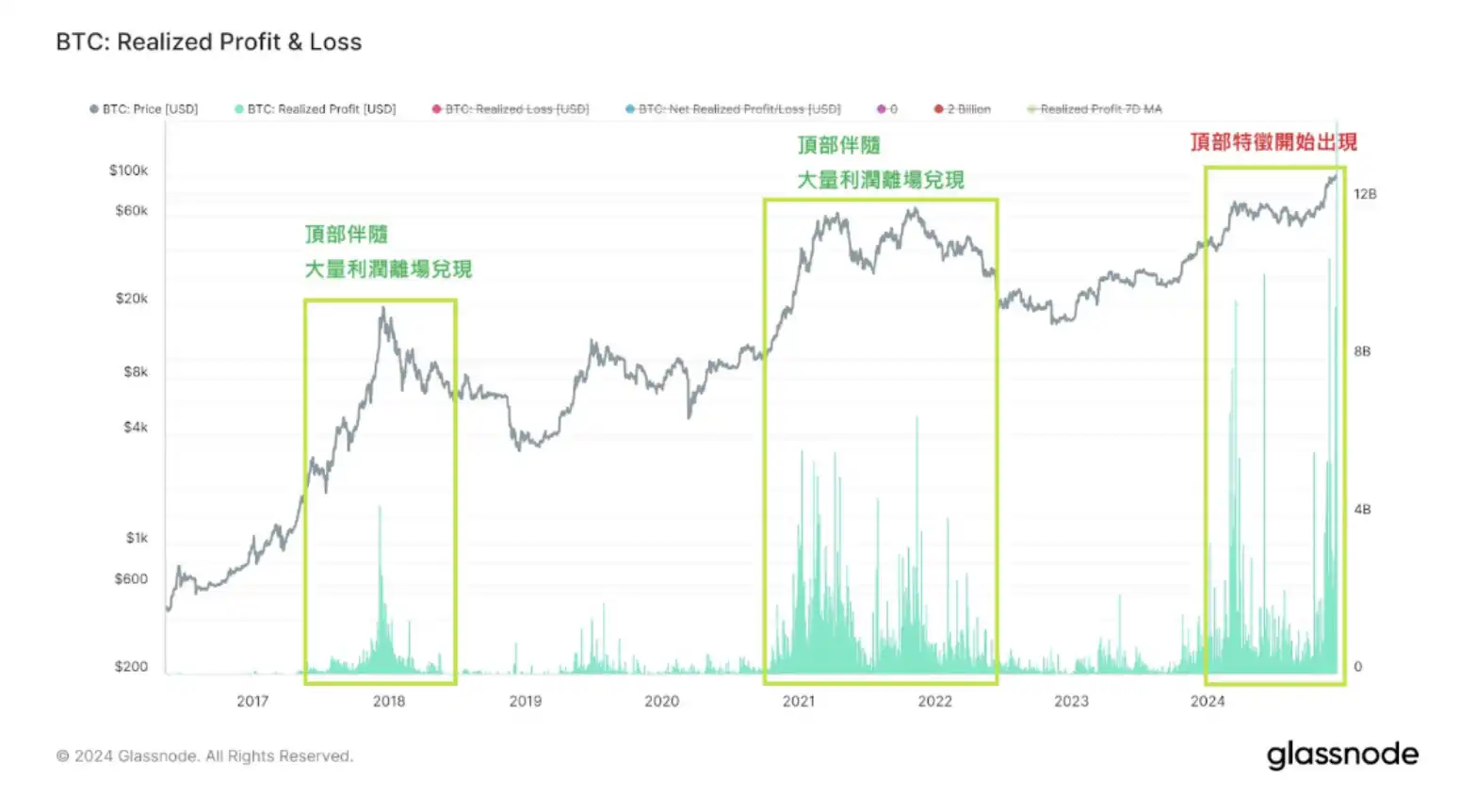
Tops are usually accompanied by significant Realized Profit
Conclusion
The above is all the content of On-Chain Data School (III). For readers interested in delving deeper into on-chain data analysis, remember to keep track of this series of articles!
If you would like to see more analysis and educational content on on-chain data, feel free to follow my Twitter handle (X)!
I hope this article has been helpful to you. Thank you for reading.
You may also like

Why Tokenized Stocks Are Booming in 2026 While Crypto Is Still Struggling
From Pump.fun to Collector Crypt: Has Solana's income throne changed hands?
Looking at Stripe's ambitions and the future of stablecoins from OUSD
Do you want to buy CRCL?
Wosh: Inflation has cooled in recent weeks, AI is reshaping the economy, and forward guidance has lost its necessity
The most secretive AI winner
Former ByteDance employee's account: How I started with two Pinduoduo hard drives and made six times the profit with Seagate to achieve financial freedom?
MiCA reshuffle begins, Binance temporarily bids farewell to the EU
How does Gate redo "buying and selling stocks" from the cryptocurrency world to the stock market?
Visa and Mastercard join 140 giants to launch a new stablecoin, but the impact on the market landscape may still be limited
Circle CEO responds to OUSD's challenge: Stablecoins are a winner-takes-all business, and we will not slow down
Argentina vs Cape Verde: When a Record-Breaking Legend Meets an Unbreakable Underdog
WEEX exclusive pre-match analysis of Argentina vs Cape Verde, exploring Messi-led Argentina’s dominance and Cape Verde’s historic defensive breakout, with a breakdown of volatility, structure, and match dynamics.
WEEX Launches Depth Chart for Spot Trading
Raising interest rates to protect STRC and selling coins to maintain credit, this time the strategy has chosen the two most expensive paths
Morning Report | Samsung announces a 265.5 trillion won investment plan, focusing on semiconductor and AI computing power data centers; Vitalik publishes an article detailing the entire technology tree behind the confusion protocol (iO) mainline
In the era of AI, what is left of Bitcoin?
NeoSoul announced plans to integrate with the OKX Agentic Wallet, promoting AI agents' participation in the on-chain economy
Why Is Bitcoin Lagging Stocks in 2026? AI Stocks, ETF Outflows, and the Nasdaq Rally Explained
Why Tokenized Stocks Are Booming in 2026 While Crypto Is Still Struggling
From Pump.fun to Collector Crypt: Has Solana's income throne changed hands?
Looking at Stripe's ambitions and the future of stablecoins from OUSD
Do you want to buy CRCL?
Wosh: Inflation has cooled in recent weeks, AI is reshaping the economy, and forward guidance has lost its necessity
The most secretive AI winner