
- Buy Crypto
- Markets
 Futures
- Spot
- Copy Trade
- Earn
- More
PolySwarm: Exploring the Potential of Decentralized Malware Detection and NCT Token Utilization
By: en coinotag|2025/05/07 20:30:03
0
Share
PolySwarm is revolutionizing malware detection by leveraging a decentralized approach where experts compete to provide accurate threat analysis. The platform’s unique infrastructure not only enhances security but also creates a compelling economic incentive for security experts to participate actively. “With PolySwarm, accuracy in malware detection directly translates to financial rewards for contributors,” says a representative from COINOTAG. Explore how PolySwarm’s innovative ecosystem is reshaping cybersecurity with expert-driven malware detection, backed by a tokenomics model. Learn more! PolySwarm: A Decentralized Cybersecurity Ecosystem PolySwarm is a groundbreaking cybersecurity platform that transforms the conventional malware detection landscape by incorporating a crowdsourced model. By connecting numerous independent experts and engines, PolySwarm facilitates quicker and more comprehensive detection of malicious threats than traditional antivirus software. Revolutionizing Threat Intelligence PolySwarm’s unique model not only accelerates response times but also broadens the scope of threat identification by using various specialized micro-engines. These engines collaboratively analyze potential threats in real-time, enabling enriched threat intelligence. This decentralized framework enhances both speed and reliability in identifying new malware types not typically addressed by conventional antivirus solutions. How PolySwarm Operates: The Mechanics of Threat Detection The platform functions as a decentralized marketplace for threat detection, employing an innovative model akin to a prediction market. Here’s an overview of the operational flow: Artifact Submission Users or security teams submit potentially malicious files or URLs to the PolySwarm network, attaching a bounty in the form of its cryptocurrency, NCT. This serves as an incentive for engines to analyze the artifact thoroughly. Role of Micro-Engines Once submitted, numerous independent micro-engines analyze the artifact simultaneously. Each engine provides an assertion about the artifact’s nature, backed by a token stake, encouraging accuracy through economic incentives. This competitive element drives engines to prioritize precision in their threat assessments. The PolyScore Mechanism The platform aggregates the diverse assertions to calculate a PolyScore, reflecting the collective confidence of the micro-engines regarding the artifact’s maliciousness. This consensus mechanism removes reliance on single-engine assessments and promotes a transparent verification process. Final Validation and Payouts After initial analysis, a validation phase ensues, overseen by designated arbiters. These trusted participants confirm the artifact’s classification, ensuring integrity before disbursing bounties based on performance accuracy. Tokenomics: The Driving Force Behind PolySwarm At the core of the PolySwarm ecosystem lies its ERC-20 token, NCT. Utilized for securing transactions, rewarding accurate assessments, and staking on predictions, NCT underpins the economic incentives within the platform. The fixed supply of tokens further enhances its stability and long-term utility. NCT price history (as of May 2025): CoinMarketCap Comparing PolySwarm to Traditional Cybersecurity Solutions Practical Implementations of PolySwarm PolySwarm has proven its real-world applicability in several cybersecurity domains. Its integration into existing security platforms allows for seamless utilization. Here are key areas of application: Integration into Security Tools PolySwarm facilitates its threat intelligence feed integration into various existing platforms, enhancing analyst workflows without requiring separate dashboards. Incident Response Efficiency Security teams employ PolySwarm as a rapid-response tool for analyzing suspicious files during incidents. Its capability to provide consensus-driven results quickly is invaluable in mitigating potential threats. Encouraging Research and Development Cybersecurity researchers can monetize their expertise by deploying micro-engines within the PolySwarm ecosystem, creating new income streams while contributing to community security. Challenges Facing PolySwarm Despite its advancements, PolySwarm faces certain challenges, such as ensuring consistent quality across the diverse micro-engine pool. Furthermore, the model may prove complex for casual users unfamiliar with the jargon employed in decentralized systems. Conclusion PolySwarm represents a significant evolution in the cybersecurity ecosystem, offering a decentralized, community-driven alternative to traditional malware detection. Its innovative framework not only amplifies the threat detection process but also empowers security experts to contribute meaningfully. As the platform evolves, it stands to become a pivotal player in reshaping how organizations manage cybersecurity. Frequently Asked Questions How does PolySwarm differ from traditional antivirus platforms? Unlike traditional antivirus, which relies on a single vendor’s engine, PolySwarm aggregates results from multiple independent engines. It rewards only correct verdicts, creating direct incentives for precision. What is NCT used for in the PolySwarm ecosystem? NCT (Nectar) is the platform’s native token used for payments, staking, and rewards. Can individuals use PolySwarm, or is it enterprise-focused? PolySwarm is accessible to individuals but is designed primarily for enterprise integration through APIs.
You may also like

Particle Founder: The entrepreneurial insights I have gained the most from in the past year
Stop lean startup, stop lightning entrepreneurship, and think carefully about what your product aspirations are.

Huang Renxun's latest podcast transcript: The future of Nvidia, the development of embodied intelligence and agents, the explosion of inference demand, and the public relations crisis of artificial intelligence
The competition in the future is not just about whose model is larger or whose computing power is stronger, but also about who understands the industry better, who can embed AI more deeply into real processes, and who can organize these capabilities into a runnable and scalable system.

OKX Ventures Research Report: AI Agent Economic Infrastructure Research Report (Part 1)
The existing infrastructure is hostile to the Agent economy. Agents can think and act independently at the "capability level," but at the "economic level," they are still locked into infrastructure designed for humans.

The migration of settlement rights: B18 and the institutional starting point of on-chain banks
In the traditional system, banks decide the settlement; in the on-chain system, code begins to take over this responsibility.

From Tencent and Circle: Looking at the Simple and Difficult Questions of Investment
The AI narrative continues to ferment, but the recent performance of related stocks varies, with some in the midst of summer and others as if in winter.

The second half of stablecoins no longer belongs to the crypto circle
What Coinbase doesn't want, Mastercard is eager to buy.

Cursor "Shell" Kimi Controversy Reversed: From Copyright Infringement Allegations to Authorized Collaboration, China's Open Source Model Once Again Becomes a Global AI Foundation
Cursor was accused of being based on Kimi K2.5, which sparked controversy, and was later confirmed to be compliant through Fireworks AI due diligence.

The Real Reason Tokens Don't Sell: 90% of Crypto Projects Overlook Investor Relations
Provide an Investor Relations Best Practices Guide for Crypto Projects.

Is the income of pump.fun real, earning a million dollars a day despite the market downturn?
If it can really earn this much, what is the reason for the low price of $PUMP?

The real reason why tokens are not selling: 90% of crypto projects neglect investor relations
Investor Relations Practice Guide for Cryptocurrency Projects.

Who is the true winner of the "Tokenization" narrative?
Virtually everyone benefits, but the reason for the benefit, the timing, and the underlying logic are completely different.

Moss: The Era of AI-Traded by Anyone | Project Introduction
AI Trading Agent is rapidly growing its infrastructure.

Chip Smuggling Case Exposes Regulatory Loophole | Rewire News Evening Update
AI chips have become a strategic asset more sensitive than missiles

How a Structured AI Crypto Trading Bot Won at the WEEX Hackathon
Ritmex demonstrates how disciplined risk control and structured signals can make an AI crypto trading bot more stable and reliable on WEEX, highlighting the importance of combining execution discipline with scalable AI trading systems.

Old Indicator Fails, Three Major New Signals Emerge: BTC True Bottom May Still Be Below $60K
When the grocery shopping auntie on the subway, or Tony the hairdresser, start asking you about BTC, crypto, and cryptocurrency investments, selling immediately will be the only best option.

Meeting OpenClaw Founder at a Hackathon: What Else Can Lobsters Do?
Imperial College London MetaGame: AI Agent × Web3 Landing Three Major Directions.
Huang Renxun's Latest Podcast Transcript: NVIDIA's Future, Embodied Intelligence and Agent Development, Soaring Demand for Inferencing, and AI's PR Crisis
The future of competition is not only about whose model is bigger, whose computing power is stronger, but also about who understands the industry better, who can more deeply integrate AI into real processes, and who can organize these capabilities into a set of executable, scalable systems
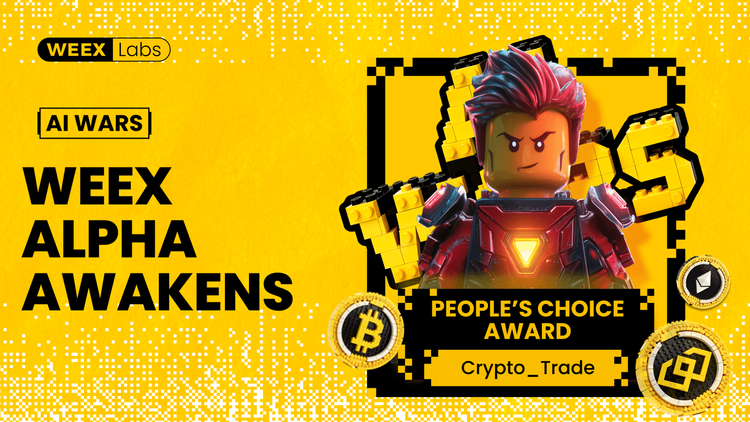
How a Structured AI Crypto Trading Bot Won at the WEEX Hackathon
Crypto_Trade shows how structured inputs and controlled adaptability can build a more stable and reliable AI crypto trading bot within the WEEX AI Trading Hackathon, highlighting a practical path toward scalable AI trading systems.
Particle Founder: The entrepreneurial insights I have gained the most from in the past year
Stop lean startup, stop lightning entrepreneurship, and think carefully about what your product aspirations are.
Huang Renxun's latest podcast transcript: The future of Nvidia, the development of embodied intelligence and agents, the explosion of inference demand, and the public relations crisis of artificial intelligence
The competition in the future is not just about whose model is larger or whose computing power is stronger, but also about who understands the industry better, who can embed AI more deeply into real processes, and who can organize these capabilities into a runnable and scalable system.
OKX Ventures Research Report: AI Agent Economic Infrastructure Research Report (Part 1)
The existing infrastructure is hostile to the Agent economy. Agents can think and act independently at the "capability level," but at the "economic level," they are still locked into infrastructure designed for humans.
The migration of settlement rights: B18 and the institutional starting point of on-chain banks
In the traditional system, banks decide the settlement; in the on-chain system, code begins to take over this responsibility.
From Tencent and Circle: Looking at the Simple and Difficult Questions of Investment
The AI narrative continues to ferment, but the recent performance of related stocks varies, with some in the midst of summer and others as if in winter.
The second half of stablecoins no longer belongs to the crypto circle
What Coinbase doesn't want, Mastercard is eager to buy.


 App
App