Risk Warning: Examining the 'Politicization' Scam of Cryptocurrencies Through LIBRA

By: blockbeats|2025/02/20 11:45:03
0
Share
copy
Original Title: "Risk Alert | Understanding the 'Politicized' Cryptocurrency Scam through LIBRA"
Original Source: SlowMist Security Team

Background

In recent years, an increasing number of politicians have ventured into the cryptocurrency field, issuing digital currencies under the guise of "national economic revitalization" or "innovation," among other pretexts, in an attempt to endorse tokens through the "celebrity effect" and promote the popularization of cryptocurrency. Although these tokens claim to be driving economic reform and technological innovation, they often conceal significant risks, becoming a "wealth trap" for speculators and ordinary investors. From TRUMP launched by the Trump family to the recently controversial LIBRA, these politicized cryptocurrencies have undoubtedly become the focus of the market. However, at the same time, they have also brought about significant security risks and the potential for a financial crisis.

As a company focused on blockchain security, we will use LIBRA as an example to reveal the potential risks of these politicized cryptocurrency projects and provide users with clearer security alerts.

The “Politicized” Cryptocurrency — LIBRA

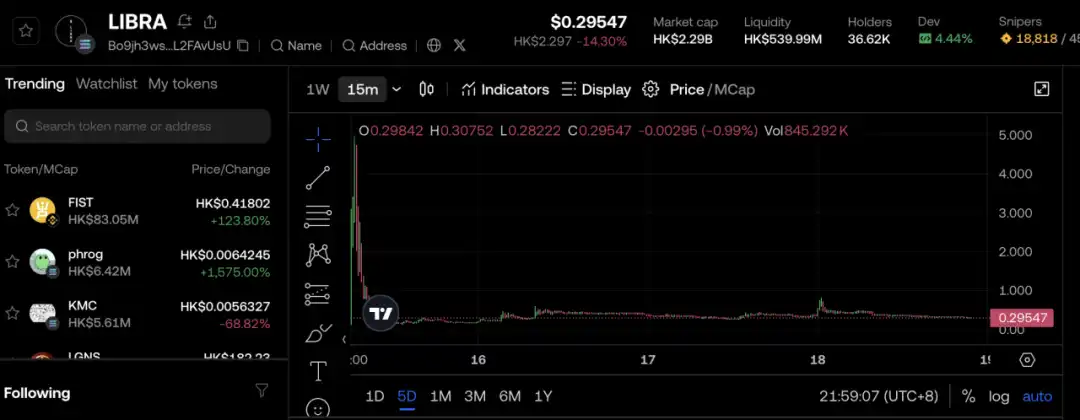
On February 15, Argentine President Milei launched a Memecoin named LIBRA, claiming that this would help promote the revival of the Argentine economy and publicly released the related contract address. After the announcement, numerous Memecoin enthusiasts rushed to participate in the project, causing LIBRA's price to skyrocket rapidly, with a market cap peaking at nearly $5 billion. However, just hours after the token was launched, the project team withdrew liquidity, causing the market cap to plummet rapidly to $590 million, resulting in significant losses for investors. Following the incident, Milei deleted the relevant promotional tweets, claiming to be unaware of the specific details of the LIBRA project, and announced the initiation of an anti-corruption investigation. As the situation unfolded, not only did lawyers file a lawsuit against Milei for alleged fraud, but it also sparked calls from the political opposition for impeachment proceedings against him.

Risk Warning: Examining the 'Politicization' Scam of Cryptocurrencies Through LIBRA

According to the analysis by the on-chain anti-money laundering and tracking tool MistTrack, eight wallets associated with the LIBRA team have currently profited over $100 million, detailed as follows:

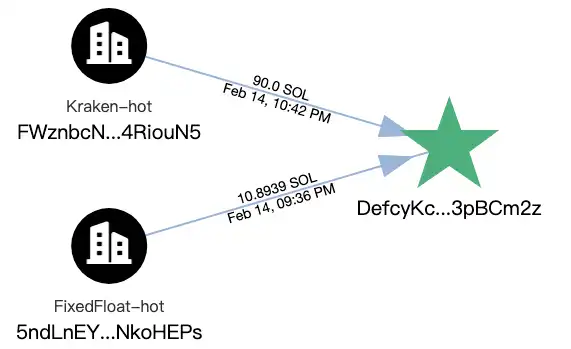
Address 1 - DefcyKc4yAjRsCLZjdxWuSUzVohXtLna9g22y3pBCm2z

On 2025-02-14 21:36:54 (UTC), this address withdrew 10.89 SOL from FixedFloat as initial capital and had previously withdrawn SOL from Kraken:
2025-02-14 21:37:49 to 2025-02-14 21:38:02 (UTC), create a new SPL Token, named LIBRA (Bo9jh3wsmcC2AjakLWzNmKJ3SgtZmXEcSaW7L2FAvUsU), then Mint 1 Billion SPL Tokens:

2025-02-14 21:38:48 (UTC), in the same transaction, transfer 200 million LIBRA to the address Gj9esbWVNJyy55SDJzYudMAznewqmW3Xb6GpUakcCNwT, with no further movement; transfer 500 million LIBRA to the address FdWhTThthSN7mbcmBgh18dzogi1dXqQqBb6BnnzZEJJn, ultimately ending up at address 42rex5yRsP1mdAKHzB5avDzagT6mqB5uYPergUFZ2Tgn.

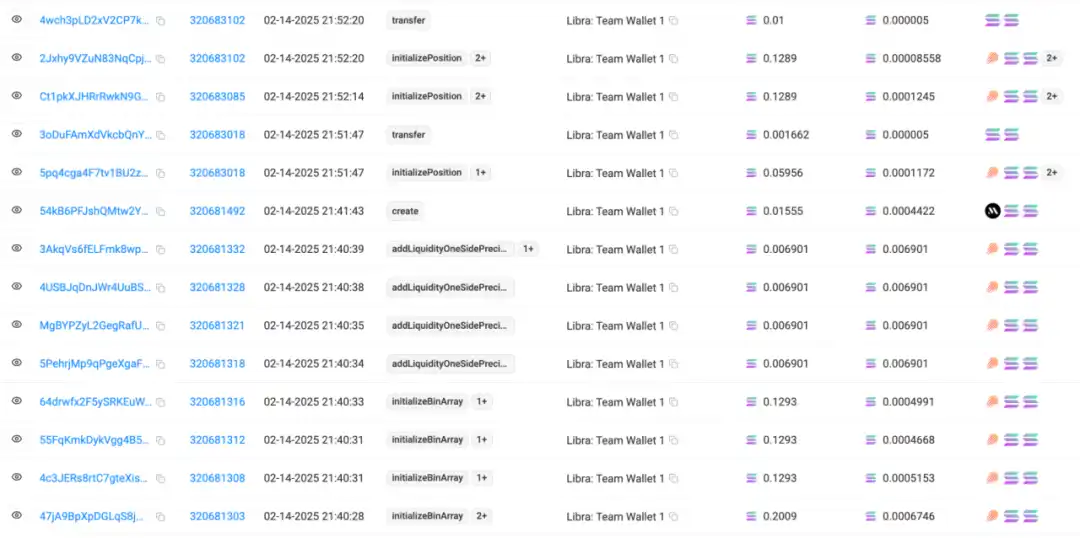
2025-02-14 21:40:24 to 2025-02-14 21:52:20 (UTC), create DLMM Config and Token Metadata:
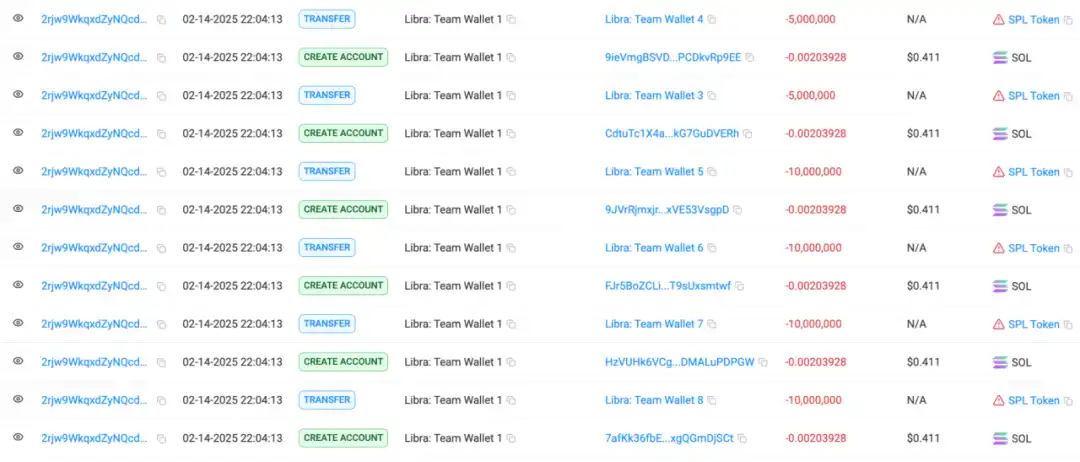
22:01, publish a tweet. 22:04, create relevant accounts and transfer LIBRA:
Profit address 1 profits approximately 13.06 million USDC via claimFee, not yet withdrawn:
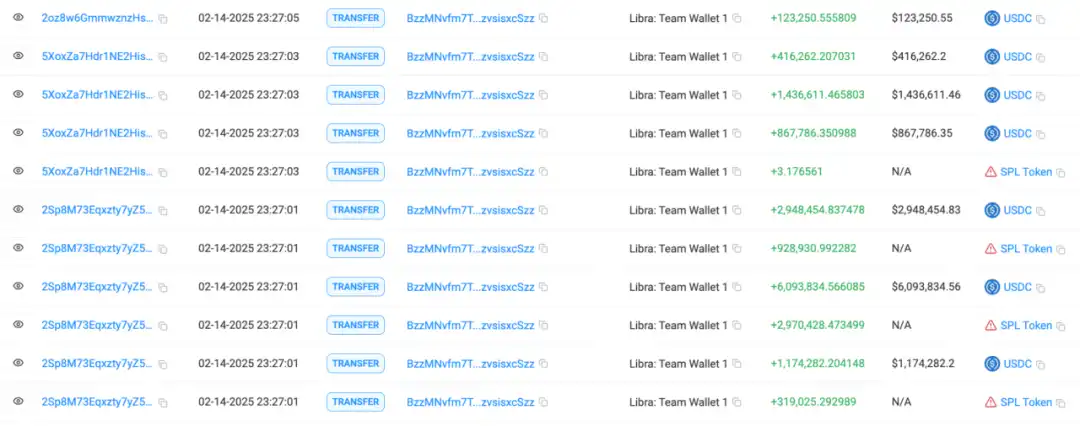
In addition, profit address 1 also transferred 650,000 LIBRA to address 3apupKwTisjy4Wx1zVndXVegmxtR9majPEgHatBRZ1LF at 22:30:34, the beneficial owner of this address is currently unknown.

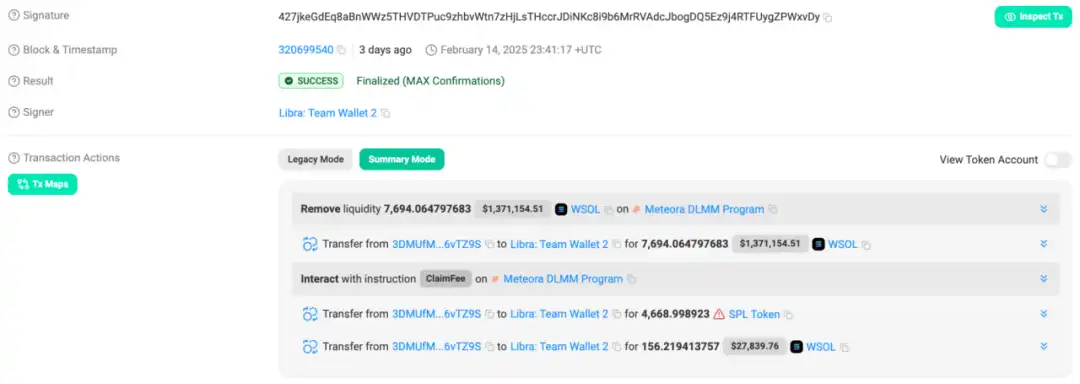
Address 2 - 2QmyirshoyT2ApsQU8bXdeGa2vTsNp1rxEzv4qhzTwyh

Profit approximately 32,052 SOL in address 2, not yet withdrawn, valued at approximately 6.4 million USD:
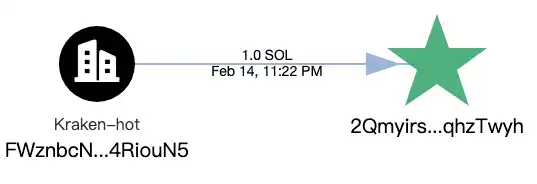
The address previously withdrew SOL from Kraken:
Address 3 - BXoCWWijZiVQFXNRqcZAiHQroYkaUnjkRznnZrt9gj42

Profited approximately 148,343 SOL, worth around $28.84 million:
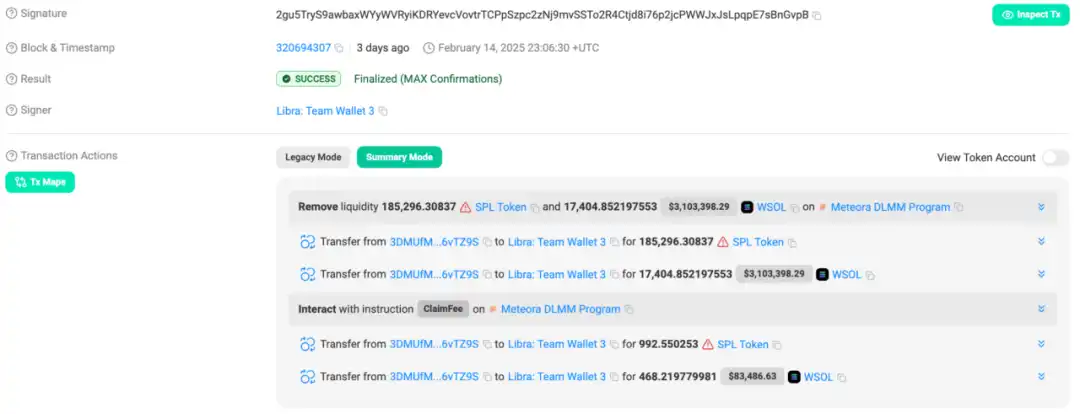
The address transferred 148,343 SOL to address B9KTwxhc9e6qrjw5nfmhgcN38oKFTBtnef8AwaTPVQ6q, which has not been withdrawn yet.
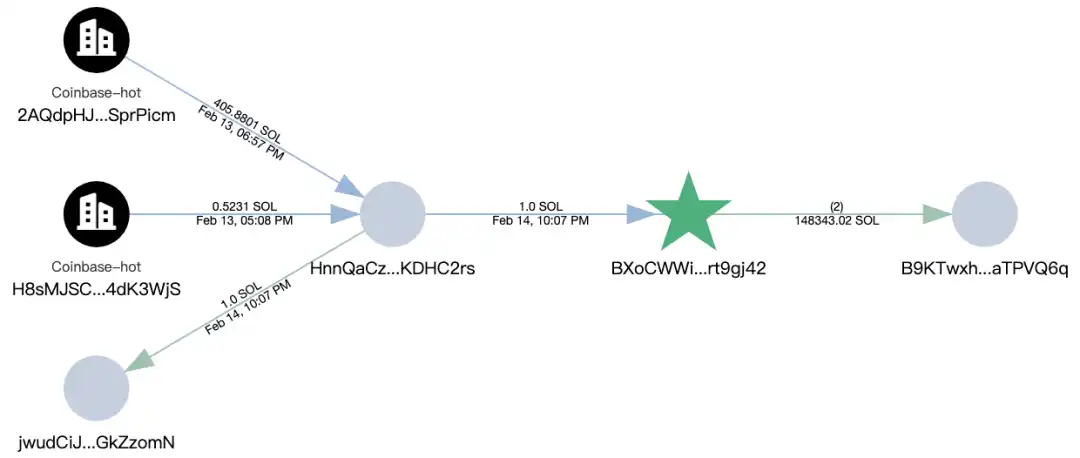
Furthermore, the initial funds of this address came from 1 SOL transferred from address HnnQaCzoFBSkT1xgksM6biyAZSyZgiorYsE6ZKDHC2rs, and address HnnQ also transferred 1 SOL to profit address 4, with address HnnQ's initial funds coming from Coinbase.

Address 4 - jwudCiJ5QUUmfxPXN41jaqYKnSc3UmKo5RoRGkZzomN

Profited approximately 69,276 SOL, worth around $13.47 million:

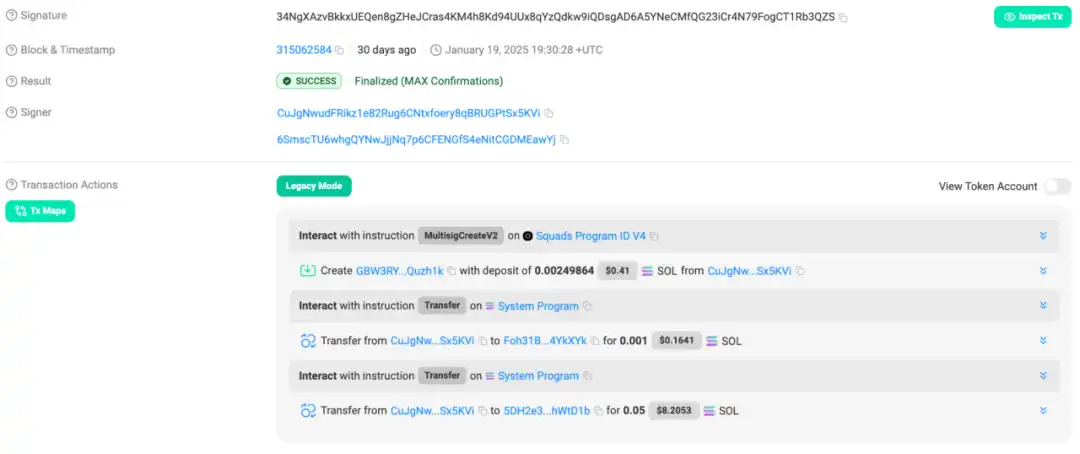
The address transferred 69,276 SOL to address FTjLYkNARZHnqekpKj5mHzbJx7EqW1fSr15Ec4oijBUQ, which has not been withdrawn yet. The initial funds of address FTjL came from 0.14 SOL transferred from address CuJgNwudFRikz1e82Rug6CNtxfoery8qBRUGPtSx5KVi.

It is worth noting that the initial funds of address CuJgNwudFRikz1e82Rug6CNtxfoery8qBRUGPtSx5KVi came from Bybit, and this address provided funding for the deployment of Melania, a Memecoin launched by Melania Trump, the former First Lady of the United States.
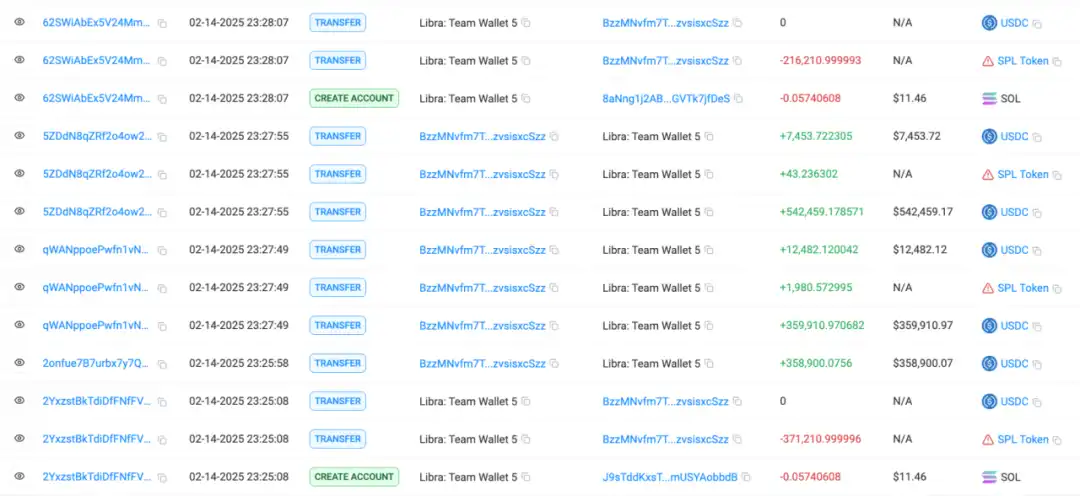
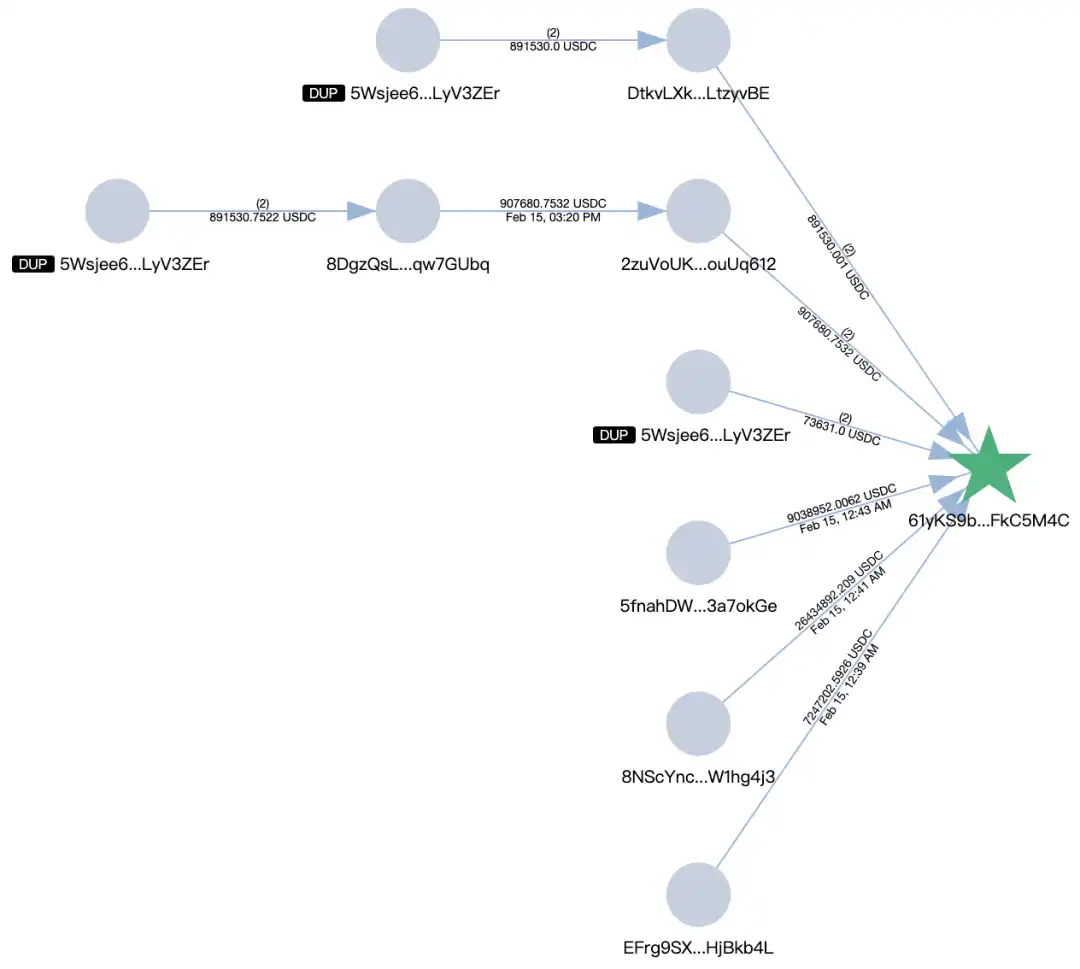
Address 5 - 5Wsjee6FgZQtxjUBedfNq9ZbV6RN7wgb4N422LyV3ZEr

Profit of approximately 1.85 million USDC:
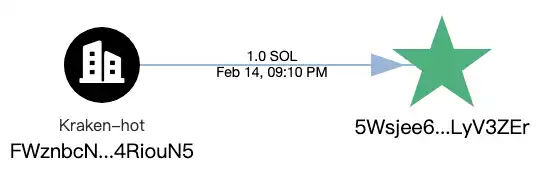
The address previously withdrew SOL from Kraken:
After multiple transfers, the USDC ultimately remained in address 61yKS9bjxWdqNgAHt439DfoNfwK3uKPAJGWAsFkC5M4C. Furthermore, we found that other sources of USDC in address 61yK were transferred from profit addresses 6, 7, 8, with a current total balance of 44.59 million USDC.
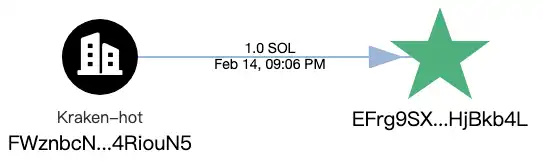
Address 6 - EFrg9SXbnCfuVqJPJf2hKKY3CtTPLHvipEpgrHjBkb4L

Profit of approximately 7.25 million USDC, transferred to address 61yKS9bjxWdqNgAHt439DfoNfwK3uKPAJGWAsFkC5M4C, and address 6's SOL came from Kraken:
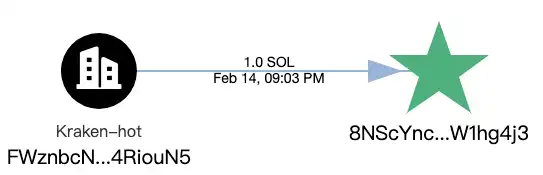
Address 7 - 8NScYncjpY1mKrbxVJFFdVqNPEocyXTnQqy9GW1hg4j3

Profit of approximately 26.43 million USDC, transferred to address 61yKS9bjxWdqNgAHt439DfoNfwK3uKPAJGWAsFkC5M4C, and address 7's SOL came from Kraken:
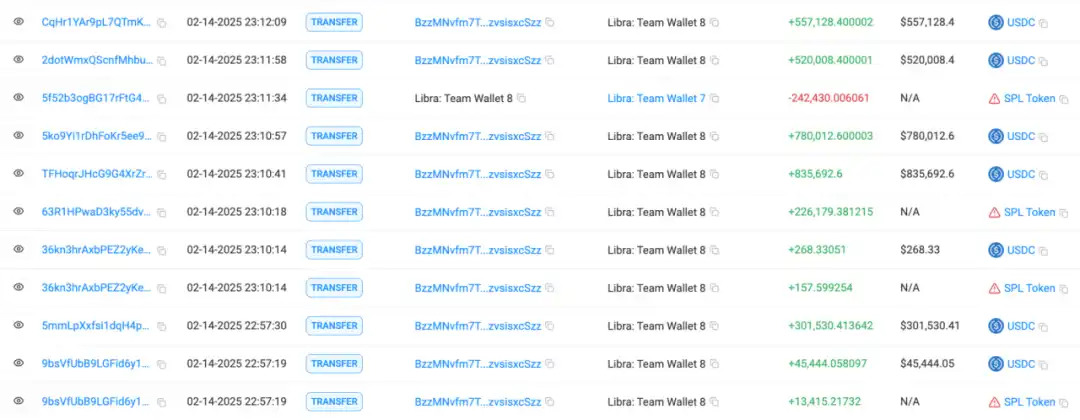
Address 8 - 5fnahDWBtUB8QBTXWHm2QzfAoAVHToxvMf38i3a7okGe

Profit of approximately 9 million USDC, transferred to address 61yKS9bjxWdqNgAHt439DfoNfwK3uKPAJGWAsFkC5M4C, and address 8's SOL came from Kraken:
As a newly launched project, LIBRA has not undergone a market audit, lacks a public technical whitepaper or compliance safeguards, and lacks value support. It is worth noting that some media outlets have pointed out controversial remarks in Milei's social media history, suggesting this behavior may be due to a hacked account. Furthermore, there have been allegations from users claiming that crypto influencer Threadguy admitted in a previous live stream that he was aware of LIBRA's token issuance information weeks in advance, potentially indicating another insider trading incident. This raises further questions about the legitimacy and security of this "token issuance operation." In addition, there have been rumors that a close associate of Milei accepted a $5 million bribe to push this token project in front of the president, facilitating the president's promotion of LIBRA. All these revelations further expose the possible manipulation and lack of transparency behind politicians launching tokens, highlighting the core issue of inadequate regulation behind the project.

The Risks Behind the Celebrity Effect

Milei is not the first politician to dabble in cryptocurrency. In January 2025, Trump also launched a Memecoin called TRUMP, which, solely based on his personal brand effect, successfully sparked a market frenzy. On the day of its launch, $TRUMP's market value skyrocketed by 1250%, with a trading volume exceeding 5 billion dollars.

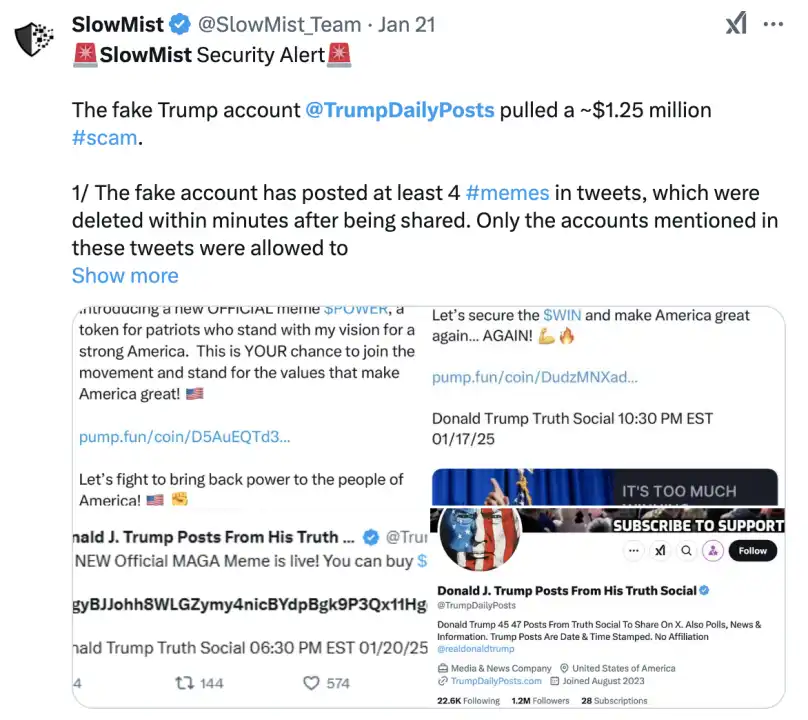
Users' FOMO sentiment towards $TRUMP also led to new scams. An X account named @TrumpDailyPosts with over 1.6 million followers not only synchronizes Trump's posts on Truth Social to Twitter but also posts Trump-related news and other tweets. According to an analysis by the SlowMist Security Team, this account had posted at least 4 tweets about the Memecoin, all of which were deleted minutes after posting, and only the mentioned account was allowed to comment.
The Trump family's actions are not the first to cause controversy. As mentioned earlier, the token MELANIA launched by Trump's wife Melania led to a halving of the TRUMP price, causing MELANIA's market value to evaporate by 7.5 billion dollars in just 10 minutes, resulting in significant wealth losses for users. Although Trump and his family claim that these actions are "in support of cryptocurrency innovation," these tokens often lack underlying value support, relying on the core of celebrity effect hype, with the market lacking a true assessment of the project's value. Once the market hype fades, the token's value will rapidly collapse, causing significant losses to ordinary investors, appearing glamorous on the surface but hiding substantial risks.

Politicized cryptocurrency does not equate to economic innovation and is often merely a tool for shifting contradictions and attracting attention.

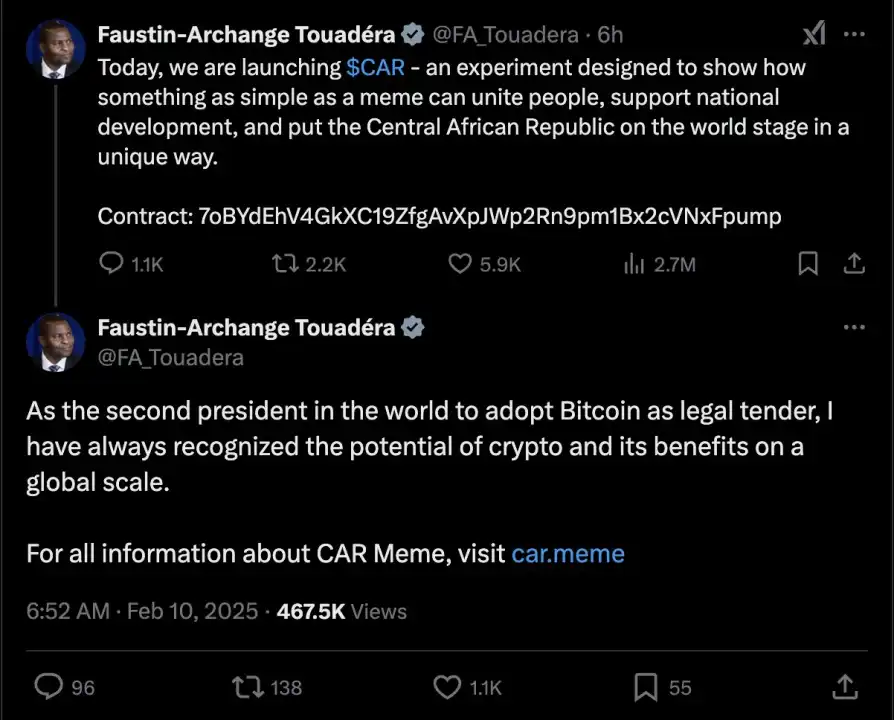
In February 2025, the President of the Central African Republic, Faustin-Archange Touadéra, launched a Memecoin called CAR, claiming that this move would drive national development through crypto assets. However, an investigation by the SlowMist Security Team found that CAR's official website was only registered for 4 days, with 80% of the tokens concentrated in 6 associated addresses, funded by Binance, lacking security audits and technical support.
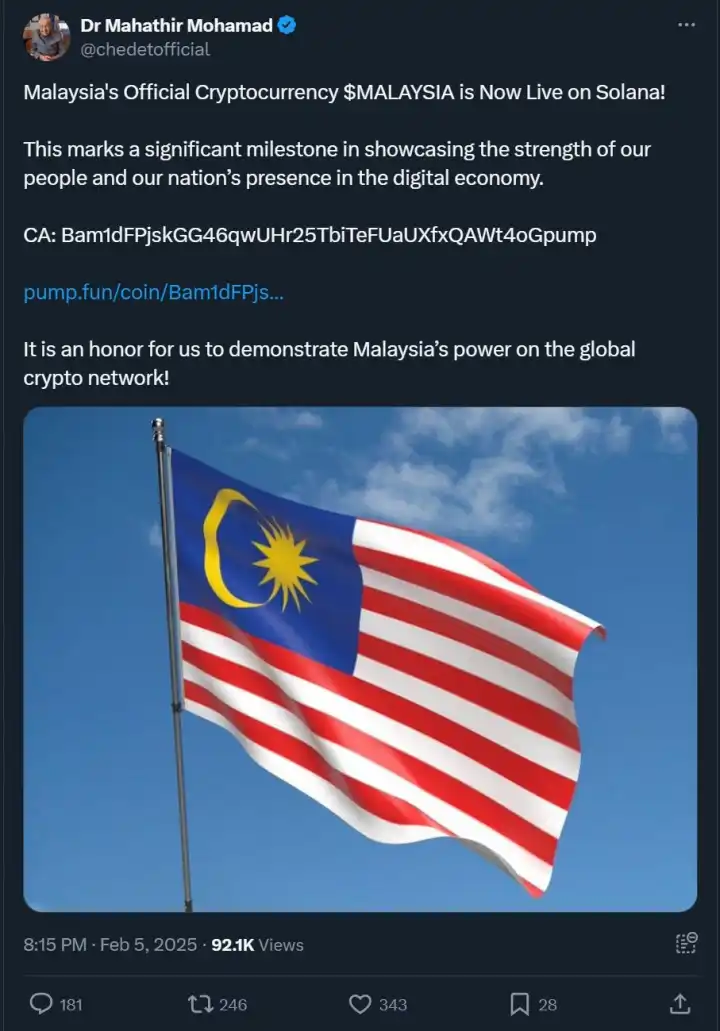
That same month, the social media account @chedetofficial of Malaysia's former Prime Minister also tweeted an announcement of the launch of $MALAYSIA, with the account suspected to have been hacked.
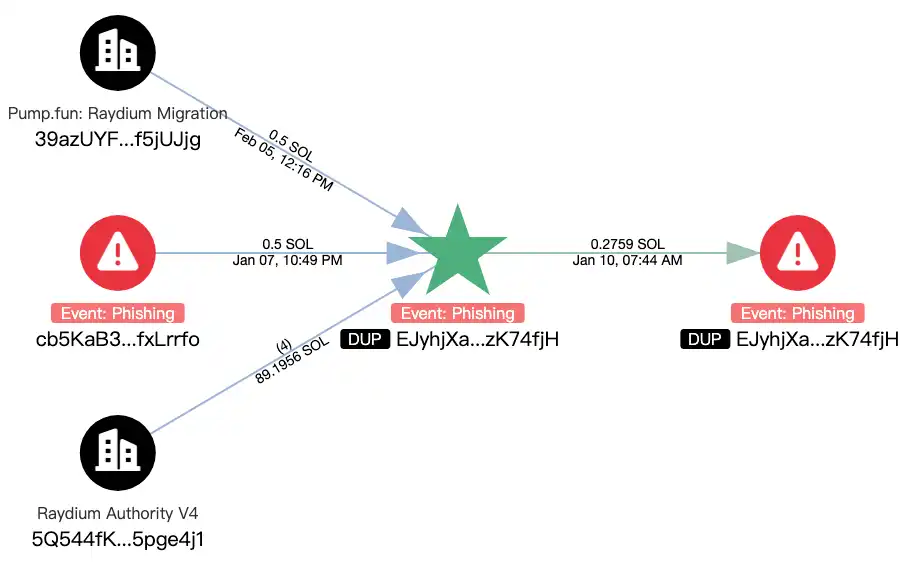
We identified through MistTrack that the creator of the smart contract address (CA) associated with this account has been linked to a historical malicious group.
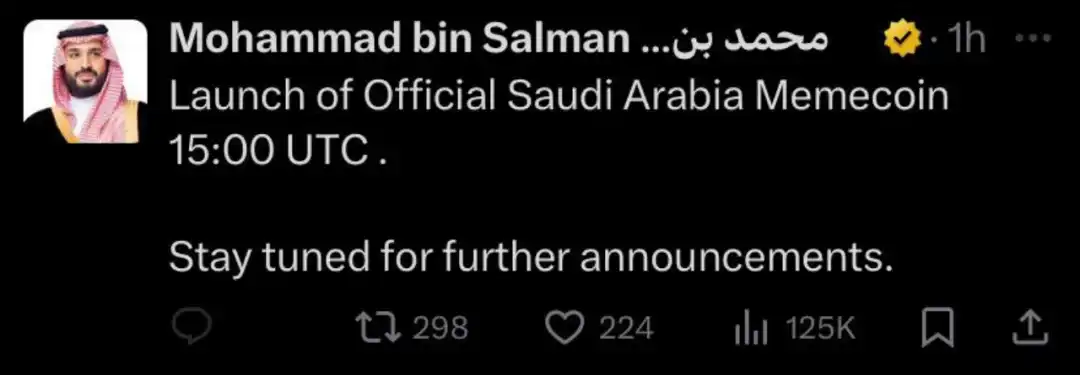
Fast forward to February 17, a fake X account claiming to be a Saudi Crown Prince official has been continuously posting tweets about Memecoin:
In addition to the above "coin launch" event, some politicians have also attempted to boost fiscal revenue through cryptocurrency mining farms, with Iran being one of them. The Iranian government had announced the legalization of domestic cryptocurrency mining farms to bring in more foreign exchange for the country. However, this move not only failed to effectively relieve Iran's economic pressure but also resulted in massive resource wastage and illegal power consumption due to a lack of proper regulation and policy safeguards, further diminishing the government's credibility in the international community.

Such tokens often experience an initial price surge through hype and fund manipulation, but when the market bubble bursts, investors are often left bearing the brunt of the losses. We have witnessed investors get liquidated within a very short period, suffering significant losses. This vicious cycle not only tarnishes the market image of cryptocurrency but also poses a significant threat to the wealth of ordinary investors.

Beware of Politicized Cryptocurrency Scams

The innovation of cryptocurrency should be built on a transparent and fair regulatory framework, rather than becoming a tool for politicians to exploit their personal influence and capital for hype. While the celebrity effect may attract a large number of investors in the short term, this hype often lacks underlying value, and these projects are usually unaudited, unregulated, and lacking reliable technical support. In such cases, investors blindly follow the trend, and once market sentiment reverses, token prices quickly collapse, leaving ordinary investors as the biggest victims.

We advise users to remain vigilant when dealing with such projects. It is essential to critically assess their authenticity and security from multiple perspectives, avoid blindly following trends, and preferably choose platforms that have undergone rigorous audits and compliance. To better protect their assets, users can utilize professional on-chain tracking tools such as MistTrack (https://misttrack.io/) to monitor and analyze their funds. MistTrack can assist users in real-time transaction tracking, fund flow analysis, thereby reducing the risk of encountering scams or Rug Pull events, and better safeguarding asset security.

Original Article Link

You may also like

Token Cannot Compound, Where Is the Real Investment Opportunity?

The next chapter in the crypto industry will undoubtedly be written by Crypto-empowered Stocks.

February 6th Market Key Intelligence, How Much Did You Miss?

1. On-chain Flows: $508.2M USD inflow to Ethereum today; $390.8M USD outflow from Arbitrum 2. Biggest Gainers/Losers: $HBTC, $AIO 3. Top News: Current Bitcoin weekly RSI oversold signal comparable to June 2022

China's Central Bank and Eight Other Departments' Latest Regulatory Focus: Key Attention to RWA Tokenized Asset Risk


Foreword: Today, the People's Bank of China's website published the "Notice of the People's Bank of China, National Development and Reform Commission, Ministry of Industry and Information Technology, Ministry of Public Security, State Administration for Market Regulation, China Banking and Insurance Regulatory Commission, China Securities Regulatory Commission, State Administration of Foreign Exchange on Further Preventing and Dealing with Risks Related to Virtual Currency and Others (Yinfa [2026] No. 42)", the latest regulatory requirements from the eight departments including the central bank, which are basically consistent with the regulatory requirements of recent years. The main focus of the regulation is on speculative activities such as virtual currency trading, exchanges, ICOs, overseas platform services, and this time, regulatory oversight of RWA has been added, explicitly prohibiting RWA tokenization, stablecoins (especially those pegged to the RMB). The following is the full text:


To the people's governments of all provinces, autonomous regions, and municipalities directly under the Central Government, the Xinjiang Production and Construction Corps:


  Recently, there have been speculative activities related to virtual currency and Real-World Assets (RWA) tokenization, disrupting the economic and financial order and jeopardizing the property security of the people. In order to further prevent and address the risks related to virtual currency and Real-World Assets tokenization, effectively safeguard national security and social stability, in accordance with the "Law of the People's Republic of China on the People's Bank of China," "Law of the People's Republic of China on Commercial Banks," "Securities Law of the People's Republic of China," "Law of the People's Republic of China on Securities Investment Funds," "Law of the People's Republic of China on Futures and Derivatives," "Cybersecurity Law of the People's Republic of China," "Regulations of the People's Republic of China on the Administration of Renminbi," "Regulations on Prevention and Disposal of Illegal Fundraising," "Regulations of the People's Republic of China on Foreign Exchange Administration," "Telecommunications Regulations of the People's Republic of China," and other provisions, after reaching consensus with the Cyberspace Administration of China, the Supreme People's Court, and the Supreme People's Procuratorate, and with the approval of the State Council, the relevant matters are notified as follows:


  I. Clarify the essential attributes of virtual currency, Real-World Assets tokenization, and related business activities


  (I) Virtual currency does not possess the legal status equivalent to fiat currency. Virtual currencies such as Bitcoin, Ether, Tether, etc., have the main characteristics of being issued by non-monetary authorities, using encryption technology and distributed ledger or similar technology, existing in digital form, etc. They do not have legal tender status, should not and cannot be circulated and used as currency in the market.


  The business activities related to virtual currency are classified as illegal financial activities. The exchange of fiat currency and virtual currency within the territory, exchange of virtual currencies, acting as a central counterparty in buying and selling virtual currencies, providing information intermediary and pricing services for virtual currency transactions, token issuance financing, and trading of virtual currency-related financial products, etc., fall under illegal financial activities, such as suspected illegal issuance of token vouchers, unauthorized public issuance of securities, illegal operation of securities and futures business, illegal fundraising, etc., are strictly prohibited across the board and resolutely banned in accordance with the law. Overseas entities and individuals are not allowed to provide virtual currency-related services to domestic entities in any form.


  A stablecoin pegged to a fiat currency indirectly fulfills some functions of the fiat currency in circulation. Without the consent of relevant authorities in accordance with the law and regulations, any domestic or foreign entity or individual is not allowed to issue a RMB-pegged stablecoin overseas.


(II)Tokenization of Real-World Assets refers to the use of encryption technology and distributed ledger or similar technologies to transform ownership rights, income rights, etc., of assets into tokens (tokens) or other interests or bond certificates with token (token) characteristics, and carry out issuance and trading activities.


  Engaging in the tokenization of real-world assets domestically, as well as providing related intermediary, information technology services, etc., which are suspected of illegal issuance of token vouchers, unauthorized public offering of securities, illegal operation of securities and futures business, illegal fundraising, and other illegal financial activities, shall be prohibited; except for relevant business activities carried out with the approval of the competent authorities in accordance with the law and regulations and relying on specific financial infrastructures. Overseas entities and individuals are not allowed to illegally provide services related to the tokenization of real-world assets to domestic entities in any form.


  II. Sound Work Mechanism


  (III) Inter-agency Coordination. The People's Bank of China, together with the National Development and Reform Commission, the Ministry of Industry and Information Technology, the Ministry of Public Security, the State Administration for Market Regulation, the China Banking and Insurance Regulatory Commission, the China Securities Regulatory Commission, the State Administration of Foreign Exchange, and other departments, will improve the work mechanism, strengthen coordination with the Cyberspace Administration of China, the Supreme People's Court, and the Supreme People's Procuratorate, coordinate efforts, and overall guide regions to carry out risk prevention and disposal of virtual currency-related illegal financial activities.


  The China Securities Regulatory Commission, together with the National Development and Reform Commission, the Ministry of Industry and Information Technology, the Ministry of Public Security, the People's Bank of China, the State Administration for Market Regulation, the China Banking and Insurance Regulatory Commission, the State Administration of Foreign Exchange, and other departments, will improve the work mechanism, strengthen coordination with the Cyberspace Administration of China, the Supreme People's Court, and the Supreme People's Procuratorate, coordinate efforts, and overall guide regions to carry out risk prevention and disposal of illegal financial activities related to the tokenization of real-world assets.


  (IV) Strengthening Local Implementation. The people's governments at the provincial level are overall responsible for the prevention and disposal of risks related to virtual currencies and the tokenization of real-world assets in their respective administrative regions. The specific leading department is the local financial regulatory department, with participation from branches and dispatched institutions of the State Council's financial regulatory department, telecommunications regulators, public security, market supervision, and other departments, in coordination with cyberspace departments, courts, and procuratorates, to improve the normalization of the work mechanism, effectively connect with the relevant work mechanisms of central departments, form a cooperative and coordinated working pattern between central and local governments, effectively prevent and properly handle risks related to virtual currencies and the tokenization of real-world assets, and maintain economic and financial order and social stability.


  III. Strengthened Risk Monitoring, Prevention, and Disposal


  (5) Enhanced Risk Monitoring. The People's Bank of China, China Securities Regulatory Commission, National Development and Reform Commission, Ministry of Industry and Information Technology, Ministry of Public Security, State Administration of Foreign Exchange, Cyberspace Administration of China, and other departments continue to improve monitoring techniques and system support, enhance cross-departmental data analysis and sharing, establish sound information sharing and cross-validation mechanisms, promptly grasp the risk situation of activities related to virtual currency and real-world asset tokenization. Local governments at all levels give full play to the role of local monitoring and early warning mechanisms. Local financial regulatory authorities, together with branches and agencies of the State Council's financial regulatory authorities, as well as departments of cyberspace and public security, ensure effective connection between online monitoring, offline investigation, and fund tracking, efficiently and accurately identify activities related to virtual currency and real-world asset tokenization, promptly share risk information, improve early warning information dissemination, verification, and rapid response mechanisms.


  (6) Strengthened Oversight of Financial Institutions, Intermediaries, and Technology Service Providers. Financial institutions (including non-bank payment institutions) are prohibited from providing account opening, fund transfer, and clearing services for virtual currency-related business activities, issuing and selling financial products related to virtual currency, including virtual currency and related financial products in the scope of collateral, conducting insurance business related to virtual currency, or including virtual currency in the scope of insurance liability. Financial institutions (including non-bank payment institutions) are prohibited from providing custody, clearing, and settlement services for unauthorized real-world asset tokenization-related business and related financial products. Relevant intermediary institutions and information technology service providers are prohibited from providing intermediary, technical, or other services for unauthorized real-world asset tokenization-related businesses and related financial products.


  (7) Enhanced Management of Internet Information Content and Access. Internet enterprises are prohibited from providing online business venues, commercial displays, marketing, advertising, or paid traffic diversion services for virtual currency and real-world asset tokenization-related business activities. Upon discovering clues of illegal activities, they should promptly report to relevant departments and provide technical support and assistance for related investigations and inquiries. Based on the clues transferred by the financial regulatory authorities, the cyberspace administration, telecommunications authorities, and public security departments should promptly close and deal with websites, mobile applications (including mini-programs), and public accounts engaged in virtual currency and real-world asset tokenization-related business activities in accordance with the law.


  (8) Strengthened Entity Registration and Advertisement Management. Market supervision departments strengthen entity registration and management, and enterprise and individual business registrations must not contain terms such as "virtual currency," "virtual asset," "cryptocurrency," "crypto asset," "stablecoin," "real-world asset tokenization," or "RWA" in their names or business scopes. Market supervision departments, together with financial regulatory authorities, legally enhance the supervision of advertisements related to virtual currency and real-world asset tokenization, promptly investigating and handling relevant illegal advertisements.


  (IX) Continued Rectification of Virtual Currency Mining Activities. The National Development and Reform Commission, together with relevant departments, strictly controls virtual currency mining activities, continuously promotes the rectification of virtual currency mining activities. The people's governments of various provinces take overall responsibility for the rectification of "mining" within their respective administrative regions. In accordance with the requirements of the National Development and Reform Commission and other departments in the "Notice on the Rectification of Virtual Currency Mining Activities" (NDRC Energy-saving Building [2021] No. 1283) and the provisions of the "Guidance Catalog for Industrial Structure Adjustment (2024 Edition)," a comprehensive review, investigation, and closure of existing virtual currency mining projects are conducted, new mining projects are strictly prohibited, and mining machine production enterprises are strictly prohibited from providing mining machine sales and other services within the country.


  (X) Severe Crackdown on Related Illegal Financial Activities. Upon discovering clues to illegal financial activities related to virtual currency and the tokenization of real-world assets, local financial regulatory authorities, branches of the State Council's financial regulatory authorities, and other relevant departments promptly investigate, determine, and properly handle the issues in accordance with the law, and seriously hold the relevant entities and individuals legally responsible. Those suspected of crimes are transferred to the judicial authorities for processing according to the law.


 (XI) Severe Crackdown on Related Illegal and Criminal Activities. The Ministry of Public Security, the People's Bank of China, the State Administration for Market Regulation, the China Banking and Insurance Regulatory Commission, the China Securities Regulatory Commission, as well as judicial and procuratorial organs, in accordance with their respective responsibilities, rigorously crack down on illegal and criminal activities related to virtual currency, the tokenization of real-world assets, such as fraud, money laundering, illegal business operations, pyramid schemes, illegal fundraising, and other illegal and criminal activities carried out under the guise of virtual currency, the tokenization of real-world assets, etc.


  (XII) Strengthen Industry Self-discipline. Relevant industry associations should enhance membership management and policy advocacy, based on their own responsibilities, advocate and urge member units to resist illegal financial activities related to virtual currency and the tokenization of real-world assets. Member units that violate regulatory policies and industry self-discipline rules are to be disciplined in accordance with relevant self-regulatory management regulations. By leveraging various industry infrastructure, conduct risk monitoring related to virtual currency, the tokenization of real-world assets, and promptly transfer issue clues to relevant departments.


  IV. Strict Supervision of Domestic Entities Engaging in Overseas Business Activities


(XIII) Without the approval of relevant departments in accordance with the law and regulations, domestic entities and foreign entities controlled by them may not issue virtual currency overseas.


  (XIV) Domestic entities engaging directly or indirectly in overseas external debt-based tokenization of real-world assets, or conducting asset securitization activities abroad based on domestic ownership rights, income rights, etc. (hereinafter referred to as domestic equity), should be strictly regulated in accordance with the principles of "same business, same risk, same rules." The National Development and Reform Commission, the China Securities Regulatory Commission, the State Administration of Foreign Exchange, and other relevant departments regulate it according to their respective responsibilities. For other forms of overseas real-world asset tokenization activities based on domestic equity by domestic entities, the China Securities Regulatory Commission, together with relevant departments, supervise according to their division of responsibilities. Without the consent and filing of relevant departments, no unit or individual may engage in the above-mentioned business.


  (15) Overseas subsidiaries and branches of domestic financial institutions providing Real World Asset Tokenization-related services overseas shall do so legally and prudently. They shall have professional personnel and systems in place to effectively mitigate business risks, strictly implement customer onboarding, suitability management, anti-money laundering requirements, and incorporate them into the domestic financial institutions' compliance and risk management system. Intermediaries and information technology service providers offering Real World Asset Tokenization services abroad based on domestic equity or conducting Real World Asset Tokenization business in the form of overseas debt for domestic entities directly or indirectly venturing abroad must strictly comply with relevant laws and regulations. They should establish and improve relevant compliance and internal control systems in accordance with relevant normative requirements, strengthen business and risk control, and report the business developments to the relevant regulatory authorities for approval or filing.


  V. Strengthen Organizational Implementation


  (16) Strengthen organizational leadership and overall coordination. All departments and regions should attach great importance to the prevention of risks related to virtual currencies and Real World Asset Tokenization, strengthen organizational leadership, clarify work responsibilities, form a long-term effective working mechanism with centralized coordination, local implementation, and shared responsibilities, maintain high pressure, dynamically monitor risks, effectively prevent and mitigate risks in an orderly and efficient manner, legally protect the property security of the people, and make every effort to maintain economic and financial order and social stability.


  (17) Widely carry out publicity and education. All departments, regions, and industry associations should make full use of various media and other communication channels to disseminate information through legal and policy interpretation, analysis of typical cases, and education on investment risks, etc. They should promote the illegality and harm of virtual currencies and Real World Asset Tokenization-related businesses and their manifestations, fully alert to potential risks and hidden dangers, and enhance public awareness and identification capabilities for risk prevention.


  VI. Legal Responsibility


  (18) Engaging in illegal financial activities related to virtual currencies and Real World Asset Tokenization in violation of this notice, as well as providing services for virtual currencies and Real World Asset Tokenization-related businesses, shall be punished in accordance with relevant regulations. If it constitutes a crime, criminal liability shall be pursued according to the law. For domestic entities and individuals who knowingly or should have known that overseas entities illegally provided virtual currency or Real World Asset Tokenization-related services to domestic entities and still assisted them, relevant responsibilities shall be pursued according to the law. If it constitutes a crime, criminal liability shall be pursued according to the law.


  (19) If any unit or individual invests in virtual currencies, Real World Asset Tokens, and related financial products against public order and good customs, the relevant civil legal actions shall be invalid, and any resulting losses shall be borne by them. If there are suspicions of disrupting financial order and jeopardizing financial security, the relevant departments shall deal with them according to the law.


  This notice shall enter into force upon the date of its issuance. The People's Bank of China and ten other departments' "Notice on Further Preventing and Dealing with the Risks of Virtual Currency Trading Speculation" (Yinfa [2021] No. 237) is hereby repealed.


Former Partner's Perspective on Multicoin: Kyle's Exit, But the Game He Left Behind Just Getting Started

Kyle knew his game, so he decided to focus on playing the game he was good at and interested in.

Why Bitcoin Is Falling Now: The Real Reasons Behind BTC's Crash & WEEX's Smart Profit Playbook

Bitcoin's ongoing crash explained: Discover the 5 hidden triggers behind BTC's plunge & how WEEX's Auto Earn and Trade to Earn strategies help traders profit from crypto market volatility.

Wall Street's Hottest Trades See Exodus

This time there is no single triggering factor, but rather market anxiety about asset valuation, with many already skeptical of these valuations being too high, leading to investors choosing to retreat almost simultaneously.

Popular coins

Latest Crypto News

Read more