
Vitalik Chinese Community Conversation: Ethereum Needs a New Narrative and New Users; Internal EF Reform Underway


On the evening of February 19th, invited by FSL Chief Revenue Officer Mable Jiang, Ethereum founder Vitalik Buterin participated in a special flash text AMA in the "Flash Interview Circle" within the Tako App. The interview had collected anonymous questions from the community in advance, aiming to address the community's concerns and confusion about Ethereum's future development.
The interview covered topics such as ETH's future adoption and ultimate narrative, how to view the relationship between L2 and the Ethereum main chain, MegaETH's centralized sequencer solution, and more. Vitalik even answered a community user's question about whether he is a communist. It is worth noting that this is also the first time Vitalik has conducted an AMA in Chinese in recent years.
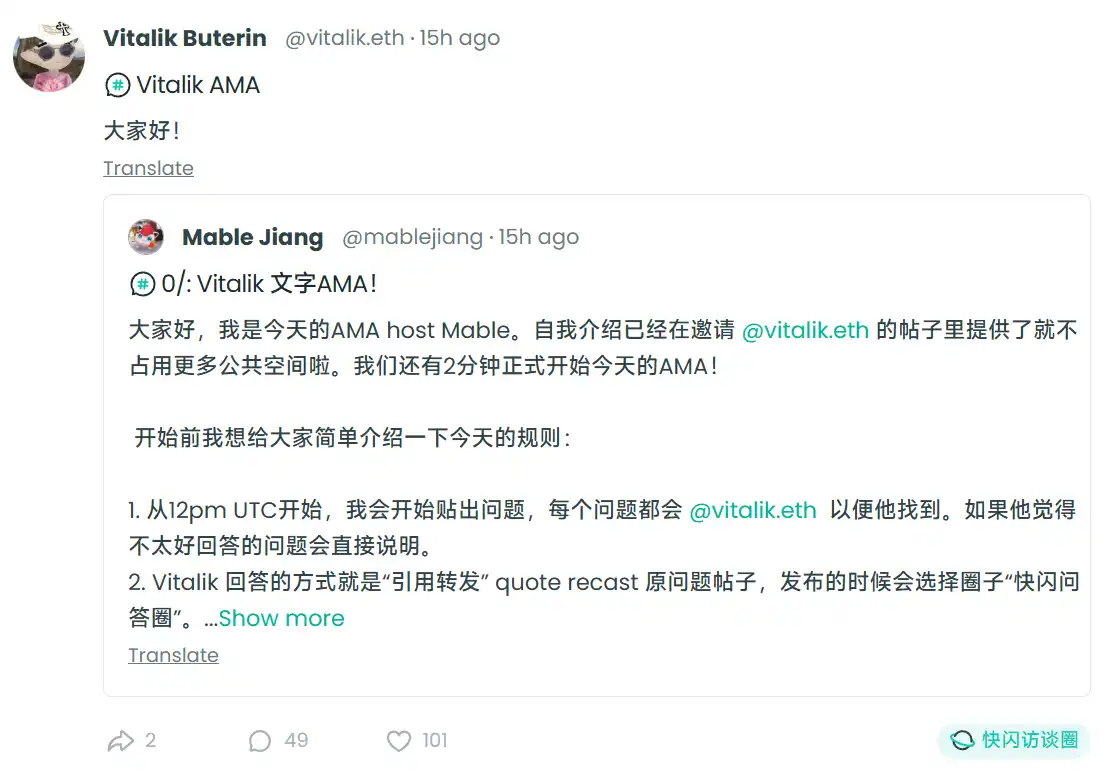
Below is a summary of the content of this AMA:
Q1: In your view, should today's Ethereum be closer to Bitcoin's existence or to that of a world computer? In a previous X post, you mentioned that many of those who hold negative views on ETH are actually short-term speculators, and their frustration is almost of no constructive help to the ETH community. However, within the OG ETH-Maxi camp, there are also many people who loudly promote the idea that "ETH is money" (such as Bankless, the largest ETH Maxi media) and compare ETH to BTC, considering it another competitive form of digital currency (possibly even a better form of money). For the future adoption of ETH, what is the ultimate narrative you envision?
Vitalik: Is Ethereum a world computer or money? I think these two ways of thinking are compatible with each other.
If you need to distinguish which blockchains are "truly decentralized," you can use a relatively simple test: if their foundation disappeared, could the chain survive? I have a feeling that only Bitcoin and Ethereum can answer this question clearly: of course, they could. The majority of Ethereum's development is outside the foundation, client teams have independent business models, many researchers are no longer within the foundation, and almost all activities except Devcon are independent. It is hard to reach this stage, 5 years ago Ethereum was not like this.
Abandoning these advantages in pursuit of TPS is a big mistake because there will always be new chains coming out with suddenly higher TPS than you. But decentralization and resilience are valuable, qualities that few blockchains possess.
These characteristics are conducive to creating a long-term valuable digital currency and also beneficial for a good world computer. However, the world computer also needs to address the scalability issue. The concept of the "world computer" does not mean a "computer that can simultaneously support every application worldwide," but rather "a place where applications worldwide can interact with each other." High-performance computing can be placed in Layer 2 without any issues. However, this beauty still requires Layer 1 to have sufficient scale. For specific details, please refer to an article I recently wrote: "Vitalik's New Article: Substantial Expansion of L1 Still Has Value, Making App Development Easier and Safer"
ETH is the world's application (including finance and others like ENS) and is a digital asset suitable for interoperability between them. ETH does not need every transaction to be placed on L1 but requires enough throughput to allow anyone who wants to use L1 occasionally to do so. Therefore, these two directions are also compatible: helping Ethereum achieve the characteristics of a better world computer is also the feature of making ETH a better digital currency.
Q2: Today, we have seen the emergence of many L2 solutions, primarily based on the OP stack, with some attempts at zk-rollups. I would love to hear your assessment of the rollups roadmap over the past few years, hoping for a relatively objective review: What areas do you think have been done well, where did it deviate from the original vision, and do rollups, on the whole, benefit Ethereum or are they parasites (I recently saw you calling for these L2 solutions to give back to Ethereum)? Does ETH really need these L2 solutions?
Vitalik: Ethereum needs a hybrid L1 + L2. Until now, our scaling approach can be understood as a hybrid L1 + L2, but I don't think anyone has clearly defined which transactions should be on L1 and which should be on L2.
The answer of "put everything on L2" is somewhat hard to accept because:
* This makes it easy to lose the position of ETH as a medium of exchange, store of value, etc. If you are concerned about L2 stealing L1 users and not giving back to L1, this issue would be more severe in a scenario where "L1 does almost nothing."
* Cross-L2 operations still require L1. If an L2 has issues, users still need a way to move to another L2. So there are some use cases that are very hard to avoid using L1. I wrote an article on this topic here: "Vitalik's New Article: Significantly Expanding L1 Still Has Value, Making App Development Easier and Safer"
The answer of "put everything on L1" is also somewhat hard to accept because:
* If L1 supports a lot of transactions, it could become centralized, even when using technologies like ZK-EVM
* The world's demand for on-chain transactions is limitless. No matter how high L1's TPS is, there will always be an application that needs 10 times more TPS (e.g., AI, micro-payments, micro-prediction markets, etc.)
* L2 does not only do scaling but can also provide faster confirmation speeds through preconfirmations and can address the MEV issue through sequencers
So we need a hybrid L1 + L2 solution. I think the role of L2 will continue to evolve. For example, right now, it seems like an evm-equivalent L2 is already sufficient. We may see more privacy-focused L2 solutions (such as Aztec, zkSync, etc.), or more application-specific L2 solutions (if an application wants to control its MEV situation, etc.). So in the short term, I think we should continue to improve L1's capacity, increase blobs to give L2 more space, promote cross-L2 interoperability, and then the market will decide which scaling solution is suitable for which application.
Q3: The rollup roadmap has been proposed for quite some time. Do you think that Arbitrum / Optimism-PBC / StarkWare's current centralized sequencers pose a significant challenge for future regulation as they cannot be truly censorship-resistant? Do you think they will move towards a decentralized sequencer solution? If your answer to the previous question is yes, how do you view MegaETH's centralized sequencer solution?
Vitalik: Regarding centralized sequencers, centralized sequencers actually have many advantages:
* A centralized sequencer can ensure that users' funds are not stolen through frontrunning or similar methods
* instant preconfirmations
* It is very easy to turn a traditional application into a blockchain application because the server directly becomes the sequencer
The decentralized nature of blockchain can be used to mitigate the risks of a centralized sequencer: mechanisms like forced inclusion prevent sequencers from censoring users, while optimistic or zk proof mechanisms prevent sequencers from changing or violating the application's rules (e.g., suddenly inflating a token or NFT collection)
However, there are still risks with a centralized sequencer, so we cannot rely solely on a centralized sequencer to solve the problem. The ability to use a rollup-based solution or conduct transactions directly on Layer 1 is also important. Therefore, I support driving both parts of the ecosystem simultaneously with these two approaches, and then we can see which approach is more suitable for which application. Maintaining the ability for regular users to make censorship-resistant transactions is, of course, crucial.
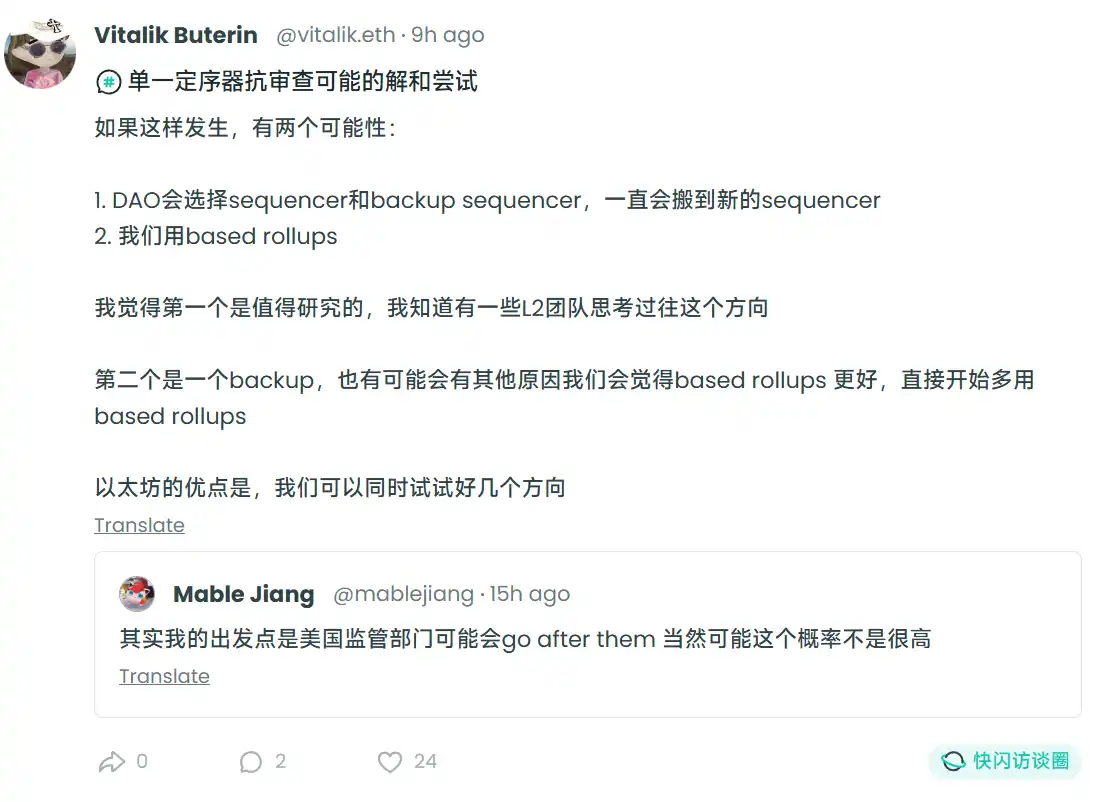
Vitalik responding to a comment "My point was actually that the US regulatory authorities might go after them, though perhaps the probability of that is not very high": Anticensorship solution and attempt for a single sequencer. If this were to happen, there are two possibilities:
1. The DAO will choose a sequencer and a backup sequencer, and we will keep moving to a new sequencer
2. We will use based rollups
I think the first option is worth exploring, and I know some L2 teams have thought about it. The second is a backup, and there may be other reasons why we prefer based rollups and start using them more. The advantage of Ethereum is that we can try several directions at the same time.
Q4: The technical roadmap for ETH 3.0, the goals it hopes to achieve, and the differences between the goals of the rollup era and the goals of the rollup era announced at Devcon in November last year. Has the 3.0 design proposed at Devcon taken into account the fact that rollups have not truly provided practical value to the Ethereum mainnet?
Vitalik: The relationship between value capture between L2 and L1. There is currently nothing called ETH 3.0. Some might say that Justin Drake's 5-year plan is, but that plan is only for the consensus layer, not the execution layer, so it is only a part of the future of the Ethereum blockchain.
The relationship and balance between L1 and L2 is an execution layer issue. Here is another roadmap: strengthening L1 capabilities (increasing gas limit, adding stateless verification (such as Verkle), and other features, etc.), improving cross-L2 interoperability, enhancing blobs, etc. I also think the question of whether L2 is paying enough transaction fees to L1 cannot be viewed solely from a short-term perspective. For example:
* Prior to 4844, everyone's complaint was the opposite: Is L1 sucking blood from L2?
* Now, the blob fee in the last 30 days is 500 ETH
* If the blob target is increased from 3 to 128, according to our plan, with the same blob gas price, it will burn 21,333 ETH per month, and 256,000 per year
So the narrative can easily change rapidly, and now we need to strengthen L1, so that what should happen on L1 can happen on L1, increase blobs, and then maintain the adaptability of our community.
Q5: You have decided to step up as the leader of the EF. I believe this decision was made after much consideration and is a courageous leap into the unknown. I admire it greatly. Would you mind sharing with us today your entire thought process? At the same time, I am curious if you endorse Chinese socialism? The starting point of my question is related to the "proper board" mentioned in your discussion with Ameen: Before stepping onto the right path of development, do you think an organization needs strong leaders to guide and correct its direction?
Vitalik: "Decentralization" does not mean "doing nothing."
I think the blockchain community, and the world as a whole, are in a rather precarious state. Many things with no long-term value, or even malicious intent, are happening. These things and the people behind them are getting a lot of attention. But we cannot just shout against these things and not offer a better alternative. So our goal should be to do this alternative well, to demonstrate proof that a stable, brighter future is possible.
Here, I'll say both within the blockchain community (if a memecoin that crashes 97% in a day is not our future, what is?) and on a macro societal level: Many people now believe that democracy is impossible, and things can only be done by a strong leader. But at Devcon, a political scientist told me that he respects Ethereum a lot because we are a genuinely open and decentralized ecosystem, and we have succeeded at our current scale, which gives him hope. So if we can succeed in this way, the positive impact on the world could be significant, providing many people with a bright and successful example to follow.
However, "decentralization" does not mean "doing nothing." The Ethereum Foundation's philosophy of subtraction does not mean "reduce the Foundation to 0," but rather a way to maintain ecosystem balance. If there is an imbalance in an ecosystem (e.g., a part of the ecosystem is too centralized, or there is an important but unattended public good), we can help counterbalance. Once this issue is resolved, the Foundation can retreat from that area. If a new imbalance arises elsewhere, we can move resources there, and so on.
In Chinese culture, the way we pursue may be most similar to the thinking of the Tao Te Ching, but following this path requires intelligence and the Foundation's ability to elevate in certain areas—it's not a matter of "doing nothing and succeeding." So, in the short term, more effort may be needed to make some important pivots.
Q6: I am not part of the core Ethereum circle, so I am not very clear on some detailed political issues. From your perspective, what do you understand to be the main reasons why some ETH Maxis OGs have left the Ethereum community? When Shuyao and I recorded the podcast, she mentioned an interesting point: Ethereum needs to go to zero before it can rebuild (half-jokingly). In the current stage of Ethereum, do you believe that there is indeed a major reshuffle of existing holders and community members needed to pave its unique path?
Vitalik: Ethereum needs a new story and new users.
There are many different people with different stories. For example, many people in the blockchain community would have said 10 years ago that the goal of blockchain is to create a globally neutral system, protect individual freedom, counterbalance government hegemony; now, if a president mints a memecoin, they would say, "Wow, this is real-world adoption, so good," but why didn't it happen on our chain? If we can be a bit friendlier to those politicians, next time it will happen on our chain! Personally, I think these people have gone astray. Of course, they would say I am too idealistic, not realistic, and so on. Every party has its own story.
Some people may also say that Ethereum's ecosystem is too OG-controlled and doesn't leave enough room for new blood. However, this criticism comes from another direction, with different groups making these arguments.
I believe there is only one right path to get us out of these predicaments: we need newer stories to explain why Ethereum is what it is, what the ETH coin is for, what L1 and L2 are for, etc.? It is no longer the era of infra; it is the era of applications, so these stories cannot be abstract "freedom, openness, anti-censorship, cypherpunk public goods, etc."; we need some clear application layer answers. I plan to support more in the near future: info finance (which also serves as the direction of AI + crypto), privacy protection, high-quality public goods financing methods, and continue to do well in building a world-class open finance platform, which must also include real-world assets. There are many things here that are valuable to many users at the same time and in line with the values we have always had. We need to re-support this direction so that new people have more opportunities to join.
Q7: Do you think Ethereum needs a more corporate type of management? Do you believe that the current difference between ETH and SOL is fundamentally an efficiency difference between different "organizational forms," as well as a difference in goals? What are the respective goals?
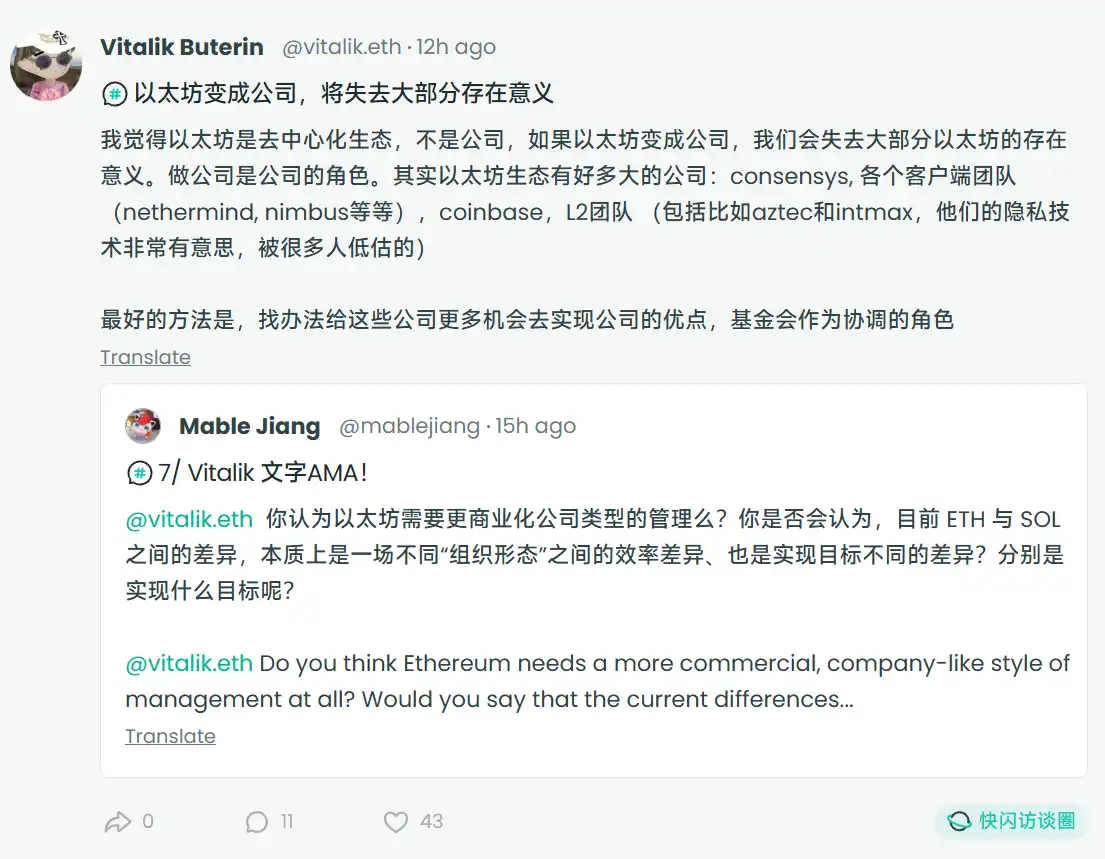
Vitalik: Turning Ethereum into a company would lose most of its meaning
I think Ethereum is a decentralized ecosystem, not a company. If Ethereum were to become a company, we would lose most of the meaning of Ethereum's existence. Running a company is the role of a company. In fact, the Ethereum ecosystem has many large companies: ConsenSys, various client teams (Nethermind, Nimbus, and others), Coinbase, L2 teams (including, for example, Aztec and Matter Labs, whose privacy technologies are very interesting and underestimated by many).
The best way is to find ways to give these companies more opportunities to realize the advantages of a company, with the foundation acting as a coordinating role.
Q8: You have always been focused on the application of ZK technology in the web3 space. Besides ZK applications in asset transaction scenarios, in a social media network, what scenarios do you think can introduce ZK to achieve privacy protection?
Vitalik: I am very interested in many non-financial ZK use cases, such as:
* Anti-Sybil verification. Many services require you to log in with KYC not because they want to know who you are, they just want to know you are not a bot, or if you are banned, you cannot come back with 100,000 new accounts. To achieve this use case, only a ZK proof of personhood or proof of reputation is needed, and sometimes proof of tokens is also sufficient, like AnonWorld.
* Privacy-protecting AI applications using cryptographic means. Here, ZK may not necessarily be the most suitable technology; FHE may be. Recently, FHE has also made significant progress, and if we can further reduce the overhead of FHE, there may be an opportunity.
* Wrapping any web2 account with zk-SNARKs for use in web3. ZKEmail, Anon Aadhaar, ZKPassport, ZKTLS, and so on are good examples.
I believe this technology has many opportunities to address a wide range of security, governance, and other issues in social and other areas in a way that protects individual freedom and privacy.
Q9: Do you encourage more developers to join Ethereum, incentivize and retain existing developers (compared to some new L1 or even L2 more generous developer incentives, Ethereum certainly has a more complex situation), is this currently a priority? Accelerating network decentralization, improving scalability, exploring more application scenarios (Apps), in these three aspects, which one do you think is the highest priority for Ethereum?
Vitalik: The alignment of the Ethereum community is not a social game but a technical game. Here we actually need to find a way to simultaneously solve three problems:
1. Attracting more developers
2. Encouraging developers to develop applications that are more open-source, secure, compliant with public standards, have long-term value, etc.
3. In the process of addressing (2), avoiding the ecosystem becoming a closed circle ("We are aligned because we are good friends of developers")
So I recently said Ethereum alignment should be a technical game, not a social game. I want to emphasize this issue because I think that right now, in terms of decentralization, the most pressing centralization issues are often not at the L1 level, but at the L2 or wallet or application level. So the entire ecosystem needs to work together to simultaneously expand and attract new developers and progress in these decentralized and trustless aspects.
There are several ways we can help achieve this situation:
1. Education, making it easier for developers to understand what blockchain is about, what should be on-chain, what should not be on-chain, what matters in the blockchain space, etc.
2. If some of the blockchain's unique technical aspects are too difficult for application developers, the foundation can do them themselves, making it easier for developers to integrate. For example, zk programming languages, as well as a16z's helios, etc.
3. Provide clear standards to developers. For example, if you are developing an Ethereum client, there are many tests that you can run to see if your client can pass. If you are working on L2, there are frameworks like l2beat's stage 1, stage 2, etc. This should also apply to zk applications, wallets, etc.
Q10: Today, in the context of the evolution of AI acceleration technologies, you previously mentioned the concept of d/acc (decentralized defensive acceleration / or defense against accelerationism). Now, looking at the effective acceleration process regarding the dispersal/decentralization of technology rights, does it meet your expectations? Do you have any concerns in this regard? Personally, I feel somewhat powerless as I know "The Beijing Folding" may be a kind of future. From a humanistic perspective, I do not want it to happen, but I feel it is getting closer to us.
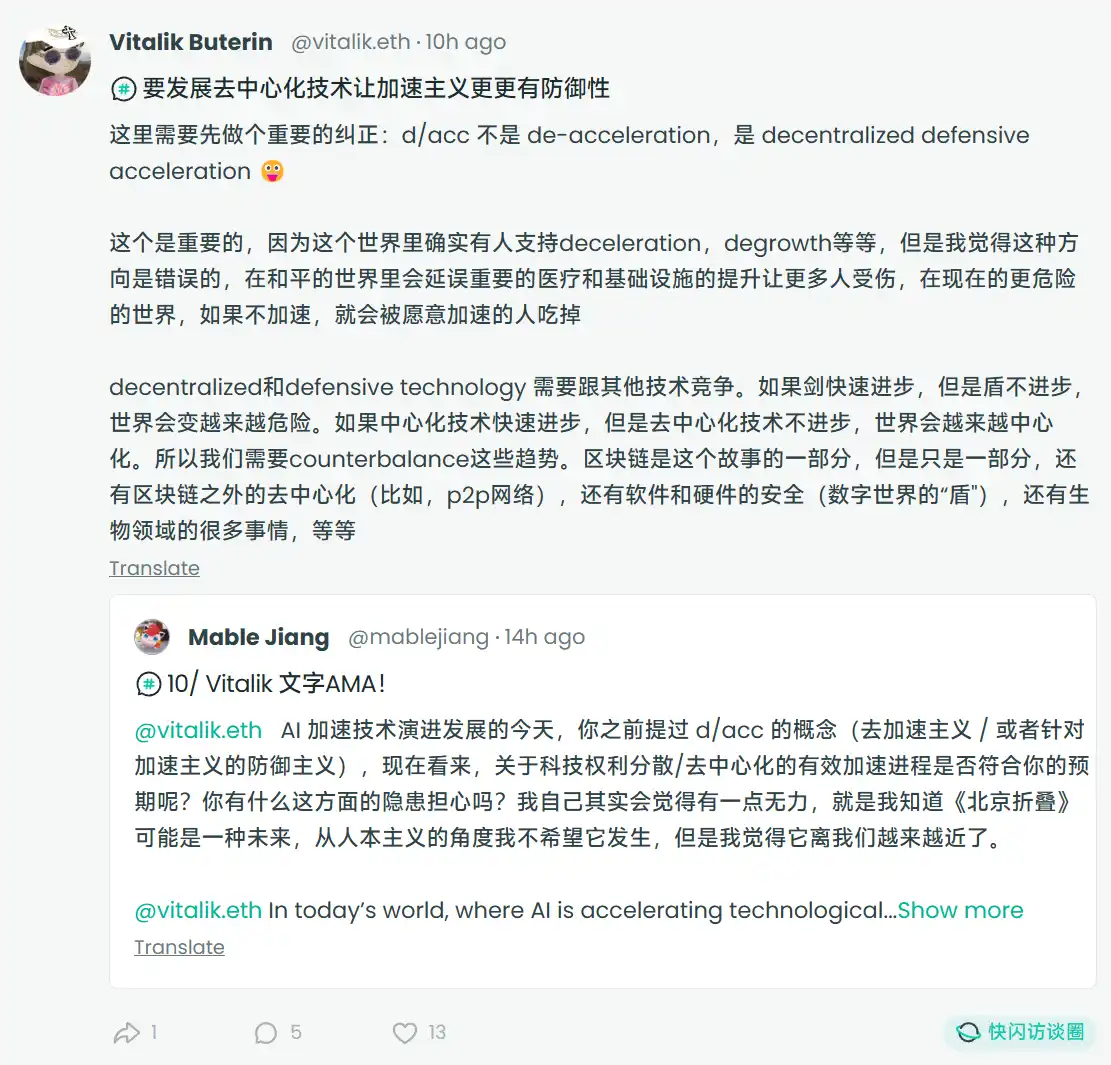
Vitalik: Here I need to make an important correction: d/acc does not mean de-acceleration; it stands for decentralized defensive acceleration. This is important because in this world, some people do indeed support deceleration, degrowth, and so on, but I believe this direction is wrong. In a peaceful world, it would delay crucial advancements in healthcare and infrastructure, causing more harm. In the current more dangerous world, if we do not accelerate, we will be overtaken by those willing to accelerate.
Decentralized and defensive technology need to compete with other technologies. If the sword progresses rapidly but the shield does not, the world will become increasingly dangerous. If centralized technology advances quickly but decentralized technology does not, the world will become more centralized. Therefore, we need to counterbalance these trends. Blockchain is part of this story, but only a part. There is decentralization beyond blockchain (such as P2P networks), software and hardware security (the "shield" of the digital world), many things in the biological field, and so on.
Q11: Do all Ethereum Foundation employees, including the leadership team, have KPI/OKR or similar performance evaluation mechanisms? Non-profit organizations generally face issues of inefficiency. Do you believe the EF has such issues? If so, how are they addressed? Can you systematically elaborate on all aspects of accelerating Ethereum's development? With Ethereum being ten years old and updates happening once a year, the development progress seems a bit slow and requires significant acceleration.
Vitalik: The Ethereum Foundation has recently undergone many internal reforms, so any answer I can provide now will quickly become outdated. This question may be better revisited in 6 months.
Q12: How do you understand Crypto as a countercultural infrastructure and its role in achieving DeGenCommunism? Do you think current Memecoins (more referring to rapid launches on Solana) represent a "beneficial chaos" for achieving DeGenCommunism? (This term is derived from your blog) Couldn't find the anonymity feature, so I'm sending it directly. Also, I highly recommend you play "Disco Elysium"; I believe you will enjoy it.
Vitalik: DeGenCommunism's core is to improve the "rules of the game." Chaos is not necessarily beneficial or bad; it depends on the situation. An interesting question is, how can we create "rules of the game" that lead to the naturally occurring chaos in the community having a positive effect?
For example, civil wars have a negative effect unless it's to rid oneself of a tyrannical regime. But market chaos often has a positive effect, eliminating old inefficient companies, giving new companies a chance to emerge. However, sometimes the market can also lead to the issues we see in the blockchain community. So, this is actually very complex.
So how can we create better rules? I think current Memecoins are far from ideal. I wrote an article last year to explore if there are better directions "Vitalik on memes: Is there still room for meme coins?"
Q13: You should be aware of the "This Art is Always on Sale" Harberger Tax experiment by Simon de la Rouviere (sponsoring art as an asset class - patronage as an asset class). Do you think such experiments could lead to new developments in decentralized social networks in the future? Are there any mechanisms you are looking forward to seeing used for experimentation in decentralized social networks?
Vitalik: Yes, I think decentralized social media is a great opportunity to try many new mechanisms. Harberger tax is an example, and there are some other examples like:
* Mechanisms similar to community notes: https://vitalik.eth.limo/general/2023/08/16/communitynotes.html
* Creator Payouts, similar to Twitter and YouTube but more fair and transparent. You can try retro funding, deep funding, quadratic funding, etc.
* Combining social media with DAO governance
Q14: How do you view the fact that despite being part of a group of people in the crypto world, we still heavily rely on centralized social apps like Telegram and Twitter for communication and collaboration? Building decentralized social media and truly encrypted communication tools does not seem to have received as much attention and recognition. So far, does their development meet your expectations? What advice do you have for teams exploring construction in this field?
Vitalik: This is also a concern of mine. Personally, over the past 2 years, I have been trying to move most of my conversations from Telegram to Signal. However, Signal is not perfect either. Although it is secure, it is still centralized, lacks interoperability, requires a phone number for login, exposes a lot of metadata to the server, and so on.
But creating a higher-quality messenger is difficult. I try Status every year. They are working hard to be fully decentralized, and they are doing well, but they still have some reliability issues. In fact, there are various small teams now creating their own messengers, but they are not united, making it easy for each one to fall short of excellence.
I recently started using Fileverse for my various documents, and I find that the user experience is already good enough, with many people in the Foundation using it. If a decentralized, encrypted, and so on messenger can achieve this quality, I will definitely work hard to help the community move to that messenger.
Q15: I have heard people in the Milady community mention reasons why you may have chosen Milady, but I am still curious to hear how you would personally explain your sense of belonging to Milady?
Vitalik: I think Milady can attract a lot of people because this Internet community has achieved two things at the same time:
1. Not boring
2. Not malicious
If you look at the mainstream world today, you will find that it is difficult to meet both of these conditions at the same time, milady is one of the most successful examples.
Q16: Are you a communist?
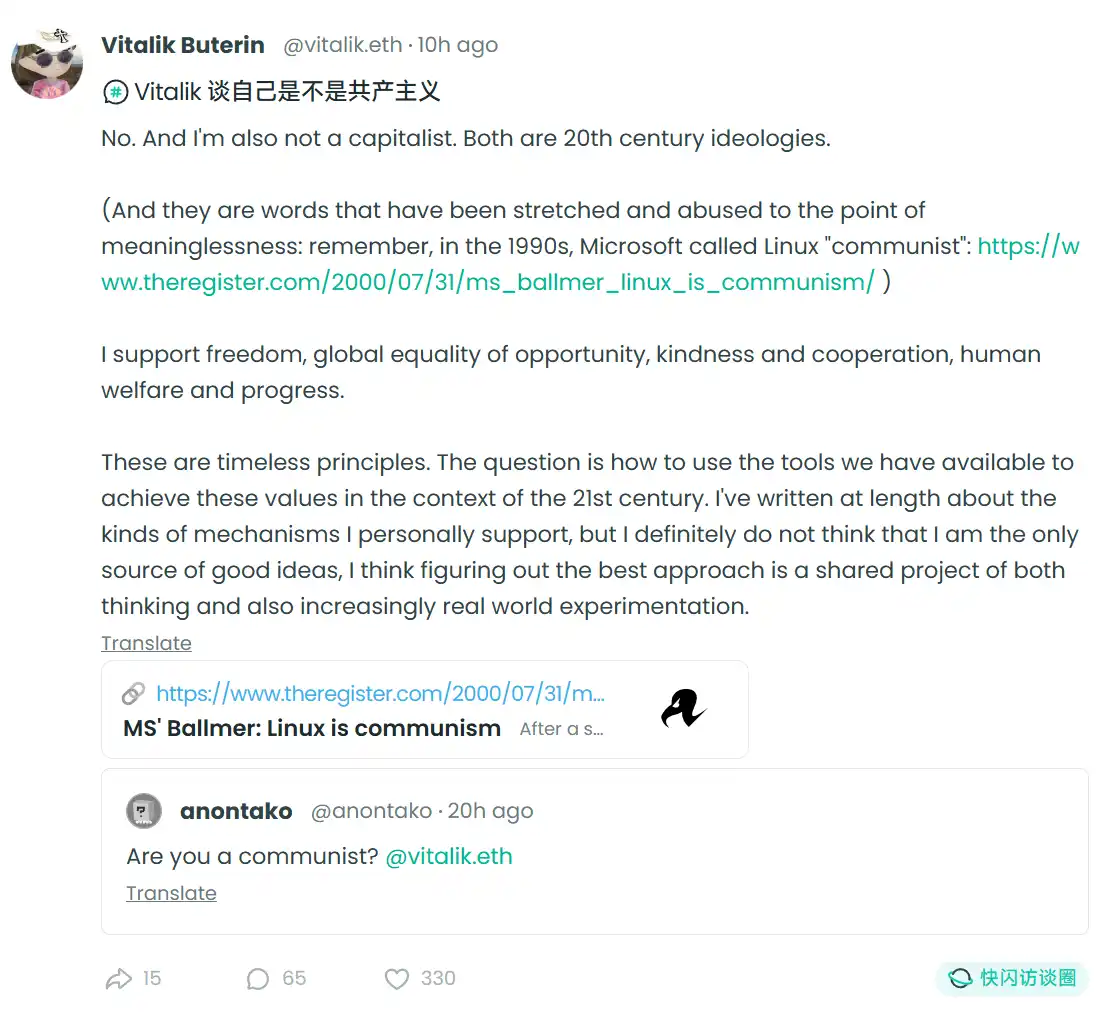
Vitalik: No, I am not a communist, nor am I a capitalist. Both are ideologies of the 20th century. (These words have been extended and abused to the point of meaninglessness: remember, in the 1990s, Microsoft called Linux "communism": https://www.theregister.com/2000/07/31/ms_ballmer_linux_is_communism/)
I support freedom, global equal opportunity, kindness and cooperation, human welfare and progress. These are eternal principles. The question is how to use our existing tools to achieve these values in the context of the 21st century. I have elaborated on various mechanisms that I personally support, but I absolutely do not believe that I am the only source of good ideas. I believe that finding the best way is a collective project that requires both thought and increasingly realistic world experiments.
Q17: Can you systematically explain how to accelerate Ethereum's development from all aspects? Ethereum has been around for ten years, with updates once a year. It feels like development is slow and needs to be greatly accelerated. eth/acc
Vitalik: Ethereum's current core development focus is on increasing the number of blobs. The main goal now is to increase the number of blobs, here are the details:
* Pectra, increase blob target from 3 to 6
* Fusaka, add peerdas, further increase blob target
* Continue optimizing peerdas in 2026 and 2027
* Add 2D data availability sampling, further increase blob target
There is also a roadmap to increase the L1 gas limit, but this is more complex, involving delayed execution, statelessness, and so on.
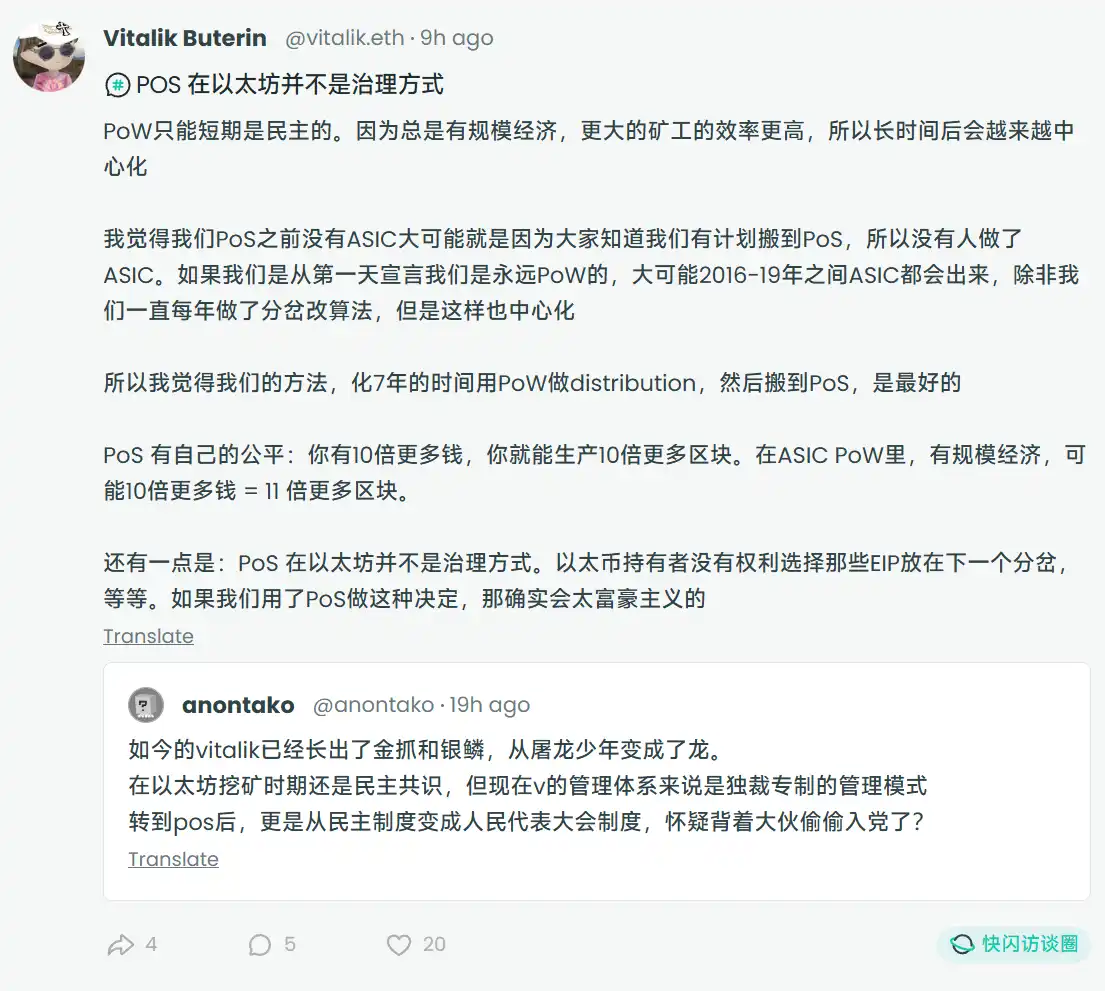
Q18: These days, Vitalik has grown golden claws and silver scales, transforming from a dragon-slaying youth into a dragon. During the Ethereum mining era, it was a democratic consensus, but now, in V's governance system, it operates as a dictatorial management model. After transitioning to PoS, it has gone from a democracy to a republic with representatives. Are you secretly joining a party behind everyone's back?
Vitalik: POS in Ethereum is not a governance mechanism. PoW can only be democratic in the short term. Because of economies of scale, larger miners are more efficient, leading to increasing centralization over time.
I think the reason we didn't have ASICs before PoS is likely because everyone knew we had plans to move to PoS, so no one created ASICs. If we had declared from day one that we were always going to be PoW, it's very likely that ASICs would have emerged between 2016 and 2019, unless we had done a hard fork to change the hashing algorithm every year, but that would also lead to centralization.
So I believe our approach, spending 7 years using PoW for distribution and then transitioning to PoS, is the best. PoS has its own fairness: if you have 10 times more money, you can produce 10 times more blocks. In ASIC PoW, there are economies of scale, so having 10 times more money might result in producing 11 times more blocks. Another point is: PoS is not a governance mechanism in Ethereum. Ether holders do not have the right to choose which EIPs go into the next fork, etc. If we used PoS to make these decisions, it would indeed be too plutocratic.
You may also like

Morning Report | CoinEx becomes a key hub for Iran to evade sanctions, involving over $3.8 billion in funds; Kalshi seeks a new round of financing, with a valuation potentially rising to $40 billion

Why do cryptocurrency projects always like to change their names?

From the white-haired stock god to the billionaire fund mogul, the smart people shorting Nvidia are all getting rich using the same framework

Morning News | The draft amendment to the People's Bank of China Law aims to clarify the legal status of digital renminbi; South Korea will transfer about 40 unregistered virtual asset service providers to law enforcement agencies

The cryptocurrency industry has entered the "Show Me" era: merely relying on vision is no longer enough
Interpreting the Ethereum Foundation's new structure: Reaffirming self-sovereignty amid institutional trends
Former SpaceX engineer reconstructs the financial execution system using first principles

Tidal Investment: We still have a positive outlook on the AI industry chain, but the reasons have changed

Standard Chartered Bank sings a 50x rhapsody again, aiming for AAVE to reach 3500 USD

The interim executive director of the Ethereum Foundation speaks out: What is our mission?
Why does OKX want to start a new company with the parent company of the New York Stock Exchange?

Why Is PAXG Price Different From Gold? 5 Reasons Crypto Traders Should Know

WEEX OpenAPI 101: 5 Powerful Modules, AI Trading Tools, and Grab Up to 70% Revenue Opportunities
Learn how WEEX OpenAPI connects traders, developers, AI agents, and trading platforms. Discover WEEX API features, Binance-compatible integration, automated trading workflows, revenue opportunities, and ecosystem possibilities.

Interview with NDV Founder Jason Huang: Popping the AI Bubble and the Myth of Microstrategy, Seeking the Ultimate Ace in the Crypto Market

Morning Report | Former Ethereum Foundation researcher establishes Ethlabs; EU Parliament Economic Committee passes digital euro regulatory proposal

Dragonfly partner Haseeb: The fastest-growing companies in the future may all be stuck at 149 people

How xBubble Breaks the Deadlock in VC's Heavy Investment in the OPC Economy

The encrypted unicorn Blockstream is deeply embroiled in a serious fraud case
Morning Report | CoinEx becomes a key hub for Iran to evade sanctions, involving over $3.8 billion in funds; Kalshi seeks a new round of financing, with a valuation potentially rising to $40 billion
Why do cryptocurrency projects always like to change their names?
From the white-haired stock god to the billionaire fund mogul, the smart people shorting Nvidia are all getting rich using the same framework
Morning News | The draft amendment to the People's Bank of China Law aims to clarify the legal status of digital renminbi; South Korea will transfer about 40 unregistered virtual asset service providers to law enforcement agencies
The cryptocurrency industry has entered the "Show Me" era: merely relying on vision is no longer enough
Interpreting the Ethereum Foundation's new structure: Reaffirming self-sovereignty amid institutional trends


