KlarnaUSD Explained: Launch Date, Tempo Blockchain & Potential for Traders




Key Takeaways
- Strategic 2026 Launch: Klarna is expanding its business model with its own stablecoin, KlarnaUSD, which is pegged 1:1 to the US dollar.
- High-Speed Technology: The coin runs on the new Tempo blockchain (developed by Stripe & Paradigm), which enables over 100,000 transactions per second – significantly more than Ethereum or Bitcoin.
- Massive Competitive Advantage: With 114 million existing users, KlarnaUSD has the potential to scale faster than competitors like PayPal (PYUSD).
- Cost Efficiency: The goal is to reduce fees for international merchant payments from the current 3–7% to nearly zero.
- Market Potential: The stablecoin market is projected to reach a volume of 27 trillion dollars by 2027, from which Klarna aims to profit through interest income on reserves.
Introduction
Klarna, the Swedish fintech giant, is targeting the crypto market in 2026: with KlarnaUSD, it is launching its own stablecoin on the ultra-fast Tempo blockchain. But what does the entry of 114 million Klarna users mean for the crypto sector? While competitors like PayPal (PYUSD) are already established, Klarna promises up to 100,000 transactions per second through its partnership with Stripe and Paradigm.
In this article, we analyze the technology behind KlarnaUSD, compare its potential with USDC, and clarify what opportunities arise for crypto investors.

What is KlarnaUSD? Definition & Launch Date
KlarnaUSD is a dollar-pegged stablecoin whose official market launch is announced for 2026. Unlike classic cryptocurrencies such as Bitcoin (BTC), which are subject to strong fluctuations, the value of KlarnaUSD remains stable at 1:1 to the US dollar. Each token is fully backed by real dollar reserves.
The CEO of Klarna, Sebastian Siemiatkowski, describes the timing as ideal: “Crypto is finally at a point where it is fast, cost-effective, secure, and scalable.”
The Technical Foundation: Stripe's “Bridge”
The token is issued via the Bridge platform from Stripe. This offers decisive advantages:
- Open Issuance: Klarna does not have to build its own blockchain infrastructure from scratch.
- Interoperability: KlarnaUSD is designed so that it can theoretically be used on other networks as well, which increases liquidity.
The Tempo Blockchain: Why 100,000 TPS Change the Market
The biggest technical difference compared to previous stablecoins lies in the underlying blockchain. Klarna relies on Tempo, a technology developed by Stripe and the venture firm Paradigm that was specifically optimized for payment speed.
In practice, this means impressive performance data compared to the competition:
- Speed: Over 100,000 transactions per second (TPS).
- Latency: The average transaction time is under one second.
- Costs: Transaction fees drop to nearly zero.
For comparison: Ethereum currently manages about 15 TPS, Bitcoin approx. 7 TPS. Even modern blockchains like Solana are surpassed by Tempo in theoretical peak load. This makes KlarnaUSD ideal for real-time payments in e-commerce, where waiting times of several minutes (as with Bitcoin) would be unacceptable.
Market Comparison: KlarnaUSD vs. PayPal (PYUSD) & USDC
Klarna is not the first fintech giant to launch a stablecoin. But how does the newcomer fare against the industry leaders?
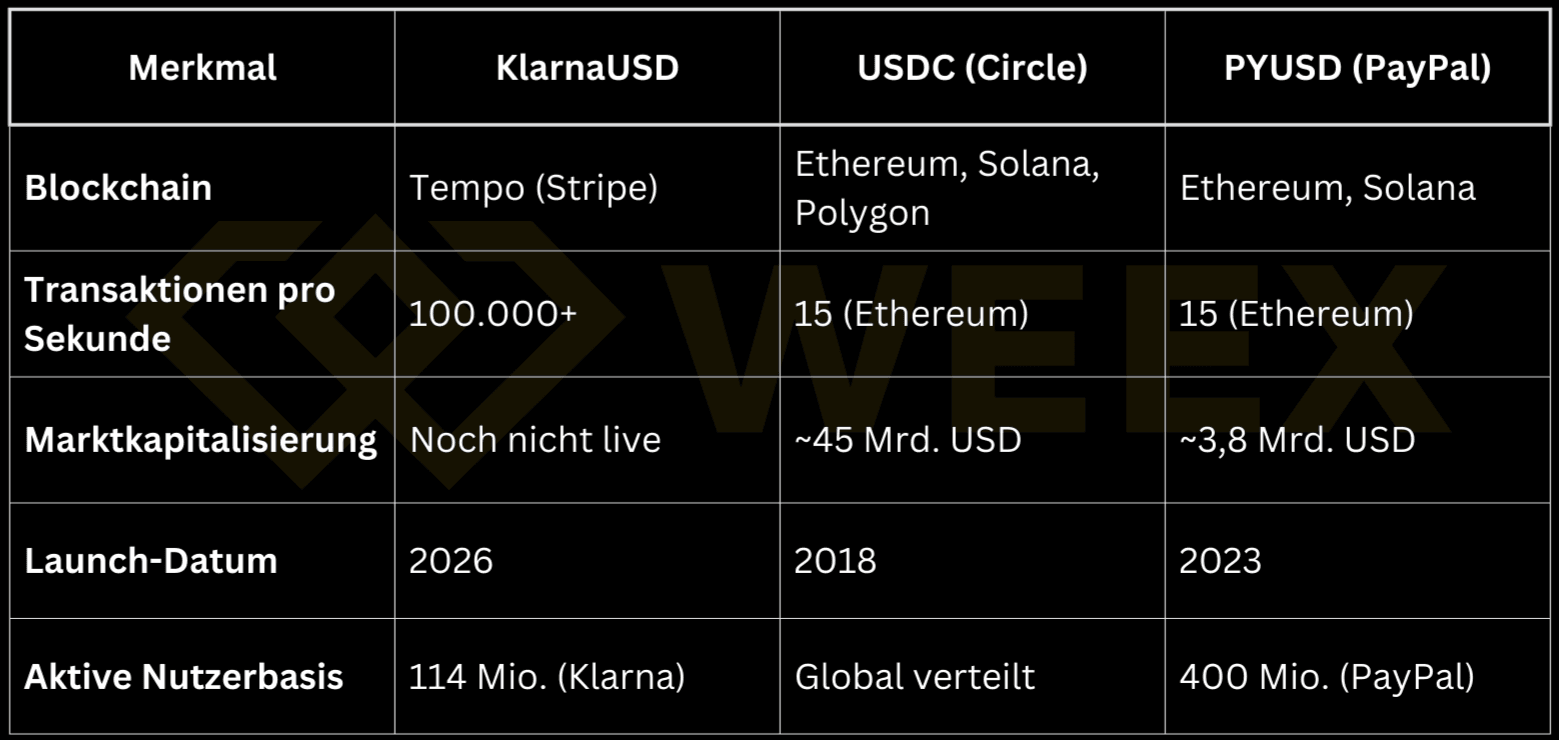
The decisive advantage: Klarna already has 114 million active users and 850,000 merchants. While PayPal's PYUSD took almost two years to reach a market capitalization of 3.8 billion dollars, Klarna could clear this hurdle significantly faster through direct integration into the shopping app.
For traders, this means: If KlarnaUSD draws volume from the traditional payment market onto the blockchain, this could massively accelerate the adoption of crypto in everyday life – a bullish signal for the entire sector.
Use Cases: More Than Just Online Shopping?
According to Reuters, Klarna plans to initially use the stablecoin for merchant payouts and cross-border payments. Here lies a gigantic potential for savings:
- Cheaper Transfers: Traditional international transfers often cost 3 to 7 percent in fees. KlarnaUSD could eliminate these costs.
- Interest Income: Similar to Circle with USDC, Klarna could generate interest on the deposited dollar reserves – a new, profitable business model.
- Global Growth: Forecasts from Klarna Investor Relations assume that the global stablecoin market will reach a transaction volume of 27 trillion dollars by 2027.
Conclusion & Outlook: When Will KlarnaUSD Be Tradable?
With the launch in 2026, Klarna is positioning itself at the forefront of a new generation of payment stablecoins. The combination of the extremely fast Tempo blockchain and a huge existing user base could quickly make KlarnaUSD a serious alternative to USDT and USDC.
However, it remains to be seen how quickly regulators will give the green light. In the EU, the MiCA regulation (Markets in Crypto-Assets) is already creating clear framework conditions, while in the US, laws like the GENIUS Act are still being discussed.
Don't want to wait until 2026? The stablecoin market already offers yield opportunities and stability for your portfolio today. Prepare for the next bull run and trade established stablecoins safely and easily.
FAQ - Frequently Asked Questions
When exactly will KlarnaUSD be available?
KlarnaUSD is expected to be introduced in 2026. Klarna has not yet announced an exact launch date but is currently in the active testing phase with selected partners.
Can I buy KlarnaUSD directly or use it as an investment?
No, KlarnaUSD is primarily designed as a means of payment and not as an investment token. A direct purchase for private investors is not planned for the launch – availability will initially be limited to payments within the Klarna ecosystem.
How does KlarnaUSD differ technically from USDC or USDT?
KlarnaUSD uses the Tempo blockchain with a capacity of over 100,000 transactions per second, while USDC and USDT run on Ethereum (15 TPS), Solana, or other blockchains. This makes KlarnaUSD significantly faster and more cost-effective for payments.
Is KlarnaUSD safe for private investors?
KlarnaUSD is secured by Stripe and the Bridge platform; both companies have established security standards. However, independent audits and practical experience with the system are currently missing – a real safety assessment can only be made after the launch.
How can I invest in KlarnaUSD or the project as a private investor?
A direct investment in KlarnaUSD is not possible. However, investors can participate in the company's success indirectly via Klarna stock (NYSE: KLAR) – if KlarnaUSD becomes profitable, it could positively influence the stock price development.
WEEX | Rising Star of Crypto Exchanges in the DACH Region
WEEX combines security, innovation, and community with features for beginners and professionals:
Security & Protection
- 1,000 BTC Protection Fund: Self-financed fund for rapid loss protection in exceptional cases
Trading & Earning
- Auto Earn: Daily automatic USDT earnings without effort
- Copy Trading: Follow elite traders automatically or apply as an elite trader for additional benefits
- WE-Launch: Early access to new projects – exclusive to WEEX users
Benefits & Rewards
- Promotions & Rewards: Trading competitions and special bonuses for active users
- Affiliate Program: Lifetime commissions from new users – details here
- VIP Benefits: Lowest fees, market insights, and personal support for high-volume traders
- WXT Token: Fee discounts, airdrops, and exclusive platform benefits
Discover current trends on WEEX Spot and start now: Register now
Disclaimer – Legal Notice from the WEEX Exchange
WEEX and its affiliates offer services for the exchange of digital assets, including derivatives and margin trading, only where they are legal and for eligible users. All content is general information, not financial advice - seek independent advice before trading. Trading cryptocurrencies is associated with high risk and can lead to a total loss. By using the services of WEEX, you accept all associated risks and conditions. Never invest more than you can afford to lose. Further information can be found in our Terms of Use and in the Risk Disclosure.