Solana Celebrates 6 Years Since Genesis Block: Network History, Path, and SOL Outlook

On March 16, 2026, Solana celebrated six years since the creation of its genesis block (the first block of the blockchain). In the crypto industry, this is more than just a milestone. For any blockchain, six years is a test not of flashy presentations, but of time, crises, load, and the ability to survive market cycles. In the case of Solana, this date is particularly telling: the network started as a high-speed technical experiment, experienced explosive growth, a reputational blow following the collapse of FTX, a series of technical issues, and yet managed to maintain its place among the world's most prominent blockchain ecosystems. The Solana genesis block in the blockchain explorer is dated March 16, 2020, at 14:29 UTC.
Why is this important right now? Because in 2026, the market evaluates major networks not just by promises of cheap and fast operations. The focus has shifted to whether there is real economic activity, whether the number of useful use cases is growing, whether the network is stable, whether major players are entering it, and whether it can withstand years of competition rather than just a day of hype. It is in this context that Solana looks interesting: on the network's official pages in March 2026, record-breaking indicators for the ecosystem regarding RWA are mentioned, the number of transactions with stablecoins and payments is growing, and over the last 90 days, Solana has operated continuously without any recorded outages.
For the reader, this is important for two reasons: first, the sixth anniversary is a great opportunity to evaluate Solana without emotions—not as a cult altcoin, but as an infrastructure asset. Second, such dates often bring questions about the long-term price of SOL, the real stability of the network, and its chance to cement itself in the architecture of the next stage of Web3 and digital finance back into the spotlight.
Solana is a network where transactions are fast, inexpensive, and can be processed in large volumes. Its architecture relies on Proof of History and parallel processing, making performance its primary competitive advantage. But speed alone does not guarantee success. What matters is whether Solana has managed to turn an engineering idea into a real economic layer. Six years after launch, this question can now be answered with substance, not just hypotheses.
What the genesis block means for Solana
The genesis block is the zero point of any blockchain. It is where the history of the network as a living system begins, rather than just a concept on paper. For Solana, this date has special significance because that was when the network transitioned from development to real operation with the participation of a validator community. Therefore, March 16, 2020, is not just the first block, but the beginning of the public life of the Solana network.
In 2020, Solana was not yet a mass-market brand. It was not associated with memecoins, large institutions, or new waves of DeFi. At that time, it was primarily an engineering bet: could one build a blockchain that would work faster than most competitors while remaining open enough for validators and developers? That is why the genesis block date is important, as it marks the moment when the abstract idea of a scalable blockchain turned into a real experiment.
In 2026, the significance of this date has changed. The market looks not at the fact of the launch itself, but at what happened afterward: whether an ecosystem emerged, whether trust returned after crises, whether there is long-term demand for SOL, and whether banks, investment funds, and payment services are ready to work on the basis of this network. That is why Solana's six years are more of an occasion for an audit than just a symbolic date.
How the history of Solana began
The history of Solana did not begin with exchange euphoria. Its origins lie in an attempt to solve one of the oldest problems of blockchains: how to determine the order and timing of transactions without slowing down the network. In its 2020 year-end report, Solana leadership stated that the network was launched in its initial format in early 2020, and by the end of the first quarter, its mainnet beta was already officially running. In the same material, the network emphasized Proof of History, Sealevel, and Turbine—technologies upon which Solana's fast performance is built: one is responsible for transaction ordering, the second for parallel processing, and the third for fast data propagation across the network.
This is an important moment. Often, blockchains attract market attention primarily through interest in their token. Solana, from the very beginning, relied primarily on technology. That is why it quickly attracted the attention of a part of the market that was looking for a fast competitor to Ethereum, but at the same time, that is why it faced particularly strict requirements. If you promise high performance, the market will very quickly check whether your network can withstand real loads.
In 2020, Solana entered the public exchange space very early. Solana Foundation reports indicated that the official listing of the SOL token on the Binance exchange took place on April 7, 2020. The report also mentioned a minimum guaranteed token price of $0.198, which was 90% of the CoinList auction starting price of $0.220. This is an interesting detail because it helps to see the starting levels from which the multi-year price cycle of SOL later began.
Six years of Solana: a timeline
2020: Mainnet beta launch and early infrastructure stage
2020 was the year of technical launch and initial deployment of the ecosystem. That was when the network moved from the Whitepaper and testing to real operation. By the end of 2020, according to Solana, the network had already processed over 8 billion transactions, and the number of validators exceeded 300. For a young blockchain, this was a strong signal: Solana did not just enter the market, but began to rapidly develop its infrastructure at an early stage.
2021: Expansion, capital, and market breakthrough
In 2021, Solana ceased to be a purely technical project and turned into a market phenomenon. In June, Solana Labs leadership announced a private token sale totaling $314.15 million, led by the American venture capital firm Andreessen Horowitz and the investment firm Polychain Capital. This round itself was not only a source of capital but also a sign that major funds saw in Solana a platform capable of claiming large-scale ecosystem growth.
2021 was the moment when SOL's recognition skyrocketed. Solana began to be actively compared to Ethereum, and the blockchain itself began to be viewed as an environment for fast DeFi applications, NFTs, and speculative activity. This was a turning point for the token price: the market moved from the mode of a little-known coin to the mode of a promising candidate for a new growth cycle.
2022: Stability issues and the FTX blow
2022 was a year of painful testing for Solana. First, the market as a whole exited the euphoria phase. Second, Solana was increasingly associated with technical glitches. Third, in the fall of 2022, the network suffered a reputational blow following the bankruptcy of the FTX and Alameda Research exchanges.
The Solana Foundation separately reported that as of November 6, 2022, it held approximately $1 million on FTX.com—this is less than 1% of its liquid assets. The foundation also noted that it did not hold SOL tokens in custodial storage on that exchange. In the crypto market, such public explanations with precise figures are rare.
After the collapse of the FTX exchange, many doubted that Solana would be able to recover. The token price fell sharply, trust in the project also weakened, but the network continued to operate and did not disappear from the market.
2023: Recovery period
In 2023, Solana began to attract market attention again. The market no longer perceived it as an undisputed favorite, but it did not write it off either. During this period, Solana began to strengthen its positions again, but not only thanks to market hype, but through real use cases.
2024–2026: Return to payments, stablecoins, and RWA
In 2026, Solana's official materials look different than they did a few years ago. On the Solana website, the main focus is now on stablecoins, tokenized assets, financial companies, and payments. In the February ecosystem report, Solana states that the market capitalization of RWA reached $1.71 billion, and on the main page in March 2026, it was noted that the volume of stablecoin transactions exceeded $650 billion. It is also mentioned there that Visa, PayPal, and Worldpay are building solutions on the basis of Solana for corporate treasury management, money transfers, digital banking, payouts, and merchant settlements.
This is a very important transformation. If previously Solana was perceived primarily as a network for fast on-chain trading, NFTs, and memecoins, in 2025–2026 it is increasingly trying to present itself as a financial landscape for more serious scenarios.
How the price of SOL has changed over these six years
The price of SOL has followed a path typical for a major altcoin: from a weak start to rapid growth, a deep drawdown, and a new stage of recovery.
According to CoinGecko data, the all-time low for SOL was $0.5008 on May 11, 2020, and the all-time high was $293.31 on January 19, 2025. As of March 17, 2026, CoinGecko shows a value of approximately $96.21, while a year ago the price was $126.17. This allows for a better understanding of the picture: the price of SOL has long since risen compared to its starting levels, but it still remains significantly below the high reached in 2025.
Chart 1. From low to high and current price
Below is a simplified chart of key SOL price points over six years.
SOL Price: Important Milestones
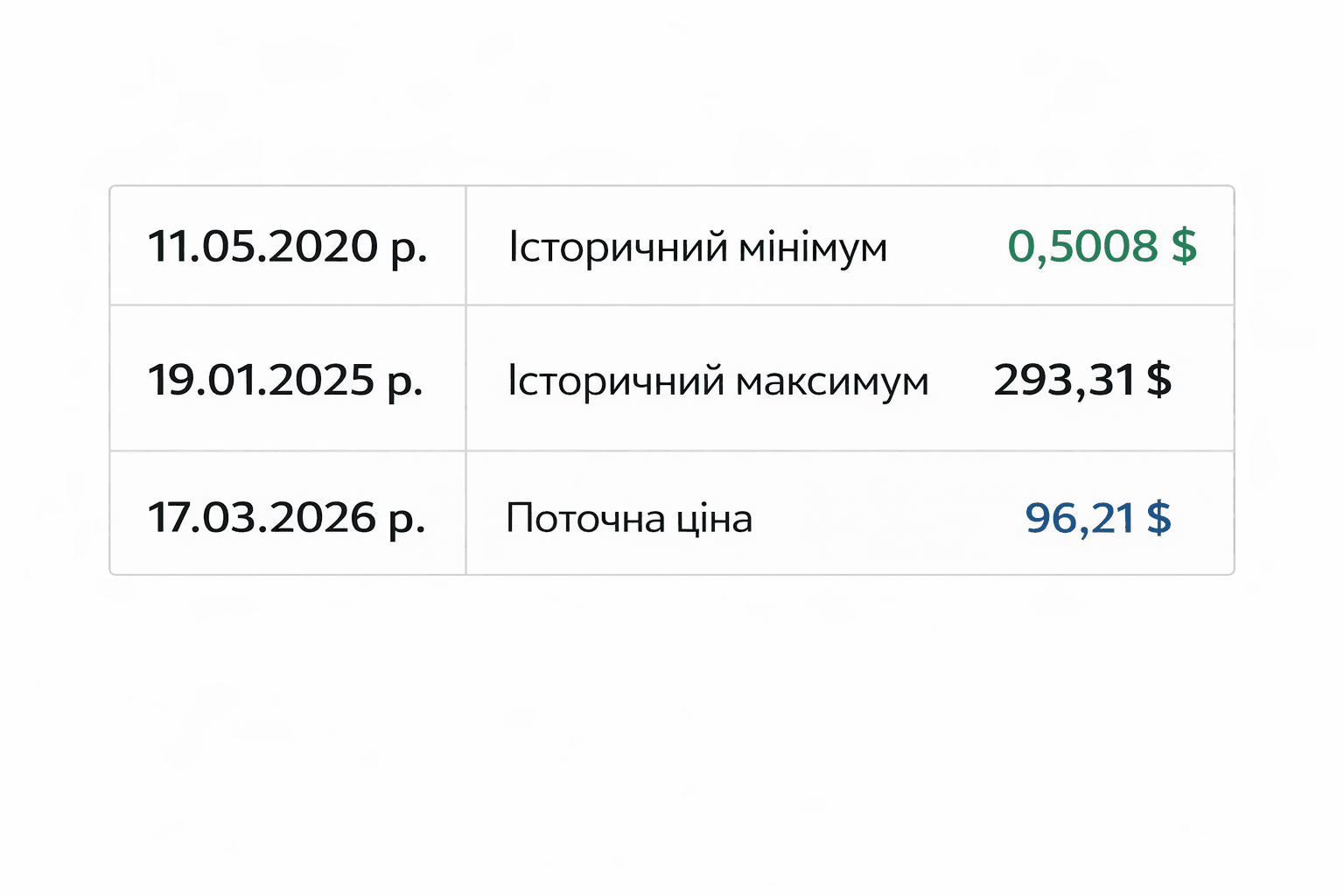
What does this mean in practice? Even after a strong pullback from the all-time high, SOL remains much higher than its starting and crisis levels. This does not cancel out volatility, but it shows that over six years, the asset has gone through several full market cycle phases and still retained significant market weight.
Chart 2: Annual dynamics around Solana's birthday
SOL level in mid-March
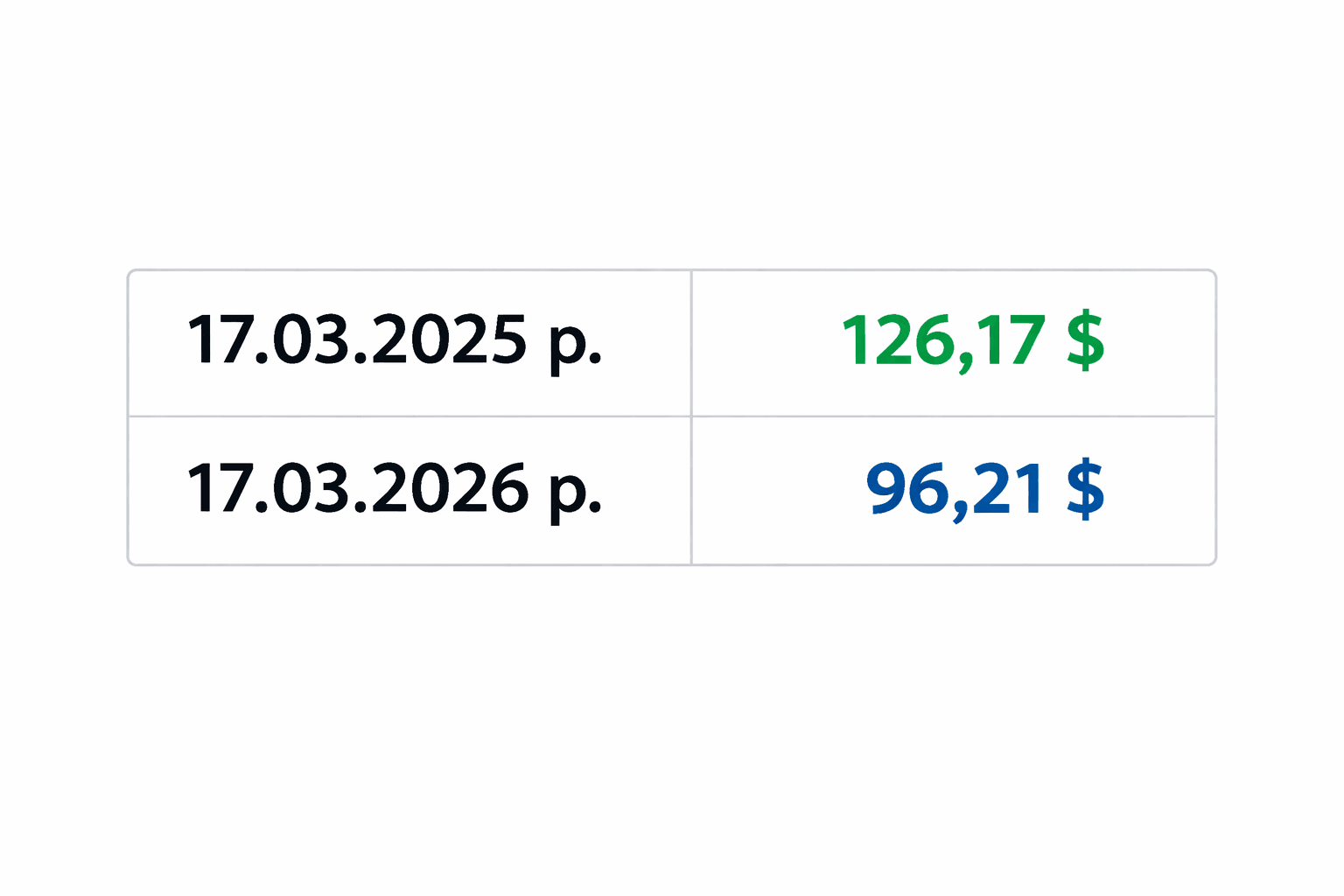
This chart is interesting because it does not show eternal growth, but on the contrary, reminds us: even a strong network with a powerful narrative can experience painful revaluations. Over the year, SOL decreased by approximately 23.74% from the level of March 17, 2025, to March 17, 2026. This is a very important reminder for those who look at anniversary dates as an automatically positive signal for price. The market does not work that way.
Chart 3: The long road from early market to mature volatility
Indexed path of SOL (conditionally, not to scale)
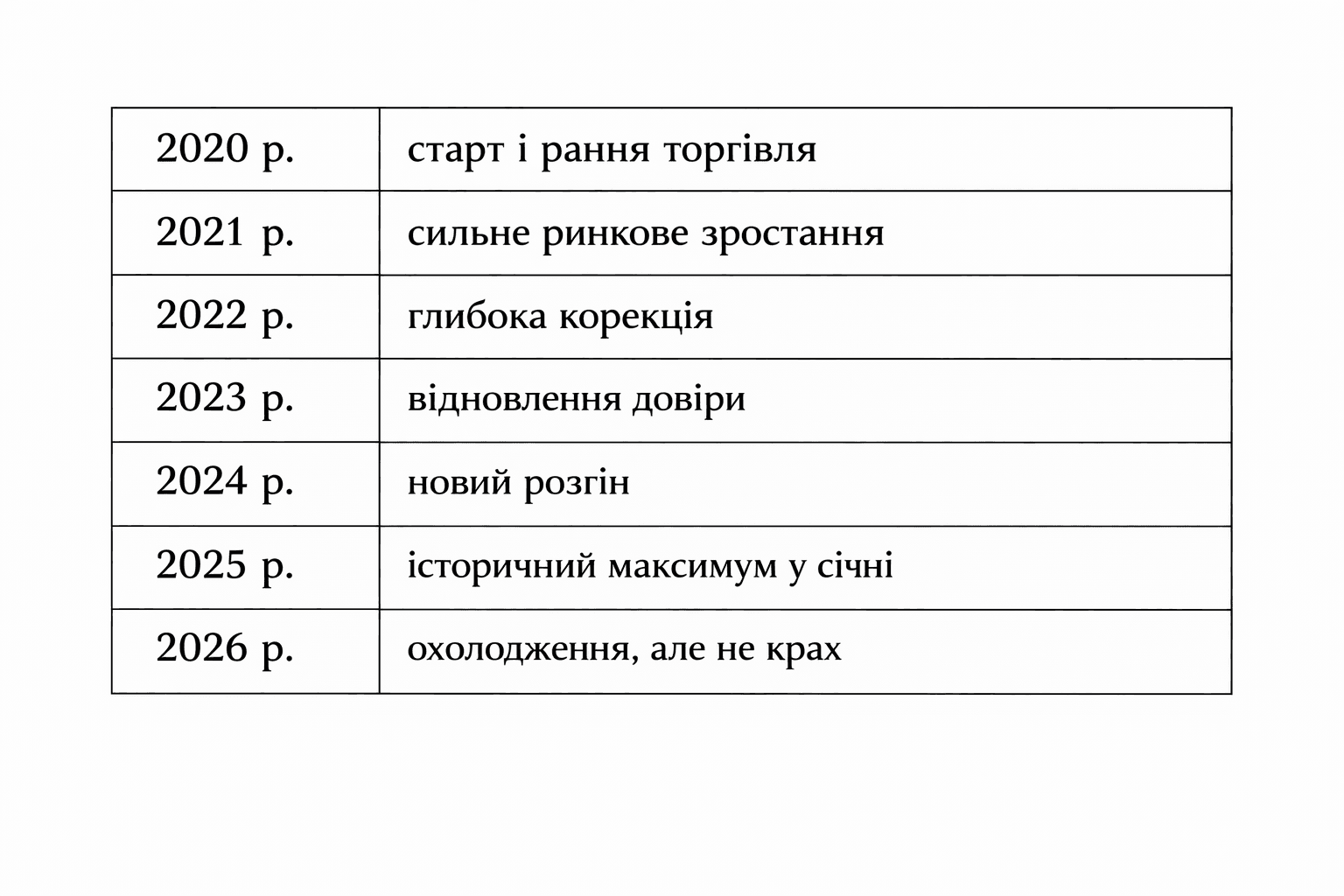
This is a simplified illustration that helps to understand the main point: the history of SOL is not a straight line upward, but a series of very contrasting phases. And that is exactly what makes it an interesting but risky asset.
Why the price of Solana was able to rise at all
Performance as the main narrative
From the very beginning, Solana sold the market not a dream of an abstract Web3 future, but a very concrete promise: high speed, cheap transactions, scalability. For users, this meant one thing—the network is suitable for scenarios where frequent interaction is important: DeFi, payments, NFTs, games, micro-transfers, and speculative activity.
An ecosystem that survived the blow
Many projects grow in a bull market. Far fewer networks are capable of recovering from a blow on the scale of FTX. In this sense, Solana passed an atypical test. It not only survived the crisis but also began to accumulate institutional use cases again. This does not make it a safe asset, but it certainly makes it a more serious infrastructure candidate than many smaller competitors.
Turning to more mature use cases
In 2026, the main argument in favor of Solana is no longer limited to transaction speed. Solana is increasingly associated not only with crypto trading but also with real financial services—including payments, tokenized assets, and business solutions, where Visa, PayPal, and Worldpay are mentioned. This is a shift from a purely crypto-native economy to a hybrid with real financial scenarios.
Disadvantages of Solana
Solana managed to recover, but the risks have not disappeared, so calling it an unambiguous winner is still too early.
History of outages
Solana has long been criticized for instability, and this criticism did not come out of thin air. The very fact that today the status page shows 90 days without outages is an important result for Solana, as in the past, the network was often criticized precisely for unstable operation. In other words, the current uptime is a positive signal, but not a rewriting of history.
High price cyclicity
SOL has already shown several times that it can appreciate very quickly—and depreciate just as quickly. This is an asset that looks good in a phase of strong market risk appetite, but can painfully slide when sentiment changes. The current distance between the all-time high of $293.31 and the level of $96.21 shows this well.
Dependence on fulfilling promises
For many years, Solana has built a narrative around scaling. That is why every technical glitch, every delay with new-generation clients, and every doubt regarding network reliability hits its perception harder than it does for some other blockchains. When positioning relies on performance, the market is less forgiving.
Firedancer and a new stage of technical maturity
One of the most discussed topics in recent years for Solana is Firedancer. In the network status report for June 2025, Solana leadership noted that Firedancer/Frankendancer had already been used for approximately 7% of the network's token share, and in a test environment, this client showed speeds of up to 1 million transactions per second. The report also emphasized that Solana and Ethereum have several clients for network operation, and such diversity makes the blockchain more resistant to technical glitches.
Why is this important? Because for large networks, client diversity is extremely important. If a blockchain depends too heavily on one main client, any critical error threatens the system. The main value of Firedancer is not just in speed, but in the fact that it can strengthen the Solana network itself.
SOL price forecast: what's next
Any cryptocurrency price forecast should be read as a scenario, not a promise. No one can honestly calculate how much SOL will cost in three, six, or twelve months. But basic trajectories can be described.
Base scenario
As of March 17, 2026, the SOL token was trading at approximately $96.21. This is a level that is already significantly lower than the all-time high, but far from a crisis low. If Solana continues to maintain strong activity in stablecoins, tokenization, and payments, and the network avoids serious technical glitches, the base scenario looks like a slow restoration of trust, rather than an instant breakthrough to new records.
Optimistic scenario
An optimistic scenario for SOL is possible if several conditions are met simultaneously: the market becomes more open to risky assets again, major financial players begin to actually use Solana, and Firedancer and other technical updates make the network more stable. In that case, the market may again begin to evaluate SOL as an asset with the potential to return to stronger ranges. But this requires not one separate factor, but a combination of strong network indicators and positive market sentiment.
Negative scenario
A negative scenario is also real. If the market focuses on risks again, and activity in speculative segments of the ecosystem falls faster than useful payment and institutional activity grows, SOL could remain under pressure for a long time. The experience of 2022 shows that in moments of narrative crisis, Solana can lose market support very sharply.
What will actually determine the price
For a long-term evaluation of SOL, what matters is not loud news, but network stability, real usage, and demand for Solana as infrastructure. If these three factors strengthen simultaneously, the token will have a fundamental story for revaluation. If not, the price will remain a hostage to the cycle.
Interesting facts about Solana over 6 years
The first block has an exact birth time
The Solana genesis block is not a conditional date, but a specific record in blockchain history: March 16, 2020, 14:29 UTC.
The all-time low and high are separated by almost six years
CoinGecko records the SOL all-time low at $0.5008 on May 11, 2020, and the all-time high at $293.31 on January 19, 2025. This is one of the most telling examples of how aggressive cycles can be in cryptocurrencies.
Solana survived not only a crypto winter but also the FTX peg crisis
For many projects, a price drop is already a critical blow. For Solana, the problem was not just the price, but the reputational connection to FTX/Alameda Research. The fact that the ecosystem did not disappear after this is one of the reasons why the market still takes it seriously.
In 2026, the focus shifted from NFT hype to payment infrastructure
In new official Solana materials, the focus has already shifted from the topics familiar in past years to stablecoins, business finance, international transfers, and tokenized assets. This can be considered a sign that the ecosystem is gradually maturing.
What Solana's 6th anniversary means for the market
In a broader sense, Solana's six years are a test of maturity. Not only for the network itself but also for the market, which has to decide: has Solana become something more than just a fast blockchain? For now, the answer is rather cautiously optimistic: the potential is visible, but it is too early to draw final conclusions.
The fact that six years after launch, Solana not only remains on the market but is also mentioned in the context of stablecoins, tokenized assets, cooperation with major financial players, and technical network development, already says a lot. However, this is not enough to answer all questions. The market will still carefully watch two things: whether technical stability will be maintained and whether institutional interest will turn into sustained on-chain activity rather than one-off pilots.
Conclusion
Solana's six years are not just a date in a headline, but a sign that the network has already gone through several different life phases: start as a technical experiment, breakthrough as a market favorite, crisis of trust, recovery, and a new attempt to establish itself as infrastructure for payments, stablecoins, and tokenized assets. The genesis block of March 16, 2020, was only the beginning. Much more important is what happened after it.
For the price of SOL, this means a simple but important thing: the asset remains highly volatile and cycle-dependent, but it already has a stronger fundamental context than in its first years of existence. For the market itself, Solana is an example of how a blockchain can almost lose its narrative and then return to the game through real use cases, not just speculation. Whether this is enough to return to all-time highs in the future is something the market will still decide. But the fact is that after six years, Solana remains not just alive, but a strategically important topic for the entire crypto industry.
If you want to dive deeper into the Solana ecosystem, we invite you to WEEX to participate in a special event with the opportunity to receive rewards of up to 120 SOL!
DISCLAIMER WEEX and its affiliates provide digital currency exchange services, including derivatives and margin trading, only where such activity is legal and exclusively to appropriate users. All content is provided for reference only and does not constitute financial advice—seek advice from a financial advisor before trading. Cryptocurrency trading is high-risk and can result in the loss of the entire investment amount. By using WEEX services, you accept all associated risks and terms. Always invest the amount you can afford to lose. Details are available in our Terms of Use and Risk Warning.