
Home Robot NEO Grows "Dexterous Hands": How Do Hands Become the API to the Physical World?

 Prefer us on Google


Source: 1X Technologies
Compiled by: Felix, PANews
On July 10, humanoid robot company 1X Technologies unveiled the next-generation NEO humanoid robot with tendon-driven mechanical hands, featuring 25 degrees of freedom (DOF) that achieve dexterity, strength, safety, and reliability close to human levels.
This article is based on the official introduction from 1X Technologies, giving you a glimpse into the details of this mechanical hand.
The mechanical hand aims to break the bottleneck of humanoid robot hardware capabilities, making data the only barrier to enhancing robot performance. By achieving or even exceeding human hand performance in key dimensions, it ensures that AI models are no longer limited by dexterity. The NEO robot can now perform nearly any task that human hands can accomplish, with the precision, adaptability, and gentleness required in real-world environments.
Humanoid robots are computers that use hands as APIs.
Models, perception stacks, and legs determine the extent to which robots interact with the world. The hands, however, determine what they can do, what they can perceive, and what developers can create based on them. A humanoid robot with dual-finger grippers only demonstrates three actions to developers: grasping, placing, and pushing. Every application written on this platform is a combination of these three actions. The ceiling of capability is not in the software but at the end of the arms.
Experiencing the world through fingertips.
When observing a person facing an unfamiliar object, you will notice that they press it to feel its hardness, slide their fingertips to perceive its texture, weigh it, trace its outline to judge its shape, and squeeze and release to feel its elasticity. Touch is not passively transmitting information like a camera; it is an experiment. The hands pose questions forcefully and receive answers through the joints that ask the questions. This is how humans understand objects and how they initially learn to operate: through millions of explorations starting from infancy.
This means that hands are not merely actuators fixed at the end of a perception system; they are a perception system in themselves, a tool. The quality of this tool is determined by the entire system. Posing questions requires precise force control. Reading answers requires reverse driving and force transparency so that feedback can return through the transmission mechanism rather than stagnate in the drive. Asking questions requires degrees of freedom and precision. Feeling the nuances requires skin. Quickly capturing answers requires bandwidth. And millions of explorations require robustness because exploration is contact, and contact inevitably causes wear.
Joints themselves are sensors.
Most robotic hands are read-only devices. You issue a position command, and the hand moves there but does not return any meaningful information. The reason lies in the drive: under common gear ratios of 100:1 and 200:1, friction absorbs the contact force before it reaches the motor. Since the joints of the hand themselves have no sensation, designers need to install external sensors on them and infer what happens at the fingertips, much like filming a hand without sensation with a camera.
NEO's hands are read-write. They are developed from scratch by a top engineering team, operating aligned drive actuators through 1X tendon drivers at a low gear ratio of about 5:1 to 15:1. All 25 degrees of freedom (22 fully driven degrees of freedom for fingers and palm, plus 3 degrees for the wrist) have native force control capabilities and can be fully reverse-driven. When you press a finger, it responds and accurately reports the magnitude of the force you applied. Force flows outward, and information flows inward along the same physical path. This is force transparency, which converts thrust into measurable values.
There is also a more subtle mechanism running in parallel: proprioception. Because each joint is closed-loop, the hand can always perceive its own posture even without looking, just as you can touch your fingertips together with your eyes closed. Posture combined with force is always achieved through the same 25 joints.
25 Ways to Ask Questions.
What can 25 force-sensing degrees of freedom bring? Not for the joints themselves, but for a series of grasping actions and ways of asking questions. The distribution of degrees of freedom is more important than the number: NEO's distribution aligns with human anatomical structure and leans towards a thumb that can truly resist. This architecture aims to achieve the best balance between robotic operational capabilities and actual manufacturing, control, and maintenance.
These new mechanical hands can achieve or even exceed human levels in fine operations. NEO can assemble LEGO blocks, retrieve screws and coins from a wallet, rotate and install light bulbs, use a screwdriver, rotate objects in hand, pull up zippers, sort grapes by color, pour tea from a kettle, catch soft balls, insert USB-C chargers, pick up wine glasses, wipe surfaces with tissues and sprays, communicate through sign language, and much more.
These mechanical hands with 25 degrees of freedom have an IP68 waterproof rating and food safety standards, allowing NEO to wash its hands like a human. The peak torque at the thumb's wrist joint can reach 3.5 Nm, the peak torque at the finger's metacarpophalangeal joint can reach 2.6 Nm, and the distal flexion force can reach 45 N. The wrist joint torque can reach 17.75 Nm. This enables the mechanical hand to perform full-hand grasping, tool usage, lifting and carrying, opening doors, pushing loaded carts, and precise pinching under load while maintaining complete flexibility. With a positioning accuracy of ±0.2 mm, they can work in small ranges (and perceive objects).
The final half millimeter.
Skin adds information channels. Tactile data is an image. It has dynamic range, resolution, channels, and field of view. The hands are equipped with rich, high-resolution tactile sensors at the fingertips and surfaces to measure normal force, contact position, and shear force. This allows NEO to detect when objects begin to slide and respond in real-time. Visualizations display the normal vector of the contact surface, pressure heat maps during handshakes, and delicate grips on fragile origami without causing any damage.
The design of the skin works in conjunction with internal sensors and the tendons behind it. It is a functional material, not a decorative one. Since visual input alone is insufficient for many tasks (especially when handling small, transparent, deformable, or obscured objects), this tactile feedback is crucial for adaptive intelligent operations.
Moreover, these mechanical hands are designed for continuous operation, maintaining performance even after millions of interaction cycles. Reliability is embedded in the design of every subsystem and component: tendon routing, bearings, finger structures, cable wiring, tactile integration, electronic components, and assembly processes. Components and complete finger assemblies have undergone millions of test cycles, and the drive units have been tested under extreme temperatures, with wrist joints verified for reliability after over 2 million cycles under high loads.
The entire hand meets IP68 standards, further ensuring safety: extremely low gear ratios, combined with tendon drives and low distal inertia, allow for safe reverse driving of fingers even when subjected to external impacts. Slow-motion videos show that when slapped, hammered, pinched in closed drawers, or struck against foam, the hand can respond.
The hardware behind it.
The performance of the application programming interface (API) depends on its physical layer. The motors are located in the forearm, where most of the human grip strength resides, driven by dedicated tendons in the wrist. This is how the lightweight hand generates such powerful force while maintaining a sufficiently low temperature for continuous operation.
The mechanical hand tightly integrates self-developed motors, custom electronic components, embedded sensors, dedicated tendon systems, compact drive mechanisms, and hand-specific firmware. This deep vertical integration enables rapid iteration and cumulative improvement. Each device is produced entirely in-house, from tendon materials and 1X motors to the final soft polymers, skin, and tactile sensing components. This year, 10,000 mechanical hands are expected to be produced.
Disclaimer: This content is provided for general branding and informational purposes only and doesn't constitute financial, investment, legal, or tax advice. Any events, rewards, online events, or related information mentioned herein should not be considered a recommendation, solicitation, or invitation to purchase, sell, trade, or otherwise deal in any crypto assets or to use any services. Crypto assets are highly volatile and may result in loss. WEEX services and online events may not be available in all regions and are subject to applicable laws, regulations, and eligibility requirements. You are responsible for ensuring that your use of WEEX services complies with local laws and for carefully assessing the risks before participating in any crypto-related activities.
You may also like
What is SCEX? The Cryptocurrency Exchange for Vietnam's Market by Sacombank
Major Update for ChatGPT: Cross-Platform Functionality, One-Click Website Creation, and Lower Costs
BTC Challenges 64,000 After Breaking 63,000, Market Trading 'Manageable Risks'
As the Bubble Bursts, Who Dominates Attention in the AI Era? A 2026 Guide to Influential AI KOLs in China and the UK
Old Money in Crypto Shifts: Paradigm Raises $1.2 Billion, Half Bet on AI and Robotics

Bitdeer unveils $36M Nevada factory to shake up Bitcoin mining
Perplexity Fine-Tuned a Chinese AI Model to Match Claude Opus 4.8 at One-Third the Cost
Bank of Korea defends bank-first stablecoin plan amid bill deadlock
JPMorgan says bitcoin's main risk isn't Strategy, but blockchain adoption that doesn't benefit public chains and tokens
Fear & Greed Index Today: What Extreme Fear Means for Crypto, Stocks and Gold
Labour MPs Push to Make UK Crypto Donation Ban Permanent
Supreme Court ruling expanding Trump's authority over federal agencies raises questions for SEC, CFTC as crypto rulemaking advances
'Bottom building in progress': Analysts say bitcoin holder capitulation signals late-stage bear market
A Comprehensive Analysis: Starting from 1996, Who is Laying the Foundation for the Next Generation of Capital Markets
Luke Dashjr, the Biggest Anti-Spammer of Bitcoin, Inscribed Phrases on the Network in 2011
Whales bought 270,000 BTC while ETFs bled $7 billion. One side is wrong
The crypto IPO class of 2025-26 is down as much as 89%. Autopsy of a listing boom
Robinhood Chain Mining Guide: A Comprehensive Tutorial from Cross-Chain to Memecoin
BitGo CEO says single-digit percentages of bitcoin's supply are 'probably right' for large holders amid Strategy's sale
Beyond Private Keys: How to Safeguard the Security Boundaries of Web3 from Wallets, L2 to Supply Chains?
Vanguard Enters the Market, Opening a New Crypto Gateway for 50 Million Traditional Investors

Why the OUSD Alliance of 150 Companies Still Cannot Shake USDT and USDC?
Citigroup Analysis: Is There Still 47% Upside for Nvidia? Can Rubin and CPO Deliver?
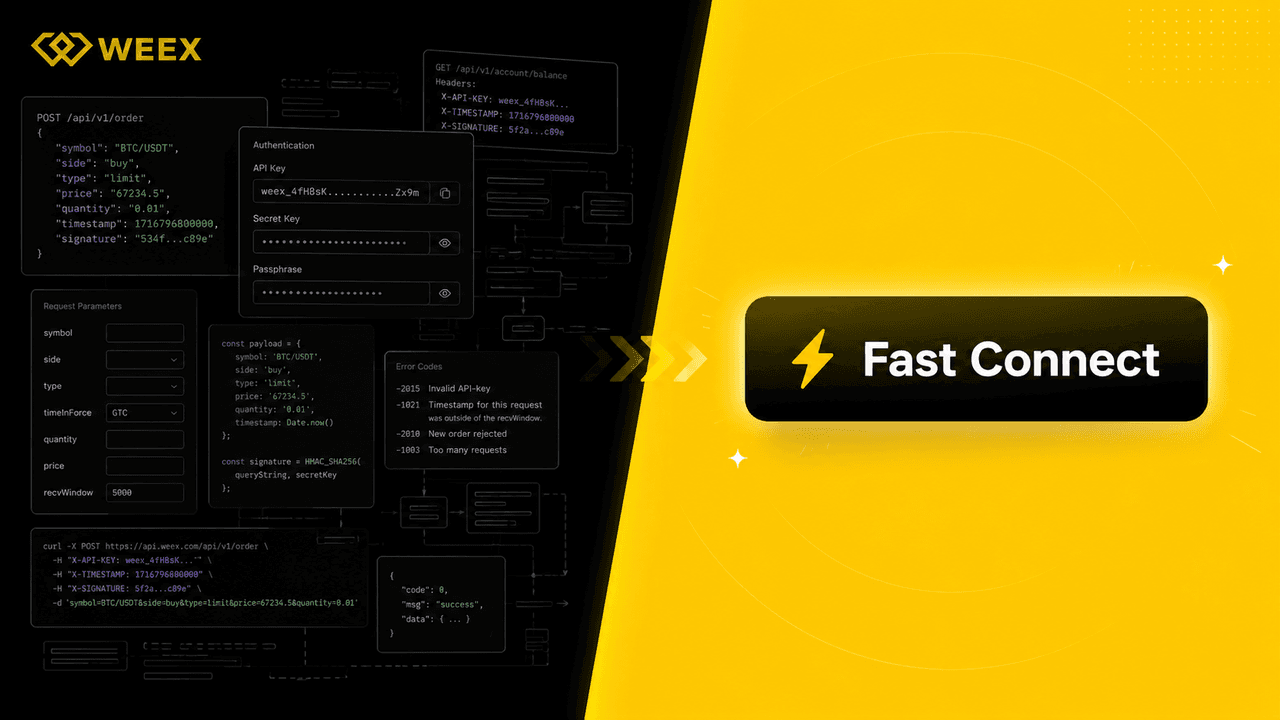
WEEX API Fast Connect: Turn Every Sign-In Into a Live Trader in Under 10 Seconds
WEEX API Fast Connect is a one-click OAuth authorization system that lets your users link their WEEX account without ever touching an API key. Frictionless onboarding, faster conversions, higher retention — built for WEEX Broker partners.
Bitcoin's dwindling exchange reserves don't pack the same bullish punch anymore

From Le Mans to the Rollercoaster: Carl Moon Takes On Portimão
Crypto world renowned KOL and racing driver Carl Moon, backed by WEEX, heads to the Ferrari Challenge Portugal round at the Algarve International Circuit, July 16–19, fresh off a podium finish at Le Mans. Here's why this race is one to watch.
Fast execution. Split-second accuracy. Security that never blinks. That's WEEX — and that's exactly how Carl races.
The Downfall of a Public Company: A $1.46 Billion Bet on WLFI, $540 Million Went to the Trump Family
Dragonfly Partner: BTC is Intergenerational Wealth, Optimistic About ETH and SOL
Goldman Sachs Calls to Go Long on Chinese AI: $4 Trillion Market Value Behind, Global Funds Only Allocated 1.2%
The New Landscape of Cryptocurrency in Europe: Why Germany Takes Center Stage?
What is SCEX? The Cryptocurrency Exchange for Vietnam's Market by Sacombank
Major Update for ChatGPT: Cross-Platform Functionality, One-Click Website Creation, and Lower Costs
BTC Challenges 64,000 After Breaking 63,000, Market Trading 'Manageable Risks'
As the Bubble Bursts, Who Dominates Attention in the AI Era? A 2026 Guide to Influential AI KOLs in China and the UK
Old Money in Crypto Shifts: Paradigm Raises $1.2 Billion, Half Bet on AI and Robotics
Bitdeer unveils $36M Nevada factory to shake up Bitcoin mining

Contents
Latest articles


Latest coin listings on WEEX


